Regular MHHV conference attendees may recall witnessing Commander Max Speedy, DSC, RAN (Rtd) presenting “Just Another Day in the Delta: EMUs in Vietnam”.
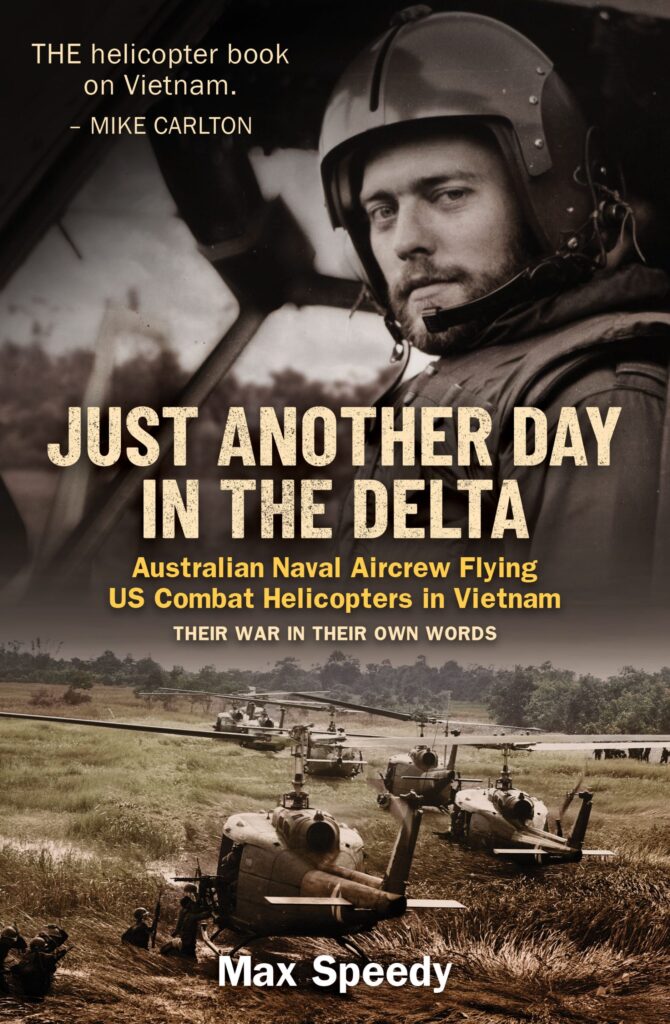
After decades of research and thoughtful reflection, Commander Speedy has put his story, and that of so many others, into book form. It was clear from these past presentations, and personal conversations, that an historic account of RANHFV from at least one of those involved was a very needed inclusion into the greater national record of Australia’s involvement in the Vietnam War.
Max Speedy’s Just Another Day in the Delta is the most complete and authoritative account yet written of one of the least-known but most distinctive Australian contributions to the Vietnam War. Between 1967 and 1971, the Royal Australian Navy Helicopter Flight Vietnam (RANHFV) was fully integrated into the United States Army’s 135th Assault Helicopter Company. The combined unit, known with wry affection as the Experimental Military Unit or the EMUs, flew UH-1 Iroquois “Huey” helicopters on daily combat operations, predominantly in the Mekong Delta. Australian naval aircrew and maintainers operated under US Army command while remaining subject to Australian naval discipline—an arrangement unique in the history of Australian forces. Speedy, who served as second-in-command of the 1968–69 contingent and flew more than a thousand combat hours, is ideally placed to tell the story. The result is a hybrid of unit history, operational analysis and collective memoir that both restores the EMUs to the public record and illuminates the practical realities of coalition warfare.
The book opens by locating the RANHFV within Australia’s broader Vietnam commitment. Australia’s decision to send combat forces was driven less by direct interest in Indochina than by alliance management in the Cold War, particularly the desire to strengthen the ANZUS relationship. When the United States asked for additional helicopter aircrew in late 1966 to help meet a serious personnel shortfall, the RAN offered trained pilots, observers and maintainers. Four successive year-long contingents, totalling 196 men, served with the 135th. The Australians quickly assumed a disproportionate share of the more demanding roles—aircraft captains and air mission commanders—so that, when most American aviation assets were committed to the 1970 Cambodian incursion, the 135th remained behind and effectively managed much of the Delta’s helicopter effort. Speedy makes clear that this was not a token presence; it was operationally essential.
The core of the book is the daily work of airmobile operations. The EMUs flew troop insertions into contested landing zones, provided gunship support, conducted medical evacuations, resupplied outposts and recovered downed aircraft. Danger was routine rather than exceptional. Between January and April 1969 alone, EMU aircraft returned with bullet holes on well over a hundred days. Almost every Australian pilot was eventually shot down at least once. Five Australian aircrew were killed and at least twenty-two wounded; across the four contingents there was scarcely a week without casualties somewhere in the company. The RAN aircrew casualty rate reached two-thirds. Speedy’s own flying logbook, which records little more than hours and co-pilots, illustrates the point: single-line entries conceal days on which aircraft were shot down, crews rescued under fire and machines returned riddled with holes. The phrase that gives the book its title—“just another day in the Delta”—was not bravado but a practical means of coping. To dwell on the previous day’s close call was to risk hesitation the next morning.
Speedy is careful to include more than the pilots. Maintainers kept aircraft serviceable under punishing battle damage and high operational tempo; the company logged roughly 33,000 flying hours in its first year with about 80 per cent serviceability. Crew chiefs, gunners, observers, medics and photographers all feature. Temporary attachments of Australian infantry as door gunners and exchanges with RAAF 9 Squadron further underline the unit’s place within a wider Australian effort. Concrete incidents give the statistics weight: a December 1967 night extraction led by Lieutenant Commander Pat Vickers under artillery and darkness; the May 1968 ambush in which all ten helicopters of a flight were hit and two destroyed; the deaths of Vickers, Tony Casadio, Darky Phillips and others; and the constant attrition of aircraft—690 hits, 30 losses and 377 damaged across the 135th’s service. Overall figures for the company are striking: 116,707 hours flown and 809,203 troops carried between 1967 and 1971.
The book’s research is thorough. Speedy has spent years cross-checking logbooks, unit records, declassified American archives and the recollections of surviving veterans, guided by the caution that “the older I get, the braver I was.” Appendices supply group and battalion assignments, commanding officers, rank equivalents, contingent lists, awards and a week-by-week summary of in-theatre records and statistics. Maps of the theatre and the 135th’s area of operations help orient the reader. The narrative moves between strategic context, technical description of Huey variants, rules of engagement and unit organisation, and the personal accounts that form the emotional centre. Forewords by the Hon Kim Beazley AC and Captain Bernard Dobson of the Sea Power Centre–Australia rightly emphasise both the operational achievement and its longer significance for modern embedded and coalition practice.
There are limitations. The early chapters devote substantial space to the background of Australia’s involvement, the evolution of helicopter warfare and the technical and doctrinal environment in which the EMUs operated. While this context is necessary, it delays the arrival of the “own words” material promised in the subtitle. Readers primarily seeking vivid combat narrative may find the first section dense. As a history written by a former second-in-command, the book naturally reflects the perspective of those who flew the missions; the political controversies surrounding the war and the longer-term personal costs for many veterans receive attention, particularly in the later chapters on homecoming and recognition, but remain secondary to the operational record. Speedy is candid about the Navy’s initial lack of interest in the combat lessons and the delayed public recognition—rectified in part by the 2018 Unit Citation for Gallantry awarded to the RANHFV and the 135th—but the tone remains that of professional accomplishment under fire.
These reservations do not diminish the book’s value. Just Another Day in the Delta is both a corrective to the marginal place the RANHFV has occupied in Australian memory and a detailed case study of how a small, highly skilled naval contingent adapted to, and became integral to, a large American combat formation. It documents the intensity of helicopter warfare in the Delta, the interdependence of aircrew and ground support, and the human cost of treating extreme risk as routine. For readers interested in Australian military history, naval aviation, the Vietnam War or the practicalities of alliance operations, it is an important, carefully sourced and absorbing work. The men who flew and maintained those Hueys did not set out to make history; Speedy has ensured that the history they made is no longer overlooked.
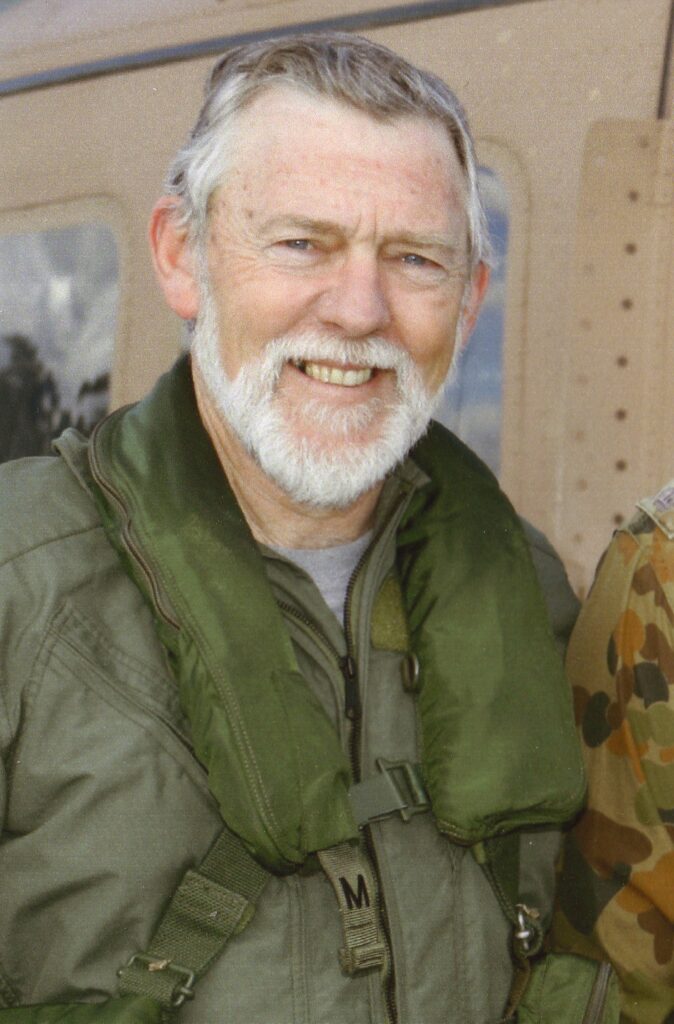 Max Speedy joined the RAN in 1962 as an Observer, was promoted to Pilot in 1967, and a year later was in Vietnam. He was the Second in Charge of the RAN Helicopter Flight and flying in the US Army 135th Assault Helicopter Company, a unique collaboration called an Experimental Military Unit, the EMUs.
As First Platoon Leader leading ten troop helicopters into enemy-defended landing zones and later as the Air Mission Commander directing the Company and its gunships, he flew over 1,000 combat hours, was decorated by the US Army, the South Vietnamese Army and finally in Buckingham Palace by HRH, Queen Elizabeth II with the Distinguished Service Cross.
Visit the links below to see presentations by Commander Max Speedy, DSC, RAN (Rtd)
Vietnam 30/50 – Thirty Years of War / Fifty Years of Reflection – MHHV
Choppers: Helicopters and the Vietnam War – MHHV
Reviewed for MHHV by Jason McGregor November 2026
Contact Jason McGregor about this article.