Challenging ANZAC: Why Now? Is the title of the opening chapter written by the book’s editors.
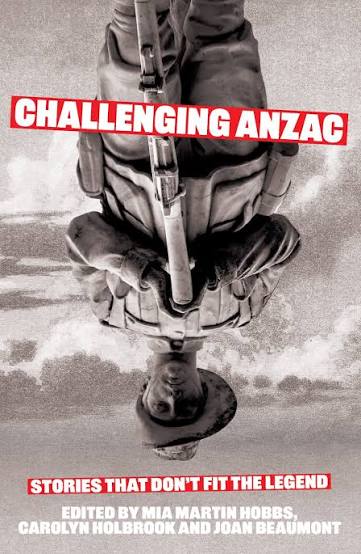
It is a good question. What more can be said about the ANZAC legend that has not been written already? Plenty it seems. Including the editors, thirteen of Australia’s leading historians have contributed stories that patently do not fit the ANZAC legend. The editors contend that the reality of warfare has always been at odds with the ANZAC myth. They and the authors who have contributed to the book analyse why, despite the dissonance between reality and the ANZAC legend, it survives. The book contains stories of Australian service personnel and others affected by war, who obviously do not fit the ANZAC legend.
In the opening chapter, Challenging ANZAC: Why Now? the editors frame the book’s context. They note that Charles Bean, the Australian journalist and official historian of World War One was an early exponent of the ANZAC legend. He subscribed to a notion Australian exceptionalism. Bean reported that Australian soldiers, who were all volunteers had proven to be exceptional fighters. According to Bean this could be explained by the largely agrarian society from which they came, that is, Australia of the early Twentieth Century. Australia in these times, he contended, was apparently almost classless and overwhelmingly egalitarian. Australian soldiers were laconic, resourceful, courageous, loyal, selfless and so on. Of course, the realities of war and veterans’ experiences in the conflicts in Australians fought in from World War One through to the recent conflicts in Afghanistan and Iraq usually do not neatly fit into this legend.
John Maynard’s chapter Fighting on the Western Front and Returning Home details the terrible experiences of Aboriginal ANZACs. They faced overt racism during their service and, unlike their white brethren, were not feted upon their return to Australian society. Indeed, those who sought to take advantage of the soldier resettlement scheme after World War One were usually blocked. Maynard asserts that after the war they continued to experience blatant racism; and that even former white comrades would express their mateship with them in couched terms, positioning them as ‘white inside’, marking their Aboriginality as inferior.
In Chapter 6, Bolshevik ANZAC, Nathan Hobby, focuses on the story of Captain Hugo Throssell, VC, who was the first Western Australian to win a Victoria Cross in the Great War. Throssell became an ANZAC celebrity but this was later complicated by his conversion to socialism at the war’s conclusion. The key point Hobby makes is that the RSL’s forebear the Returned Sailors’ and Soldiers’ Imperial League of Australia (RSSILA) became a politically conservative organisation, which was often at odds with the working-class aspirations of many returned soldiers and sailors. The idealised ANZAC myth that it propagated glossed over or ignored the many contradictions posed by working class and Aboriginal veterans.
Veteran suicide is another area which sits uncomfortably with the ANZAC myth of the stoic, fearless and laconic Australian soldier. In the aftermath of World War One, veteran suicide was at a much higher rate than that of civilians. Margaret Hutchison and Karen Bird in Soldier Suicide have written a thoughtful piece on World War One veteran suicide, drawing poignant parallels with veteran suicide in modern day. They suggest that the ANZAC myth may indeed be a contributing factor to veteran suicide.
Joan Beaumont’s chapter on Tobruk is a thorough examination of ANZAC mythologisation of the ‘Rats of Tobruk’. The fact that most of the Australian forces in the garrison were relieved, at the insistence of the Australian government well before the siege was finally relieved in early December of 1941, is rarely discussed. Popular recounting of the story of the Rats of Tobruk tends to dismiss this fact and implies that all Australian forces stayed at Tobruk until the siege was relieved.
Mia Martin Hobbs’s Chapter, Anti-War Veteran Activism From Vietnam To The War on Terror states that it should not be surprising to veterans that many of their contemporaries, with experience of the horrors of battle, would become anti-war. Nor should it be surprising that many would go on to become anti-war activists. Martin Hobbs states that her research shows that large numbers of American veterans have indeed become staunchly anti-war. Many are unafraid to voice their opinions, whereas Australians veterans interviewed generally show contempt for the anti-war movement, and most strongly adhered to ANZAC narratives of war. Her research, which includes interviews with veterans of Vietnam and the War on Terror, suggests that those who develop anti-war views tend to keep their opinions to themselves for fear of being isolated and marginalised.
In the chapter Crimes Cloaked in ANZAC, Martin Hobbs looks at the recent allegations of atrocities in Afghanistan by Australian Special Forces. She examines the various stakeholder groups’ responses to the Brereton Report, noting many initially thought that its findings would deal a fatal blow to the ANZAC legend. Martin Hobbs analyses the many complex reasons why this did not occur.
What then of ANZAC in the age of autonomous warfare? Bianca Baggiarini and Joan Beaumont ask how might the construction of the myth evolve in a future defined by the growing role of autonomous systems in warfare? What follows is a particularly interesting discussion about the evolution of autonomous systems and how the ANZAC legend will probably evolve and retain its currency despite the profound changes to warfare that these systems will continue to cause.
The final chapter by Carolyn Holbrook is How ANZAC Evolved And Why It Endures – For Now. Holbrook explores the ANZAC myth’s religiosity suggesting that it has a strong similarity to Christianity, from its, ‘…origins in a traumatic event, around which a set of morals coalesced along with a community of adherents whose cohesion was affirmed around the enactment of powerful rituals.’ Thus, facts or the history of what actually happened at Gallipoli and throughout World War One are far less important than deeper human impulses about values, as well as the groups to which people with specific values belonged. The author’s analysis provides insight as to why the myth persists to the current day, despite the many challenges to its veracity.
I found Challenging ANZAC a provocative but engaging read. Those with or open to a more nuanced understanding of the ANZAC myth will appreciate the book’s authors’ efforts to challenge its tendency towards homogenisation of Australian military history; and the prevailing orthodoxy it imposes in relation to discussion of veteran experiences in Australia’s wars. The book shows that the veteran experience in war is diverse and that more often than not, fails to conform to the heroic mythology of ANZAC. I highly commend this book to anyone interested in the ANZAC myth’s place in Australian military history.
Reviewed for RUSIV Michael Arnold, May 2026
Contact MHHV Friend about this article.