‘Among the best first-hand accounts in print’
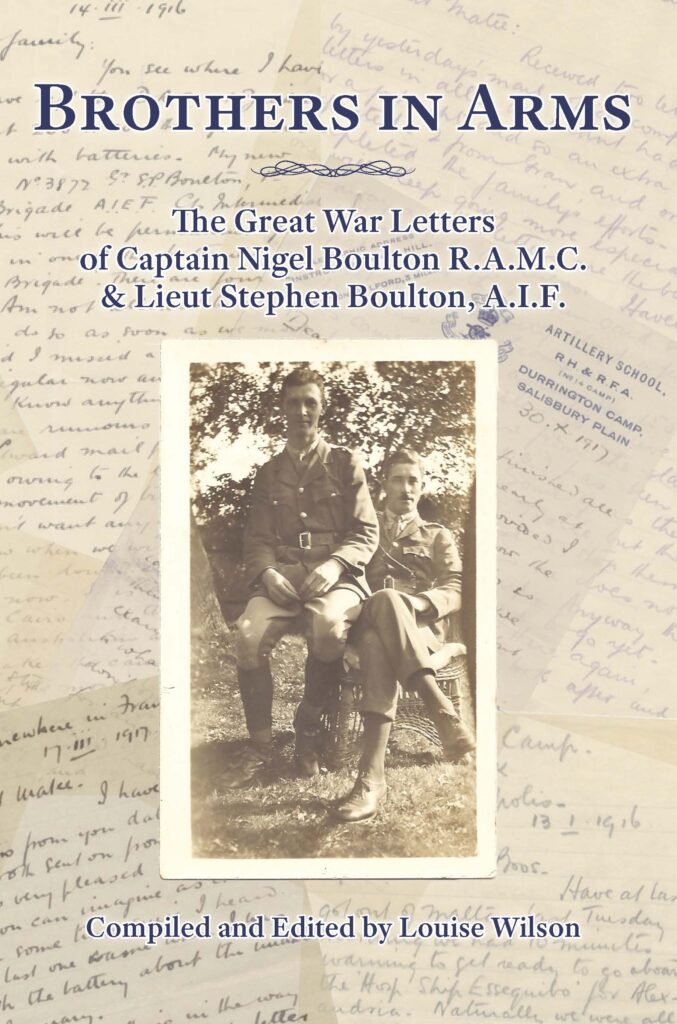 When war broke out in August 1914, University of Sydney medical graduate Nigel Boulton was training as a paediatrician in London and he promptly joined the Royal Army Medical Corps of the British Expeditionary Force. Back in Sydney, his younger brother Stephen left the Commonwealth Bank’s head office in January 1915 to enlist as an Artillery Gunner with the Australian Imperial Force. Both men then wrote long and literate letters to their widowed mother Dora, living at Gladesville in Sydney.
The brothers were born in Australia, of English parents. After the early death of their father, in the early 1900s both had attended the British Orphans Asylum, a boarding school at Slough in England, and they completed their schooling at The King’s School at Parramatta in Australia. Which country was home?
Anglophile Nigel (writing to ‘Dearest Mother’) has a strategic and medical view of the war. Aussie Stephen (writing to ‘My dear Matee’) tells his day-to-day story of front-line artillery life, the ravages of dysentery and the trials of artillery officer training at Lord’s in London as he progresses to the rank of Lieutenant in the 2nd Field Artillery Brigade.
It’s rare to find a set of letters like these. They sweep from the outbreak of hostilities in Europe through Egypt and Gallipoli to the Flanders area around Armentieres and Hazebrouck on the Ypres section of the Western Front, to Pozières and other major battles in the Somme Valley, through the struggles of 1918 when Germany nearly won the war, to the final victory on the Beaurevoir Line, to the withdrawal of Australian troops in early October 1918 and onwards to the occupation forces entering Germany in December 1918.
This is a unique, primary-source story of World War 1. The author has merely worked out the correct chronological order for the letters, researched & added short introductions to some, and inserted the occasional brief footnote where necessary. The brothers’ war letters were kept by their mother. In the later 1920s she had them typed and presented a copy to the Australian War Memorial, which promptly requested to hold the originals. In the AWM’s large collection, Stephen Boulton’s letters were among the first items to be digitised.
Reviews have been overwhelmingly positive. Excerpts follow:
• The book dispenses with long-winded introductions, which I generally ignore, and goes straight into the story. The letters have been carefully compiled and presented wonderfully and I simply couldn’t put the book down. … I have read many books detailing the first-hand accounts of Generals, Officers and the ordinary Rank and File at the front and certainly rate Brothers in Arms amongst the best in print. I would recommend this book to any who have the slightest interest in life in the Great War. Bob Dixon, formerly Warrant Officer Class One (Regimental Sergeant Major) RAMC
• I did not think reading letters would appeal to me but was I in for a surprise. In no time, I felt I was living the experience and feasting on the exchanges between Nigel, Steve and Dora. What an amazingly cohesive family they were … As I became deeply involved, I could not put the book down and while saddened by so much, I was very pleased to have the opportunity to read such an interesting personal record of a very important phase of our country’s development. Alan Reed (Air Vice Marshal, Retired)
• The rating from the Thursday group was 4.5 (Literary Merit) and 5 (Enjoyment). … Given the proliferation of stories in the media about WW1 I was not expecting to learn much more about life of a soldier and doctor during such horrible times. The personal account of day-to-day events, the mundane mixed with the ghastly, made this book a page-turner we had to finish. Convenor, Melbourne Athenaeum Library Book Groups, August 2017
• Louise Wilson is to be congratulated on producing such a superb compilation of letters in this brilliant publication. Be prepared to shed a few tears. Carol Vance-Roberts
• A thoroughly captivating book that gives a first-hand account of the horrors, anguish and sadness of all those involved in World War One. Such an interesting perspective of Colonial Australia 100 years ago. Nicholas Dennis
• I found to my surprise really that I felt I knew these people personally after reading the book by Louise Wilson. I just couldn’t put this down until I had finished it. I was struck by the detail of daily life of the men and those who loved them. Leonie Mcguire
• The war letters of the two Boulton brothers, together with Louise Wilson’s bridging notes, paint a living picture of the Great War. The voices of the unseen women at home resonate too in these letters. … a memorable and moving book. Cathy Gillespie-Jones
• BROTHERS IN ARMS has meant a lot to me as it has filled a void in the life of Dr Nigel Boulton. Dr Boulton and Nurse Lane were present at my birth. He was a fine and capable surgeon, especially as a setter of broken bones. His concern for the welfare of his patients was legendary. … BROTHERS IN ARMS has added a rich chapter into the history of Ryde and its people. Lawrence Gallop, Dec 2017
• Hearing the Boulton brothers’ day-to-day experiences and musings to their mother in real time as the war progressed gives us, I believe, the purest and most accurate kind of war memoir. For me—an amateur WW1 historian with a particular interest in Gallipoli and an insatiable curiosity about the everyday experiences of people during that time—the brothers’ letters are an invaluable trove. Reader in New Orleans, USA, Mar 2026
Available in Australia through BookPOD or internationally through selected major online outlets.
Contact MHHV Friend about this article.