Maurie Stehbens had never seen one before, but he knew what it was as soon as he saw it bobbing up and down in the waves, just ahead of his boat.
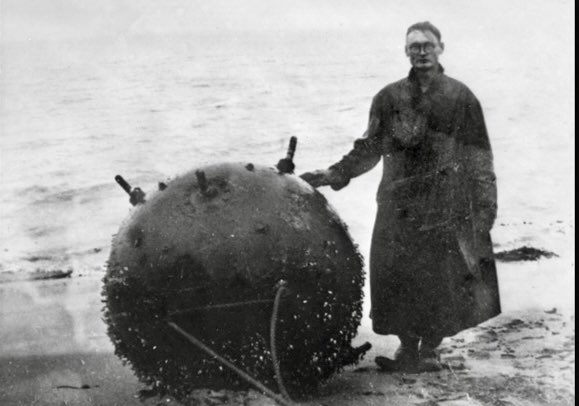
It was a mine, a German mine, 300-odd kilograms of death encased in rusty iron with those funny spikes sticking out of the top half, looking like an echidna that someone had balled up and pulled most of the quills out of. He knew it was a German mine because he was a professional fisherman, and they always needed to know such things. He knew it, too, because two more of the ugly bastards had washed ashore on beaches in the last six weeks, and not too far away from here either. He also knew he would be five pounds richer when he reported his find to the Beachport police station as that was the amount the Royal Australian Navy (RAN) had announced would be paid to anyone who located a mine. He might have to share it with Fred Ball, who had come with him on this trip to check his crayfish pots, but even so the reward would more than cover the fuel for the trip.
Ashore at Beachport that Saturday afternoon, Stehbens told Ross McCrea, formerly a mounted constable and now the little beach town’s only policeman, what he had seen bobbing up and down in the water about five kilometres out in Rivoli Bay. McCrea in turn telephoned details of Stehbens’ find through to naval authorities in Adelaide, a hundred kilometres and more away to the north-west. The information received at naval headquarters travelled down the line to HMAS Torrens, the name that had been given to the former Birkenhead Naval Depot at Port Adelaide. There, the information was passed to Lieutenant Commander Arthur McKenzie Greening, a sailor who was older than the RAN itself and whose job it would be to deal with the mine somewhere in the sea off Beachport.
In some ways, Arthur Greening was a naval anachronism, a sailor from another time and place who had witnessed at close range the evolution of modern navies. Another time, another place and another navy as well. Arthur Greening had been born at Deptford in Kent in February 1884 and had joined the Royal Navy when he turned eighteen in 1902. Ten years later, he arrived in Australia, on loan from the Royal Navy (RN) to the newly established Royal Australian Navy (RAN) for a period of three years. The First World War had broken out by then, and this had an immediate impact on him. His secondment was extended for the duration of the conflict and he was transferred, officially, to the RAN.
The skills Greening brought with him to Australia were various. He was an RN diver, and he was the organiser and instructor for the first RAN divers’ course in 1917. By then, he was also a qualified gunnery instructor and, with the coming of peace in 1918, the Australian Navy did not want to lose him. A deal was done which saw Greening remain in Australia and in the RAN, working his way through the ranks until, in 1929, he was commissioned as a lieutenant and at the same time was transferred to the RAN’s Auxiliary List. In this capacity, he was posted to Adelaide’s Birkenhead Naval Depot in 1934 and promoted to lieutenant commander in 1937. The outbreak of war in September 1939 delayed his imminent retirement and, in July 1941, he was the most broadly-experienced – if not the most senior – officer at HMAS Torrens. By then, he had some experience with almost all aspect of naval warfare, including mines, and so it was he who was asked to put together a Rendering Mines Safe (RMS) team and take it down to Beachport.
The first sailor Greening chose for his RMS team was Bill Danswan who, like Greening, was a career sailor. Danswan had to travel quite a distance to become a sailor, too, as he was from inland Australia, born at Temora in the Riverina district of New South Wales in 1918, and living there until he turned sixteen and was given parental permission to join the RAN. After training at HMAS Cerberus in Victoria, Danswan was posted to the cruiser HMAS Canberra in November 1935, remaining aboard her until February 1941 and rising from Ordinary to Able Seaman in that time. Problems with his eyes while at sea saw him being confined to shore duty after then, but mine delousing training and practical exercises at both HMAS’ Cerberus and Leeuwin, followed by a posting to HMAS Torrens kept him keen to advance his naval career. Living alone off-base, Bill Danswan was hoping to soon be joined by his wife and four-month-old daughter, who were both residing in Temora.
The third member of the team would be Tom Todd, a local sailor from Glanville, literally just down the road from HMAS Torrens. The thirty-year-old Todd had joined the RAN on 4 September 1939, shortly after learning that Australia was again at war. Since then, he had also completed his initial training at Cerberus and was then posted back to Torrens. Like Bill Danswan, he was also married with a small child, a son he and his wife had named Ronald. Unlike Bill Danswan, though, he was able to go home to his family when he was not on duty. He did have some training and experience with mines, as he had spent quite a lot of training time aboard two minesweepers, HMAS’ Nambucca and Coolabah, based nearby in the Port River. His practical experience included assisting Bill Danswan in mine demolition on three previous occasions.
Greening called Danswan and Todd to report to him at Torrens on that Saturday night and when they arrived briefed both men on the discovery of a mine off Beachport. The three men put together all the kit they thought they might need and carefully packed it into the RAN truck designed to be used in these circumstances, and departed Torrens shortly before midnight. They were at Beachport well before dawn where they arranged with Ross McCrea for all the main players to meet at 7.30 a.m. at the police station.
Their plan was put into action a short time later when four fishing boats set out from Beachport. The little flotilla was led by Maurie Stehbens in his boat, The Pilot, and that morning he was joined by Hec Haines and other boats owned by a fisherman named McCourt and by the Corigliano family. They didn’t have far to go either, as the mine had continued to drift westwards and was now just four kilometres from the coast.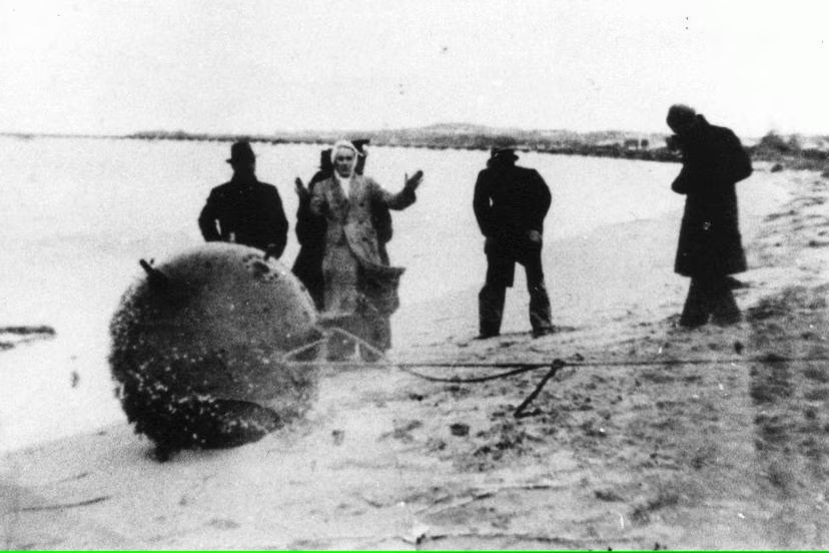
The mine’s recovery also proved a bit easier than some had thought it might be. The three RAN men had travelled out on The Pilot and when Stehbens stopped his boat some distance from the mine, Bill Danswan and Tom Todd took the fishing boat’s dinghy and rowed across to the mine. There, they attached one end of a long rope to one of the mine’s lifting lugs before rowing back to The Pilot, paying out the rope as they went. Back aboard the fishing boat the rope was secured while two of the other boats also threw ropes to Stehbens. Eventually, an arrangement whereby three boats were connected to each other and to the mine 500 metres behind them was put in place and they set off, very slowly, for Beachport, the mine continuing to bob up and down behind them.
As they came closer to the beach, it became obvious that there was a heavy surf running, so they turned and paralleled the coast, looking for somewhere to beach the mine. Around 300 metres beyond the last of Beachport’s buildings, they found a sheltered part of the beach and decided to land the mine there. The Pilot’s dinghy was again put to good use, rowing the RMS team ashore and allowing them to use the ropes to haul the mine up onto the beach, all from a safe distance at the end of the rope. When the mine was clear of the waves, the three men stopped and waited. After several minutes, they walked back down to the beach to inspect what it was they had just hauled ashore.
The spot they had chosen was about halfway between the Beachport jetty and a channel that ran between a coastal lagoon called Lake George and the sea, and those two points were designated by Ross McCrea as the closest any civilians were allowed to go to the mine and the sailors now examining it. An exception was made for a local photographer and, when he was finished, the three men set to work.
While it was still in the water, they had identified it as a German Type Y mine, and they were now able to see that it had been fitted with a Type C mechanism plate. The mine’s condition suggested that it had been in the water for some time. The metal at the top was rusty while the bottom half had marine growth and barnacles attached. A closer inspection revealed that the A-E switch was on A, meaning that the mine was armed, while the spindle at the mine’s base was about three centimetres out with mooring wire still attached. This was a critical find and Greening asked Danswan to verify it.
Danswan looked closely and agreed with Greening that the spindle was clearly out. He also suggested that, as a first step, they unshackle the mooring wire. When unshackled and then hauled in from the surf, they found almost 125 metres of wire attached, meaning that the wire had parted at or near the mine’s sinker. A closer inspection now revealed that the spindle was quite loose in its sheath and the hole for the safety pin was clearly visible. Danswan tried to push the spindle back into its sheath but found it quite resistant. He suggested to Greening that, if they could force the spindle back and then pin it in place, the firing circuit would be disengaged; they could then unbolt the breastplate, remove the explosives and burn them, the preferred method for delousing mines. A few taps with a hammer should knock the spindle back into position.
Arthur Greening vetoed the idea. He told the two sailors he believed the mine to be dangerous in its present state and that it would therefore be destroyed using a demolition charge. Here and now were not appropriate either. They had brought the mine ashore at 2 p.m.; it was now more than two hours later and beginning to grow dark and there was not enough time to set up the controlled explosion. Plus, the mine was still a bit too close to Beachport for his liking. In the morning, they would endeavour to find somewhere more appropriate.
Greening spoke to Ross McCrea about what he planned to do and the policeman agreed to organise a group of volunteers to guard the mine overnight, primarily to prevent anyone with more curiosity than common sense from getting too close to it.
The process started early on Monday morning. Bill Danswan and Tom Todd repeated part of the previous day’s activities first, attaching a rope to the mine’s lifting lugs but then sliding a large flat board underneath the mine and pulling the mine, in its original position, into the water using the board. When it was deep enough to float, the tow rope was taken up by Maurie Stehbens in The Pilot, this time with Fred Ball as his deckhand. They towed the mine away from Beachport to a spot the RMS team had selected the previous evening, taking both care and a lot of local advice.
The site they had chosen was one and a half kilometres from the last seafront buildings at Beachport. Here, the beach shelved gradually from the waterline to a line of sand hills that rose ten metres above the beach proper. Twenty metres inland from the last of these dunes was a road that led to the Beachport cemetery alongside a railway line and beyond that flat, broken scrubland. The RMS team would park their truck back in that scrub.
Everything was now done very, very carefully. Fred Ball had rowed The Pilot’s dinghy to the beach where he handed the tow rope to Todd and Danswan who retreated to a safe position in the sand hills and then pulled the mine ashore. They ensured it was steady and secure before untying the towrope. The next step was to place the detonation charge – which they had prepared earlier – to the mine, and then connect that charge to a battery via an electric cable. Some 800 metres of cable was used. Before being connected at either end the cable was laid out from alongside the mine on the beach, over the sand hills, over the road and railway line and to a hollow just into the scrub beyond, well out of harm’s way. There, the two wires from the end of the cable were taped to the wooden handles of shovels stuck into the loose soil some distance apart.
Danswan and Todd now returned to the mine and connected the wire at that end to the detonation charge without incident. Still checking the line as they walked, they crossed the sand hills and then, as they approached the road, they heard a call and saw one of the locals running along the road towards them. They stopped, and when the man caught up to them, and caught his breath, listened as he told them that a railwayman on a small trolley, which he called a tricycle, had passed down the tracks while they were working on the beach, running over their cable.
They thanked the man, assured him they would check the cable and asked him to return to the onlookers a kilometre away towards Beachport; it seemed to be a request that suited the man, who then jogged off the way he had come. Bill Danswan checked the cable carefully in the places where it crossed the railway line. Sure enough, the cable had been flattened but it had not been severed and there was no metal showing through the insulating tape covering it. He thought it would still work without any problems.
Danswan and Todd made their way across to the hollow in the scrub where they found Arthur Greening waiting for them with the battery and operating key. Danswan brought the cable ends from the shovels to the battery, connected them and, when the three men were ready, turned the key to send an electric charge down the cable to the detonator. Nothing happened.
Suspecting that the damage to the cable may have been greater than he thought, Bill Danswan disconnected the cable from the battery, reconnected the ends to the shovel handles and planted them away from the battery. He walked across to the railway line and closely examined the flattened parts of cable. Although he could not see anything wrong with the cable, he cut the damaged part out, respliced and reinsulated the cable and returned to the hollow, where he reconnected the battery. Again, the three men crouched down as Danswan turned the key. Again, nothing happened.
The cable was once again disconnected from the battery and the ends secured to the shovels’ handles. The men’s discussion now centred on probable causes for the failure to detonate with the cable connection to the detonating charge being considered the most likely malfunction. The three men walked carefully along the cable, examining it closely but finding no break. They did find at least one problem at the mine, though, as the lapping of the waves there had apparently caused the detonator lead to separate from the electric cable where their wires had been spliced together. The detonator was removed from the charge; Greening thought it best to replace the whole detonator box and the three headed back to the truck where the spares were kept.
It was a process that would take just a few minutes. Danswan and Todd would return to the mine, check the detonating charge and wait there for the new detonator. In fact it was closer to two than ten minutes later when Greening was back at the sand hills, new detonator in hand.
The explosion was both heard and felt in Millicent, forty-five kilometres to the east. There, people noted that the time was three minutes after 2 p.m. and rushed outside to see what had happened. When there was nothing apparent, no columns of smoke rising from a crashed aircraft or bombed building, they scratched their heads and went back inside. Several houses in Beachport had windows shattered and several of the Beach port spectators, a kilometre away, felt the pressure wave hit them like something physical.
Back at the bomb disposal site, Arthur Greening had run to the top of the sand hills and looked down to the beach where the mine had been. It had completely disappeared. Where it had been was now an enormous crater, slowly filling with seawater. On the edge of the crater, on the landward side, were two crumpled bodies dressed completely in navy blue. Arthur Greening did not know what to do and so he did nothing. The first spectators to arrive just a couple of minutes later found him still there, sitting on the sand, looking at the bodies below and seemingly incapable of either movement or speech.
There would be an enquiry, of course, and blame would be dished out in appropriate proportions, for Bill Danswan and Tom Todd were the first two Australian servicemen killed on Australian soil by enemy action during the Second World War. The main enquiry was held in conditions of secrecy, as were parallel and subsidiary investigations, all of which highlighted a simple, but very frightening fact. While the mine whose detonation killed the two young naval ratings was clearly a German mine, no-one knew where it had been laid, when it had been laid or how it had been laid.
War had come to Australia, but it had come via the back door because that back door had been left open. There were now real questions about whether it could be closed and vital shipping lanes protected from enemy action. If that protection was not forthcoming and not extended to all the waters of south-eastern Australia, the nation’s ability to wage war would be sorely tested. Failure would leave the country open to who knew what sort of enemy action, up to and including invasion. It was a future that might become very bleak indeed.
Written by Ian W. Shaw.
For more about enemy attacks on Australia during World War 2 click on the image below.
Contact MHHV Friend about this article.