For some time, the Burma Campaign was overlooked, and largely forgotten, as was the contribution of the participating RAAF aircrew.
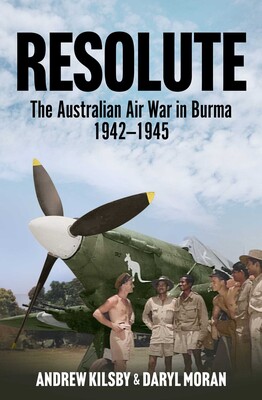
The recent publication of several books by well-known authors and veterans has, in the main, helped correct this injustice. RESOLUTE- The Australian Air War in Burma 1942 – 1945, has taken the narrative one step further, endeavouring to cover all aspects of the campaign across Burma, India and Ceylon while detailing the actions of Australian aircrew, many of whom were either serving in the RAF or were RAAF aircrew serving in British squadrons.
Resolute is authored by Dr Andrew Kilsby and Dr Daryl Moran. Andrew Kilsby, a historian with a PhD in history from UNSW@ADFA, specialises in Australian military, business, and biographical history and has edited and authored several works, including In the Fight: Australians and the War in Burma 1942–1945.
Daryl Moran, a military historian with a PhD from the University of Melbourne, has had a career as a professional educator and administrator in various schools, including a two-year posting to an international school in India. His interest in the Burma campaign was sparked during his time in India when he came across the graves of RAAF members killed in the conflict. He has published Empire’s Noble Son.
The Burma Campaign was the longest campaign fought by the Allies in World War II and provided the largest army group ever assembled by the British Commonwealth. The authors’ research has provided a very detailed narrative of the campaign, from the early days when Japanese forces were swarming across Burma and surging towards India, to the ever-slow reversal of fortune and the eventual demise of the invading forces. Air operations stretched over India, Burma, Ceylon, the Indian Ocean from Aden, Diego Garcia, Cocos Islands, and Bay of Bengal to Sumatra, Thailand and Indo China. A huge area.
By the end of the war the RAF was operating 85 squadrons in India and Burma, with RAAF aircrews scattered across the force – the history of the air war in the Burma Campaign is therefore, essentially an RAF history. There were no stand-alone Australian squadrons in the campaign, and this has obscured the presence and achievements of RAAF personnel.
Australian personnel were transparent within the large RAF system. Support, including delayed pay, lack of promotion, provision of RAAF uniforms and clarification of the length of operational tours were not defined and were disturbing for the Australians. The situation was largely resolved with the establishment of a RAAF Liaison Office in India in 1943.
The authors have expertly corrected gaps in our history with the identification of Australian aircrew tracing their activities, achievements, courage, resilience and sacrifice. Australians served across the spectrum of air operations: air to air combat, bombing attacks, transport operations, maritime strike, army support, medical evacuation and special operations. All of these activities were vulnerable to the deadly effects of monsoonal weather, accounting for many losses of aircraft and aircrew.
With an incredible attention to detail, the authors have drilled down to cover individual actions, identifying Australian participants by name, rank and crew role, describing their activities and outcomes within the context of the operations at the time.
Given there were over 1700 Australian airmen serving in the campaign, the authors have provided a comprehensive coverage of individual activities and actions, an outcome of an extensive research across a broad range of institutions and publications. There are 47 pages of end notes and an extensive bibliography.
Combined with the narrative of the campaign and its progress, and individual details, Resolute provides a very useful supplement to the Official History, Air War against Japan 1943 – 1945, where only 32 pages cover the Burma Campaign, and very few individuals are identified.
Resolute captures the intensity of the fighting from the early conflict which was heavily one sided, through the grind of war towards victory and finally, the Japanese surrender. The reader is constantly reminded of the high loss rates of aircraft and people. More than 240 RAAF aircrew killed, were in action, victims to an unforgiving weather system, or by accident.
The experiences of the small number of Australians who were either shot down or crashed and became prisoners of war in either Rangoon Jail or Bangkok Jail are recorded in detail.
Resolute has an excellent collection of photographs. The enclosed maps will prove useful for the reader who wishes to follow the campaign and the various mission objectives. A nominal roll listing 1664 participating RAAF personnel is provided, noting the award of decorations, awards and fatalities.
The significant amount of detail provided by the authors will require the close attention of the reader. Resolute is a compelling account of a largely forgotten campaign of World War II and will appeal to the serious student of military aviation history and to the reader with an interest in the feats and accomplishments of Australian airmen in war.
Reviewed by Bob Treloar
Contact MHHV Friend about this article.