It’s a sad fact of life that almost all our World War Two service men and women have passed away. Some leave nothing behind but an official record in a government archive, listing their name, rank, serial number, and so on. Others, like Tommy Thwaites’ 2/10 Ordinance Workshop, Australian Imperial Forces, left a memoir for future generations to explore, should they be interested. This memoir is a part of our history that, over time, tends to be forgotten. Without a past, we have no future.
The following is taken from Thwaites’s memoirs in 2004.
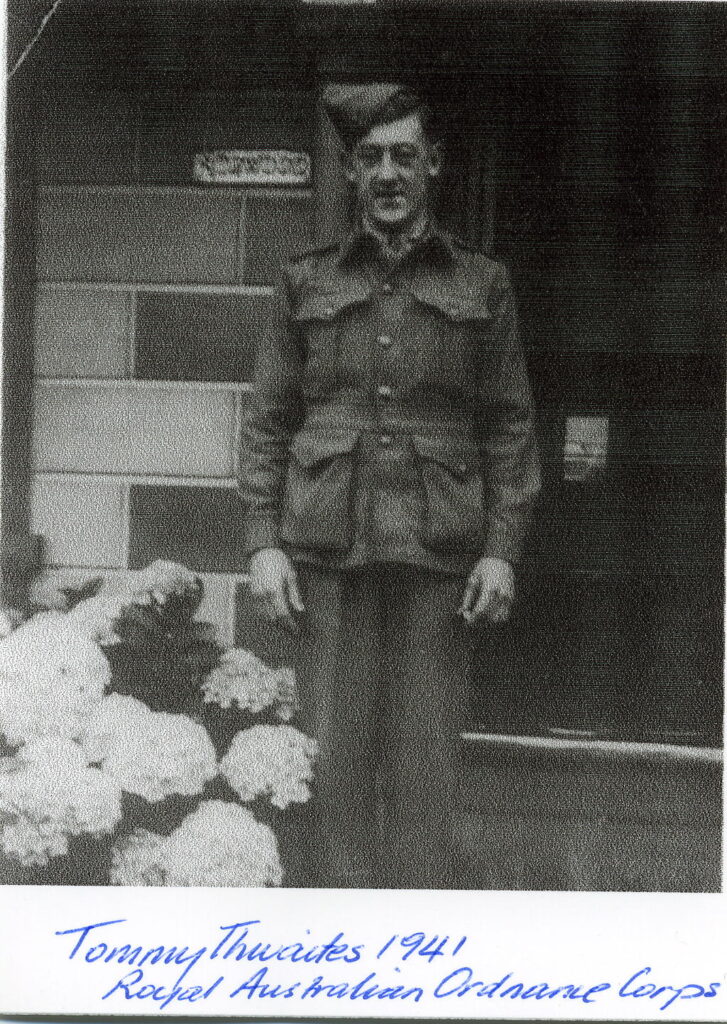 ‘My father had been on Gallipoli in World War One when he was sixteen. When World War Two started, I was an apprentice motor mechanic. As soon as I finished my apprenticeship, I enlisted in the Royal Australian Ordinance Corps in the city of Melbourne on 14 November 1941 and became Army recruit Private Tommy Thwaites. After vigorous basic training, we were shipped from Melbourne to Sydney by train.’
‘It was a warm morning in Sydney when I boarded the ship, Aquitania, with five thousand other Army recruits. I’ll remember January 10, 1942, for the rest of my life. I was excited but a bit anxious as we got closer to departure because we didn’t even know the destination. We were off to fight for our country, that’s all we knew! We sailed at midday, and we called in at the Western Australian port of Fremantle, where we picked up the 2/4 Machine Gun Battalion. By now, we knew we were going to Singapore. The Army issue of underwear was standard cool-weather gear, including long johns, and this became more useless the closer we got to the tropics. The result was that these surplus items were dumped over the back of the boat and formed a chain of direction markers to the boat. Well, the Army wasn’t trained in naval security. We sailed on into the tropics to Sunda Straits on the west end of Java, and because the Japs controlled the air, we had to change into much smaller boats to go on to Singapore.’
‘At first, our 2/10 Ordinance Workshop camped across the causeway at Johor Bahru in Malaya. While we were there, some of the boys went into the Sultan’s palace and knocked off all his musical instruments. Our fellers were always looking for something to knock off! With the Japs advancing towards Singapore, we were sent across the causeway to Singapore and camped in the Ford Motor Company.’
‘On 14 February, we had a small contingent of men under Corporal Breavington, and we were given ten rounds of ammunition and a .303 rifle. Being Ordinance Corps, we were a non-combat unit, and when they gave me these ten rounds, I wasn’t very impressed. Why? Because I hadn’t fired a .303 rifle in my life. I might as well have thrown it at the Japs. Anyway, we proceeded to a position around where the European people lived when they were in Singapore. On the way to our allocated position, we picked up a Bren gun, which weighed about twenty-seven pounds, and because I was one of the old chaps at twenty-one, the others decided I should carry it. So, on the way to the position, I came across some fellers from a machine gun company, and I asked them if they had any ammo clips for a Bren gun. They gave me three or four, and I gave them to the boys to carry. After about four hours, we came to our position and I laid the Bren gun down and said to the fellers, ‘Where are the clips?’ No answer. I asked again. Still no answer. I eventually found out that the clips were too bloody heavy for them, so they threw them away. I got really upset! I’d only been carrying a twenty-seven-pound Bren around in the bloody tropics for four hours for bloody nothing.’
‘About 6 pm on 15 February, orders came through to lay down our arms. Corporal Breavington called for a couple of volunteers. A mate and I volunteered, and his orders were, ‘Go round and break every bottle of grog you can find.’ He was concerned about his men because it would be bad enough if the Japs did come let alone if they were pissed. It would make it twice as bad. At about 10 pm we were told to proceed towards a tennis court and his last order as our Corporal was to take the bolts out of the rifles and throw them to the shithouse. After that, we were taken prisoner of war. I had been in the Army just three months. I found out after the war that Breavington and three others were executed for attempting to escape.’
‘The next day, we marched to a place called Selarang and captivity. When we got to our position, we met up with a lot of our ordinance guys and one of our cooks named Hyder. We didn’t have much in the way of supplies, so Hyder made a stew. After we had the stew, someone said, ‘Hyder, where the bloody hell did you get the meat from?’’ He said, ‘I didn’t put any meat in the stew!’ About an hour later, he found out his pet monkey was missing! Mystery solved.’
‘After being at Selerang a short time, the Japs sent me as part of a working party to a place called Bukit Timah on the other side of the city. Our job was to chop the top off a hill to put up a memorial to the dead Japs. I always maintained there were a lot of good Japs. I even backed that up by saying, ‘Well! I’ll build this bloody memorial to the bastards!’ So, we went to work every day and were put in groups of three. One group would chop the hill away with a ‘’chunkle’’ something like a hoe, and the other two fellers would have a wicker basket with two handles. You would fill it, and they would walk to the side of the hill and throw it over. We had to dig down several metres and one day we were working as ‘normally’ as we could in the bloody heat of Singapore, when this little Jap got down, got the chunkle and worked like buggery for three or four minutes. He wanted us to do the same for eight hours. When he got back to the top of the hill he started laughing, so we said to him, ‘Piss orf,’ and he kept laughing and laughing. This went on for a few days so one morning we were walking up to the hill to work and one of the boys said to this little Jap, ‘Ah, piss orf.’ The Jap called the feller to attention and whacked him right in the mouth. Some stupid bastard had told the Jap what ‘piss orf’ meant.’
‘The shrine took five hundred prisoners six months to build. It was all concrete steps up and on top of a high concrete base; there was this big wooden pole with Japanese writing on it. I don’t know how long the pole would have remained upright, as someone was rumoured to have put white ants in the base. Nearby, we were allowed to build a small pagoda in memory of the Allied dead. Anyway, when the shrine was finished, the Japanese had a belief that if they put food around on tables, the spirits can have a feed. When they went there the next day, the spirits had a good feed all right because our guys had knocked the food off during the night.’
‘There was a time when the Japs had us loading their ships. One of the blokes found some lipstick and he didn’t know where to hide it, so he could get it back to camp to sell it through the wire to the Chinese. As usual, Aussies will do anything to get a quid for themselves, so he put the lipstick up his bum, took it back to camp and sold it through the wire. It was hard to get things past the Jap guards. We used to wear G-strings, and we thought we could put things in the G-strings. It worked for a while until the Japs started feeling us behind the nuts every time we checked out. Another guy used his water bottle by removing the cover, cutting the bottom out and making a wooden replica, which he pushed halfway up the bottle. He then stuffed the lower part with cotton and put the cover on. Any contraband he could pick up, he put in the lower part of his water bottle, and when he went past the guard, who pointed to his water bottle, he could open it, and water would come out. The guard didn’t know the bottle was only half full.’
‘I’m not sure of the date, but we were sent to a place called Bang Pong in Thailand. This is where the Burma railway joined the Singapore—Bangkok line. The journey took about four days, and, at that time, we only had three meals. The hardest part of the trip was sitting around inside closed steel railway carriages going through the tropics. It was bloody hot! The only air that came in was through one door, which was open about four to five inches so everyone could have a pee, but before using the gap, you had to check the direction of the wind for obvious reasons.’
‘After arriving at Bang Pong, there’s one incident I won’t forget. Not far from the station, we had latrines, and I was sitting on the latrine when this Thai woman came up and tried to pull my shirt off and shove a ten-dollar note in my hand. I looked up at her and said, ‘Darling, you can’t have that bastard as it’s the only one I have.’ I had a signet ring that my grandmother gave me, so I sold it for ten dollars. In the shops nearby, I got ten hard-boiled eggs. They were the only eggs I had the whole time I was a POW. I’ve heard stories of people having food, etc, but where they got it from, Christ knows, ‘cause I could never knock it off.’
‘We were put into groups of about thirty-five or forty, and we had to march up to different camps so we could start on the railway. The party I was allocated to was called F Force, and we had to go to the number three camp at a place called Kami Sonkurei, which unfortunately was about two hundred miles away. We had to march twenty miles a night, as it was too hot during the day. Each section had a stretcher so that anyone not fit enough to finish the march could be carried until we stopped. It was either carry them or leave them there to die. On quite a few occasions, there would be two on a stretcher, and that meant four men had to keep changing about every twenty minutes to get one corner of the stretcher each. You did this for your mates. We did this for about four nights. Twenty miles is a decent sort of walk.’
‘The Japs gave us one night off then we had to do it all again. One night, I had a touch of dysentery, and there was already one bloke on the stretcher, so I had to do the twenty miles with dysentery. I reckon I could have the record for ups and downs in a night, no worries. After ten nights, that’s two hundred miles, which is about the same from Melbourne to Bendigo and back, we got to the camp. When we got there, some bright bastard said, ‘How are we going to get home? I hope we don’t have to walk! Another feller said. ‘Ah no, ‘We’re all going home on the railway.’ The first guy said, ‘When?’ and the reply was as soon as you bastards build it.’
‘We started off working, and the way they allocated the workforce was the Jap Commander who oversaw the camp would say at night how many men he wanted on a working party. In the morning if they had the allocated men, you would go off and do between twelve-fourteen hours of work a day. The food was about five hundred grams of dried stuff a day, so you did a bloody lot of work on very little food. One of the jobs we had was to build up the foundations for the railway tracks with dirt. They had gangs of three men to dig nine cubic metres of soil, one man using the chunkle and the other two had wicker baskets to carry the soil. The Jap in charge had a three-metre stick to drop into the pit to make sure the sides were straight and if they weren’t, he made you stay there until it was right. It wasn’t too bad for a few days but the further away you got, you still had to shift the same amount, so it got harder and so the longer you stopped there each day.’
‘As time went on, the fellers started to get crook with malaria, beriberi and many other tropical diseases. The Jap Commander would say he wanted three-hundred men for a working party and if we could only manage say two hundred and fifty, they would have to go to the hospital and pick out another fifty of the fitter ones to make up the number required. We had to bloody near carry the sick ones to work but the Japs were pretty good as they didn’t want them to work but the numbers had to be there until the day’s work was over. At night we had to carry them bloody back again.’
‘When we finished laying the foundations, we were allocated to various jobs. Such as chopping trees or helping blast stones and then breaking them up with a sledgehammer. A mate of mine and I were chopping down trees one day and of course, the tools were pretty bad. The axe head my mate was using wasn’t on very tight and while he was chopping, the axe head flew off and hit him in the shin, opening it right up. I started running around trying to find out where I could get someone to stitch him up as it was too far back to camp. I eventually found out the Jap RAP man was also the powder monkey in the quarry. I sort of helped my mate down to the quarry where the Jap put six stitches in his leg. When he finished, I made signs to the Jap for a cigarette, so he gave me one and for a light which he did. I just had a few puffs out of it when my mate said, ‘What about me, why don’t you give it to me’. I said, ‘What are you talking about, I bloody near had to carry you here.’ That feller who is no longer with us always said from that day on till the day he died, that I would never die of a heart attack because ‘you haven’t got a heart ya bastard.’ He didn’t die a POW. He eventually died of a heart attack.’
‘I had been on the railway for about six months when I heard one day a call for volunteers to become medical orderlies as all the other poor bastards had died. So, I volunteered and went up to the doctor and he asked me what experience I had. When I told him I had done a first aid course in the Boy Scouts he said, ‘Well, you’ll do.’
‘One of my jobs in the hospital, if you could call it that, was to hold blokes every morning, while the doctor was scraping away gangrene out of their ulcers with a sharpened teaspoon. There were always two of us holding them and just as well. Believe me, they would spit and bite and do anything to you. We felt sorry for the poor bastards ‘cause there were no bloody aspirin or needles of course. No nothing. Another job I had was picking maggots out of Bloke’s ulcers. On legs, knees, in the groin, anywhere there was an ulcer that had maggots there; I had to pick them out every morning with a pair of tweezers.’
‘Ulcers could start from bloody nothing, just a slight scratch then infection set in and there was nothing that could be done to stop them. A bamboo scratch could cost you a leg. Malnutrition had a lot to do with it too. Outside the hospital, there was a cholera section. I went there for a while and the only medication they had was a water bottle of salt water. Unfortunately for those poor blokes who had it, as fast as they were drinking the salt water, it was coming out of both ends. It was rare for anyone to survive. Two of us were working twelve-hour shifts and on one shift, twelve blokes died and the same happened on the next shift, another twelve died. Anyone who died of cholera had to be burnt to stop the disease from spreading through the camp. One day, I asked the feller that used to burn them what it was like. He said, ‘Oh, I don’t mind sitting with my billy on the fire, but I get bloody pissed off when they sit up and look at me.’
‘The hospital wasn’t a very nice place to work in as you can imagine. In fact, in the mornings the doctors got so pissed off because they didn’t have the medical equipment or stuff to treat the patients. The medical huts were made of bamboo with a passageway down the middle where the patients lay on both sides. I remember one day, these two doctors walking down the centre of the huts in front of me, and they would be pointing to various fellers saying which ones will die today. This went on for a few weeks and in the end, they would be saying the same thing every morning. They would say that this bloke would die at ten o’clock and that bloke at three o’clock. I don’t know why they did this, but I suppose it was their way of breaking the monotony. On the side of one hut was an operating table. This day as the doctor was amputating a guy’s leg, I was the flyman. My job was to brush the flies away and I can tell you, this doctor, didn’t worry about not having a proper medical saw, he just picked up an ordinary saw, thought this is good enough and took the blokes leg off. No worries.’
‘You know, when the rail was finished, it cost one hundred thousand lives. There were two thousand seven hundred Australians among them. The cost in lives didn’t worry the Japanese one little bit. We were all expendable. The railway had to be finished as soon as possible and with the Japanese contempt for the prisoner’s lives, the line was finished in fourteen months. F Force was the hardest hit, we had fifty per cent casualties.’
‘When we eventually returned to Changi Prison, it was like a home away from home compared to the railway. The living conditions were better, and the working situation was better too. It was probably a month or two later when I got picked out to work at the Changi Aerodrome. This meant we had to walk to work, do eight hours of labour, and then walk back again. When we got back, we could have a shower and a meal. The jail, which was built under British rule, was designed to hold under one hundred thousand people, but the Japs crammed in many thousands more. In the section I was in, the cells were designed to hold one person, but we had eight plus the toilet in ours.’
‘A mate of mine was allocated to work on the garden party. They did all right because after lunch, the Japs would let them cook a few greens or whatever they could scrounge. There were a couple of young Jewish blokes with us, and we used to have a go at them about their religion. So, one day, we had this watery soup or stew or whatever you wanted to call it with bits of fatty pork floating around in it. This mate of mine, Ernie, who was a bit of a character said, ‘I’m going over there to get their bloody food. They won’t eat it cos it’s got bloody pork in it!’ He went over and said Well, you’re not going to eat it are you; it’s got bloody pork in it! Give it to me.
One of the Jewish guys said, what are you talking about Ernie? This chicken is bloody beautiful.’ It just goes to show that religion goes out the door when you’re bloody hungry.’
‘We all knew in camp when the war had finished but that didn’t stop the bloody Japs from taking us to work the next morning. At lunchtime that same day, the 16th of August 1945, all the Japs had disappeared, and we knew that was it. While I was waiting to be sent home to Australia, I was down by the wharves and there were Japs working there under our guys who had come up on the ship ‘Duntroon’ to relieve us. There were some wooden boxes there and one was broken. I couldn’t help myself. I grabbed a piece of timber and belted the shit out of the nearest Jap and busted my hand in the process. A Sergeant came up and wanted to court martial me. I said, ‘If you don’t want to end up in the drink, you better piss off!’
‘We came home on the Duntroon. On the way home, the Commanding Officer of our group radioed ahead to Darwin to tell them not to upset us, as we were all bloody mad. In Darwin, they put on a dance for us but after the interval when the band struck up, there was hardly anyone on the dance floor because all the POWs had the nurses down on the bloody beach.’
‘We only stayed one night in Darwin and then we were sent to a camp in Sydney. A mate and I went into Sydney near Luna Park and there was a sight I couldn’t believe. There was this sheila standing around in a pair of long pants with a bottle of beer in her bloody hand and she was smoking. Bloody unbelievable. You can imagine how we felt. We have never seen anything like that in our bloody lives. That was unheard of before the war.’
‘From Sydney, we came by train to Melbourne where the authorities had Red Cross cars waiting. The thing that stood out in my mind was everyone saying, ‘Oh, I wish I was with you’ and us saying, ‘Why would you want to be with us you stupid bastards.’ We met our families and finally went home. My Grandmother, who was determined to hang on to life until her Tommy returned, welcomed me home with the best rice pudding in the world. I didn’t have the heart to tell her I had just finished about three and a half thousand feeds of rice and very little else. Later on, she cooked my other favourite dish, bread, and butter pudding.’
‘Blood hell, it was so good to be home.’
[C] Ken Wright. 2004.
Contact MHHV Friend about this article.