This book provides a fascinating and tragic account of what it was like in WW2 to be a civilian internee or prisoner of the Japanese Imperial Army in Singapore after the British Lieutenant General Arthur Percival, General Officer Commanding Malaya, surrendered to the Japanese on 15th February 1942.
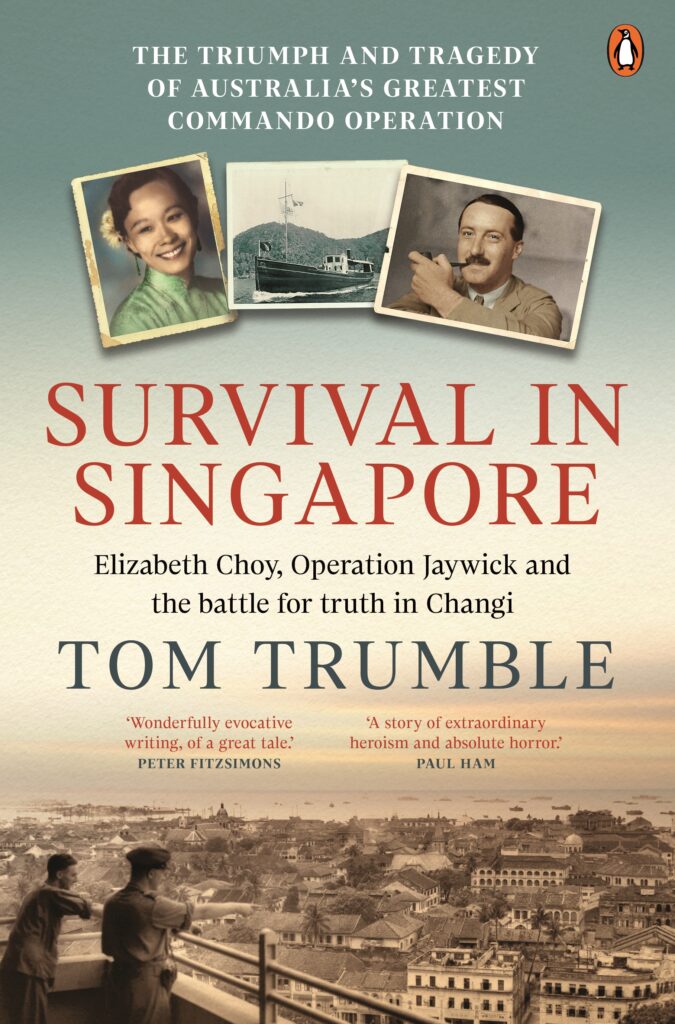
The author describes in particular how two people, a British diplomat named Robert Heatly Scott and a Chinese school teacher named Elizabeth Choy, experienced and survived the torture and cruelty of the Japanese Military Police (Kempei Tai) from 1942 to 1945. Both Scott and Choy had been leading citizens of Singapore before being interned.
The author focuses on their background and civil activities before they were tortured to extract confessions about their alleged involvement in Black Market activities to obtain food, and the successful sabotage raid in September 1943 by a small group of British and Australian Commandos who had sailed on a captured Japanese type fishing boat from Exmouth Bay in Australia to Singapore. The raid known as Operation Jaywick was led by Scottish Major Ivan Lyon, of the Gordon Highlanders and thirteen officers and men of the British Special Operations Executive and Australian Special Reconnaissance Department. It resulted in the commandos secretly damaging six Japanese merchant ships in Singapore harbour. They used limpet mines placed on the hulls, using only three folboats (a type of two-man canoe), and blew the mines up remotely. All the commandos escaped the harbour and secretly returned to Australia on their fishing boat. However, they kept the details of the operation secret. Three of the damaged Japanese ships eventually sank on 26th September 1943.
The Kempei Tai believed that a Singaporean resistance group had carried out the Jaywick raid. So, on the Double Tenth (10th October), the Kempei Tai raided all the camps and prisons like Changi, Outram goal and YMCA goal and beat up several suspects to death in trying to extract confessions. They also reduced the daily food rations, and many internees suffered from dysentery and beriberi as well as broken and damaged limbs.
Both Scott and Choy devoted themselves to caring for their fellow prisoners in horrible conditions and at the end of the war were repatriated. However, it took them ages to recover their health completely. Rob Scott appeared as a key witness in the ‘Double Tenth’ military trial of his Japanese captors in March 1946. During the trial, the world was astounded by the reported extent of the Japanese atrocities. Eight of the captors were sentenced to death. Elizabeth Choy decided not to attend any of the trial proceedings.
The book is very informative and is written in two parts. The first part covers the period before the raid, and the second part covers the period after the raid. It is well supported by endnotes, a large bibliography, an index, and 74 photographs of the people, boats, and areas mentioned in the book, as well as maps of the SW Pacific and Singapore. It is a good read and illustrates it is almost unbelievable how the human spirit can sometimes overcome the most brutal behaviour of fellow humans.
Reviewed for RUSIV by David Rees
Contact MHHV Friend about this article.