This is a most interesting work; so interesting in fact that I had to read it twice! Why? I couldn’t put it down the first read! To be sure I wasn’t mesmerised by the astonishing level of detail and facts contained in this enlightening case-study offering by Author Kirsty Harris, I read it a second time at a much-relaxed pace, taking time to absorb and reflect upon this significant book.
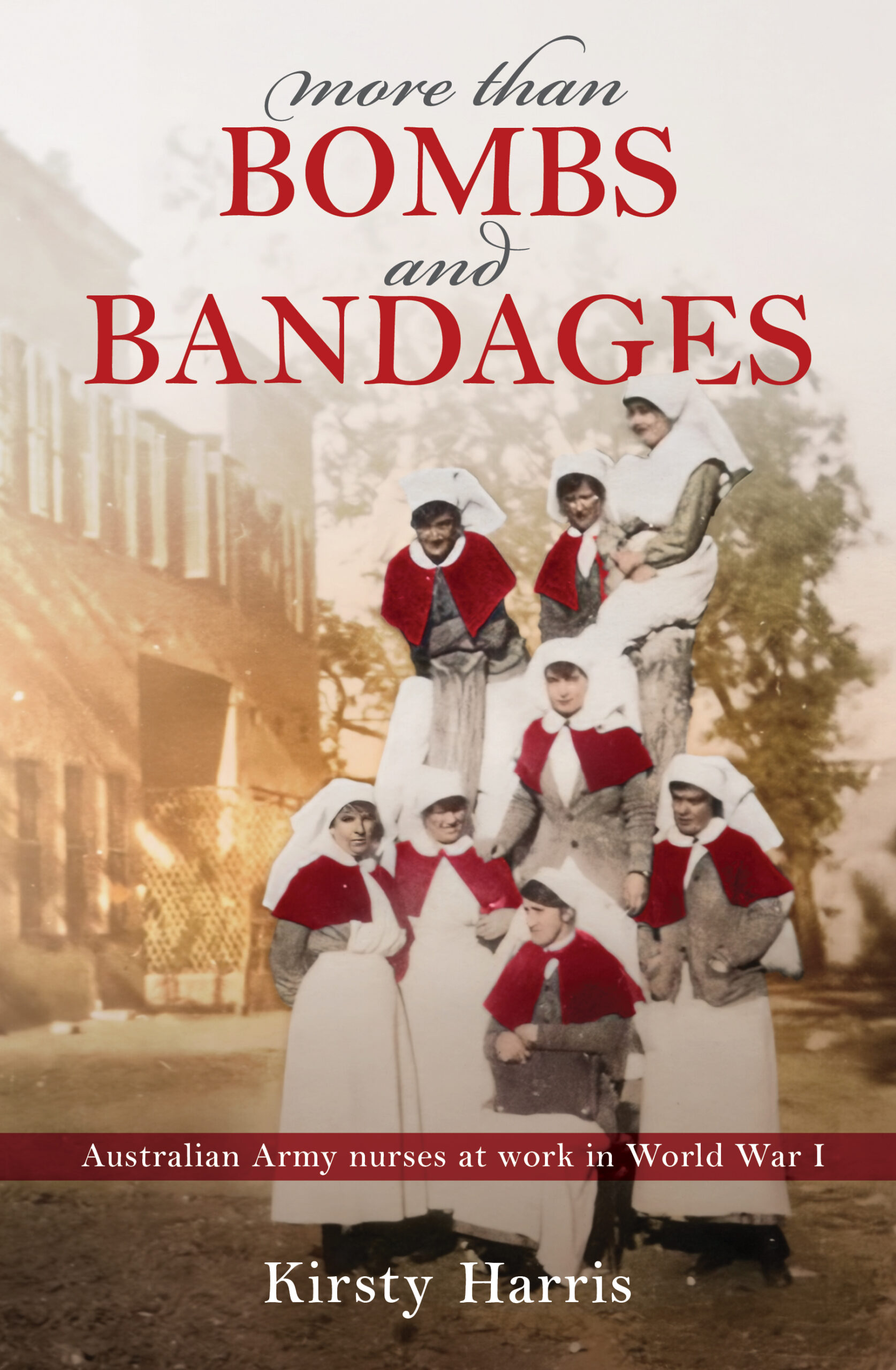
Pages: 288
Book Type: paperback
Dimensions: 153mm x 230mm
ISBN: 9781923144293
$32.99
The focus of the Author is an examination of the evolution and development of the Australian Army Nursing Service (AANS) Nurses in service and deployment during World War I. In an almost forensic way, Harris makes the juxtaposition between civilian nursing practice, (in both Private Homes and also Public Hospitals), and the Nursing experience for AANS Nurses serving in the Great War.
Commencing with an outline of the history of civil nursing in Australia, based upon the ‘Nightingale’ model from Britain, and also the Military experiences of Australian’s nursing in campaigns such as the Boer War, Crimea, and in early Federation, comparison is made of the significant departure and differences of the actual roles and experiences for AANS Nurses at War.
Author Harris defines how Training, Accreditation, and Standards for civil nurses were developed in the Colonies and early Australia, identifying how differing State regulations and schemes, affecting training and work practices, led to eventual National minimum standards. She also identifies the roles of various civilian Hospitals, such as Home, Base, and Bush. Prospective AANS Nurses were required to have been Accredited and with a minimum of three year’s experience in civil nursing.
As Harris clearly proves, AANS service required far more from Nurses; demanding requirements to be skilful, resourceful, and physically and emotionally strong, (and possess a strong degree of common-sense and aptitude for quick-thinking and independence).
AANS Nurses faced additional duties and responsibilities necessitated by challenges of warfare including danger, disease, climate, environment, relationships, (with casualties, medics, orderlies, and the dying), different cultures and languages, and expanded tasks such as performing surgery and theatre work, disease management, and the administering of drugs without direct supervision of Medical Officers; all whilst operating within the regulations and bureaucracy of Military doctrine; and performing unique jobs such as Home Sister, or Mess Sister.
AANS Nurses served on both Hospital and Transport ships, as well as barges, Hospital Trains, Casualty Clearing Stations (close to the battlefront), Stationary Hospitals, General Hospitals and Base Hospitals (often British). On the Homefront, AANS Nurses served at Military Hospitals and ‘Repat’s’ within Australia, during and post-war.
The experiences and skills of AANS Nurses and the demands placed upon them were far superior to those of contemporary civilian Nurses, and this point is strongly made by the Author and evidenced from Official Files, Newspapers, testimony and anecdotes from the AANS Nurses themselves, or drawn from their diaries and correspondence home.
Exceptional research from Author Kirsty Harris has produced this fascinating, educational and informative case-study of a very significant part of Australian History, which otherwise may have been overlooked. Reading this gem will fill you with admiration and respect for those who served in the arduous conditions of War as AANS Nurses, and the Nursing profession generally. Kudos to the Author. Most positively recommended.
REVIEW by: ADRIAN CATT 24/10/2024
Contact MHHV Friend about this article.