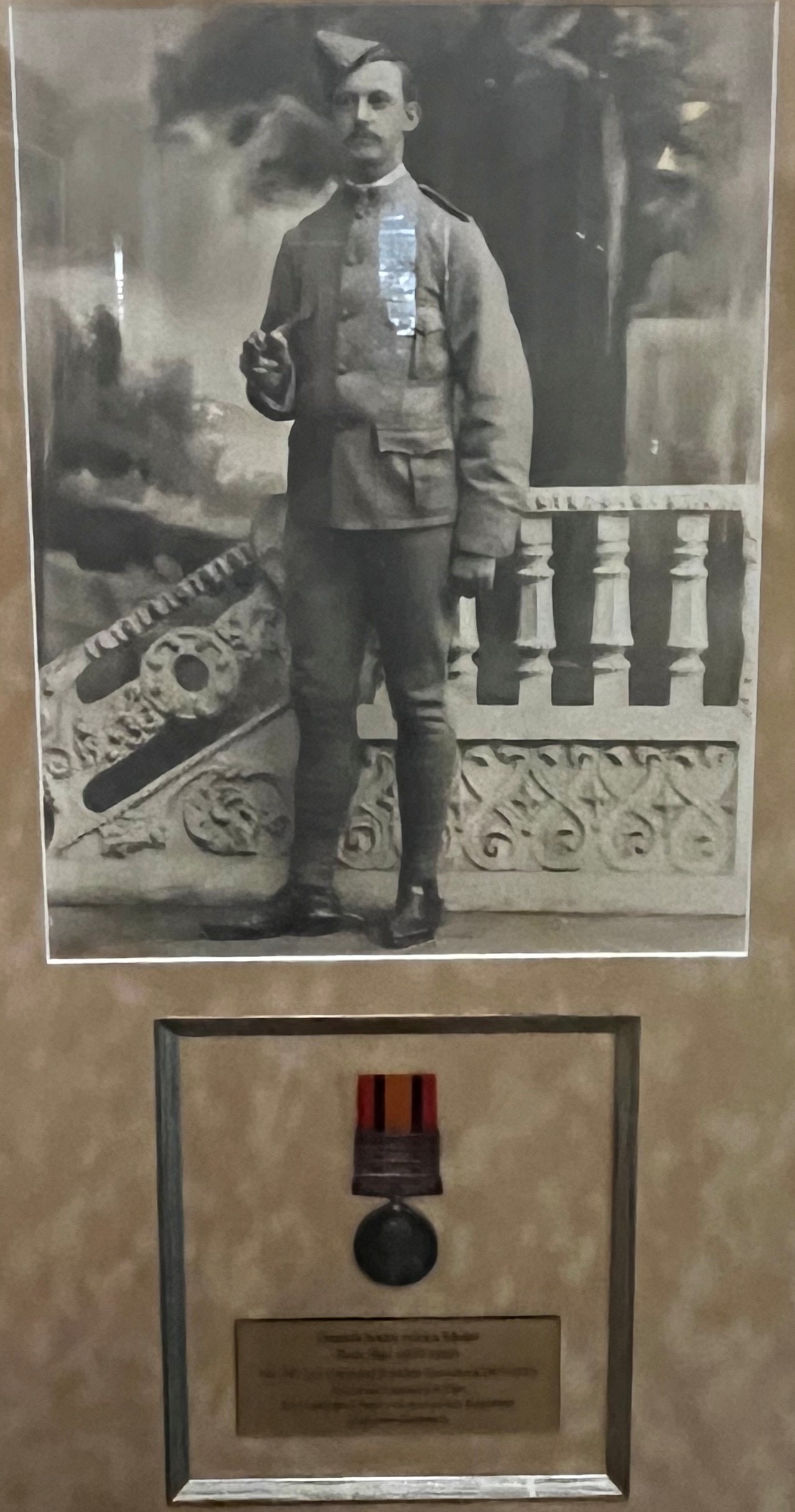
Edward Trevithick, a resident of Brighton at the end of the nineteenth century, a colonial volunteer and soldier of the Queen, was born in Beaconsfield, Tasmania in 1878.
 By 1900 Edward was living and working in Brighton, Victoria. The municipal rate book for that year records his home address as Emily Street while Church Street is given as his place of work where he was a saddle and harness maker.
As a member of the Brighton community, Edward already contributed to that notion of volunteering prominent in the mid- nineteenth century ethos of what it meant to be a Victorian … namely habits of hard work, self-improvement, community service, respectability and seriousness of character. Volunteering was a response in the colony of Victoria to fears of invasion – Russian, growing German and Japanese influence in the Pacific, even Chinese, which saw Melbourne defences Victoria referred to as Australia’s ‘Gibraltar of the South’. To that end bayside permanent fortifications were strengthened and completed, battery sites built, and rifle companies raised together with the formation of artillery and cavalry units.
Edward’s volunteer commitments saw him belonging to the Garrison Artillery (A’ Battery, Field Artillery Brigade), the Victorian Mounted Rifles and the local fire brigade. When he enlisted as a Boer War volunteer in 1900, he presented as the typical Victorian to come forward. He was Protestant (Wesleyan), single, 23-years old, a saddle and harness maker with a city address.
Edward was part of the second of four Victorian waves of recruitment for South Africa service, joining the 4th Imperial Bushmen (4IB) contingent. This was raised at Imperial request and was the responsibility of the Home Government in all matters of pay allowances and pensions. The contingent was made up of five mounted rifle squadrons under Lieutenant Colonel Nicholas William Kelly with an original strength of 631. The Bushmen units were men who could shoot and ride – seen as valuable attributes for veldt service against mobile Boer commandos. The period of service, for at least 12 months or the duration of the war, mainly drew from a cohort of men from rural occupations. There was a wide belief in the bushmen’s ability ‘to ride, to endure, to improvise and to find his way’ and it is easy to see that they took with them the romanticism imbued by 1890’s literature. Edward’s membership of the Victorian Mounted Rifles, his occupation as saddle and harness maker and with local artillery experience was perfectly equipped for service with the 4IB.
Recruitment was eagerly subscribed, indeed there was intense competition to fill advertised placements. Victoria had over 4000 volunteers from which to select 620 … applicants so numerous as to be an embarrassment to recruiting officials. Edward attested in Melbourne on 24 March 1900 and is described as almost six feet tall, with grey eyes and fair hair.
Upon recruitment there were medical tests, riding tests at a half-mile track in the Domain and musketry tests at the Williamstown Range. From there the Bushmen were sent to Langwarrin Military Reserve for training. The Imperial Bushmen were more fortunate than other contingents in that they had a month or more of basic training.
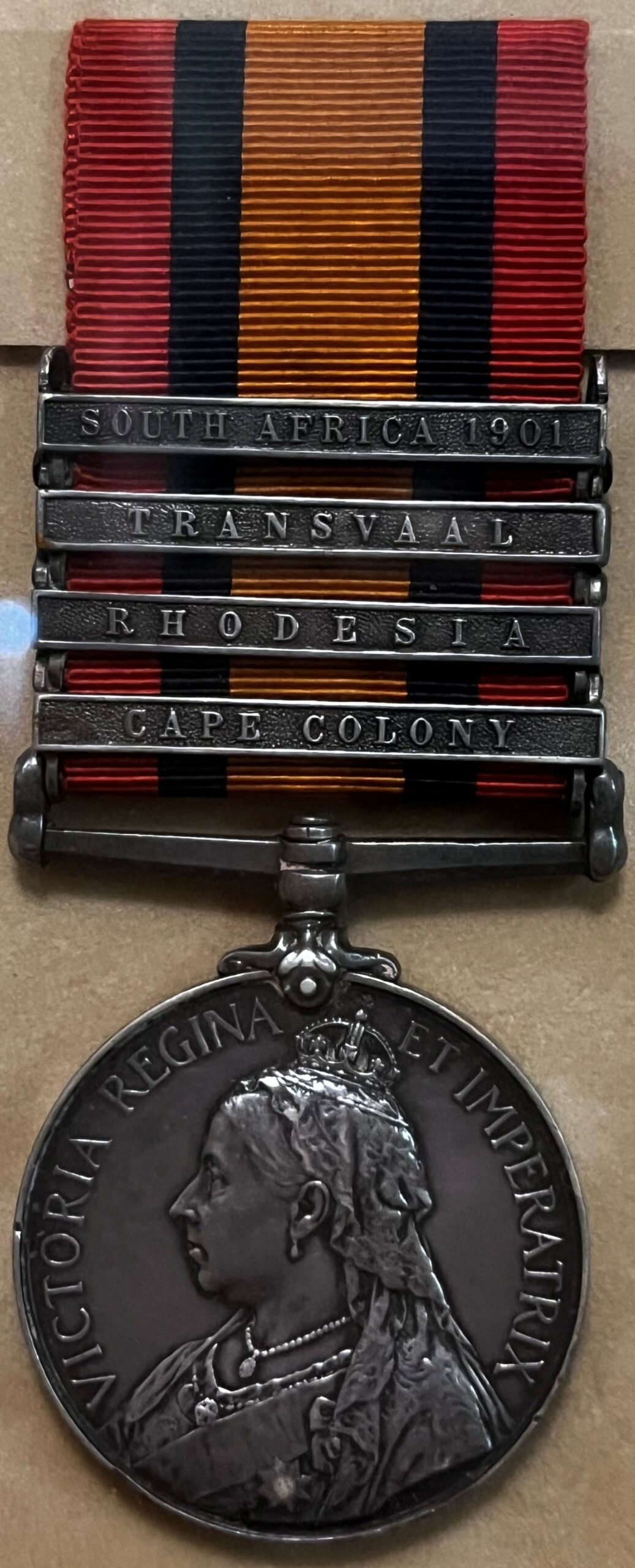
The contingent left on 1 May 1900, by the transport Victorian, and arrived on 23 May at Beira, in what is now Mozambique, disembarked, entrained to Umtali, and marched to Marandellas on 11 July to join the Rhodesian Field Force. The Bushmen travelled across Rhodesia to descend to the South Africa battlefields from the north, fighting in the western Transvaal, then driving the Boers out of Cape Colony before heading north to the capture of the last Boer capital, Pietersburg, in 1901. In most of their actions the Australians served alongside units from Britain or other Colonies. Scouting and small patrols were a common employment. ‘A’ and ‘B’ squadrons, (Edward’s squadron) under Lieutenant Colonel Kelly, were sent to Bulawayo, and thence by rail to Mafeking. They were then dispatched to Ottoshoop, and formed part of Brigadier– General Lord Erroll’s Brigade, under Lieutenant– General Sir Frederick Carrington.
The Bushmen’s areas of service are mirrored in the clasps on Edward’s Queen’s South Africa (QSA) medal. Casualty lists show that as mounted troops the Australians were constantly engaged in fighting the commandos and matched them in horsemanship and bushcraft.
While the volunteers were en route to South Africa and serving their time, their letters home kept their names and exploits in public consciousness. A letter of 19 July 1900, was received from Lance Corporal Trevithick writing from Marandellas (Southern Rhodesia) and detailing the Australian Imperial Bushmen’s trip and doings to date, was published in the Brighton Southern Cross newspaper.
The Bushmen faced many privations and diseases including black water fever, a vicious strain of malarial fever, dysentery and enteric fever (typhoid). Edward was hospitalised with enteritis on 6 January 1901; he subsequently recovered, unlike very many others who sadly perished. Reports of that time noted they were burying the dead at a rate of 20 men daily from enteric fever. Much care also was taken in looking after their horses. They had to be protected from a disease called ‘blue tongue’ and to be shielded from tsetse fly bites which meant death to horses.
The importance of a saddler and his craft was most important to the citizen soldiers in South Africa. Despite earlier problems with saddlery, the Victorian saddle furniture ‘won golden opinions all over Africa … It is generally admitted that we have the most serviceable saddlery in South Africa … I don’t think my squadron saddler has had a bridle to mend since the Regt left Victoria … I have done nearly 700 miles with my squadron … and at the present moment I have not had a sore back … The saddles are a great success & Victoria might well feel proud of them’ was recorded in one glowing written testimonial. Despite Kitchener’s incentives, e.g., three months furlough, promotions, etc., most Bushmen longed for return to Australia and resisted the pressure to remain on active service.
Extracts from Orders, summarised in P. L. Murray’s Official Records of the Australian Contingents to the war in South Africa 1899-1902, attest to the appreciation of the Victorian Imperial Bushmen. A number of senior war leaders, such as generals Henniker, Methuen, Erroll and Kitchener expressed thanks for the good work done in the arduous campaign. Good training and discipline, undeniable courage, overcoming difficulties, and a trek of over 2900 miles were qualities of the 4IB noted by those in command. Departing in the Orient they arrived back in Melbourne on 11 July 1901 and marched through the city to the Exhibition Building grounds where Sir John Madden, the Lieutenant Governor, awarded their QSA service medal.
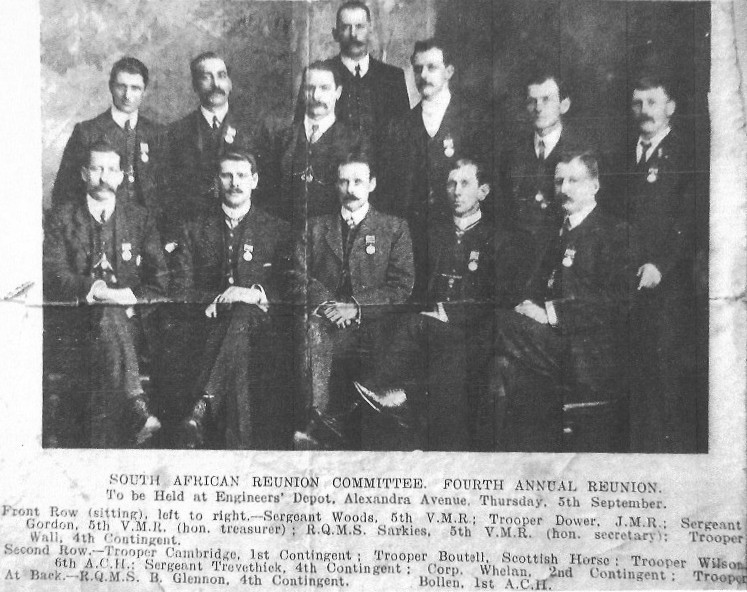
The Brighton Southern Cross of 20 July 1901 carried news of a welcome home social and coffee supper for Lance Corporal Trevithick and two others. The welcome was held on Wednesday evening at the New Street Wesleyan schoolroom, and the three returnees were welcomed as ‘old scholars of the school’ who had been fighting in South Africa. They were welcomed back into their communities. Edward married 19 months later. In January,1902 he joined the Victorian Police Force, along with 25 other veterans, as a constable. He went on to serve in many city stations including Russell Street, Carlton, Hawthorn and Essendon as well as Beechworth in north-east Victoria, resigning from the police in September 1923. The South Africa Soldiers’ Association was formed on 7 February 1908, and Edward represented the 4th Imperial Bushmen on the committee.
Edward Trevithick fulfilled a typical profile of a Victorian going to the Boer War, as both a citizen soldier and colonial volunteer. Edward’s commitment to volunteering spanned involvement in military, artillery, battery, rifle corps, fire brigade and administrative duties. Like earlier volunteers he was patriotic, socially and politically reliable and possessed of a strong sense of British heritage. His decision to live, invest and work in his local community demonstrated a vested interest in seeing the community grow. Edward displayed the characteristics possessed by earlier volunteers as evidenced by his participation in civic life. He died in Melbourne in 1932.
Anne Tan
© 2025
Bibliography
Bate, Weston. (1983) A History of Brighton. Melbourne University Press.
Bou,J.(2012) Light Horse History of Australia’s Mounted Arm. C.U.P.
Brighton Rate Book. 1900.
Bufton, J. (1905) Tasmanians in the Transvaal War. Newtown, Hobart.
Calder,W. (1985) Heroes and Gentlemen. Jimaringle: Melbourne.
Chamberlain, M. ‘The Victorians in the South African War 1899-1902’
in Victorian Historical Journal, Vol.75, No.2, Sept.2004
Chamberlain, M. ‘The men who could shoot and ride’. Unravelling the tracks of
The Australian contingents in the South African War, 1899-1902’.
Sabretache Vol.XX1X- July/September 1988
Chamberlain, M. ‘Mounting Victoria’s Boer War contingents 1899-1902’. Sabretache
Vol.XXV1 – October/December 1985
Chamberlain, M. ‘The characteristics of Australia’s Boer War volunteers’
In Historical Studies, Vol. 20, No.78, April 1982
Droogleever, R. (2009) ‘That Ragged Mob’. Trojan Press: Melbourne
Field, L.M. (1973) The Forgotten War. Australian Involvement in the South African
Conflict of 1899-1902. Thesis. Australian National University
Hales, A.A.G. (1900) Campaign Pictures of the War in South Africa. London:Cassell.
Hannan, A. (1995) Victoria Barracks Melbourne: A Social History. Australian Defence
Force Journal.
Jeffreys, M. (2011) Australia’s Gibraltar: Victoria’s Defence Heritage. AMH Publications.
Kilsby, A. (2014) The Rifle Club Movement and Australian Defence, 1860-1941. Thesis.
University of New South Wales.
Marmion & Dagg (2024) A Military History of Victoria, Australia 1830-1945: Gibraltar of
The South. Cambridge Scholars Publishing.
Marmion, B. ( 2003) The Victorian Volunteer Force on Central Victorian Goldfields,
1858-1883. Thesis. LaTrobe University.
Millar, T.B. (1957) The history of the defence forces of the Port Phillip District & Colony
Of Victoria, 1836-1900. Thesis. University of Melbourne.
Murray, P.L. Lieutenant Colonel. (1911) Official Records of the Australian Military
Contingents to the War in South Africa. Government Printer, Melbourne.
Parades/ “A” Squadron. 1st Battalion. VMR.South Melbourne:C.G.Meehan
Printers 1903.
Ryan, J.& Kemp,P. (2002) A Soldier’s Story: The Boer War to Beersheba. Kemp: Glen
Waverley.
Wilcox, C. ( 2002) Australia’s Boer War: The War in South Africa 1899-1902. Oxford.
Victorian Metropolitan and Rural/Local Newspapers [1900-1901 issues]
The Argus; Ballarat Star; Brighton Southern Cross; Leader, Melbourne; Maffra Spectator; Shepparton Advertiser.
Contact MHHV Friend about this article.