Huey is pitched not as a story of the men and machines, but rather a history of the Iroquois helicopter’s acquisition and service in Australian forces.
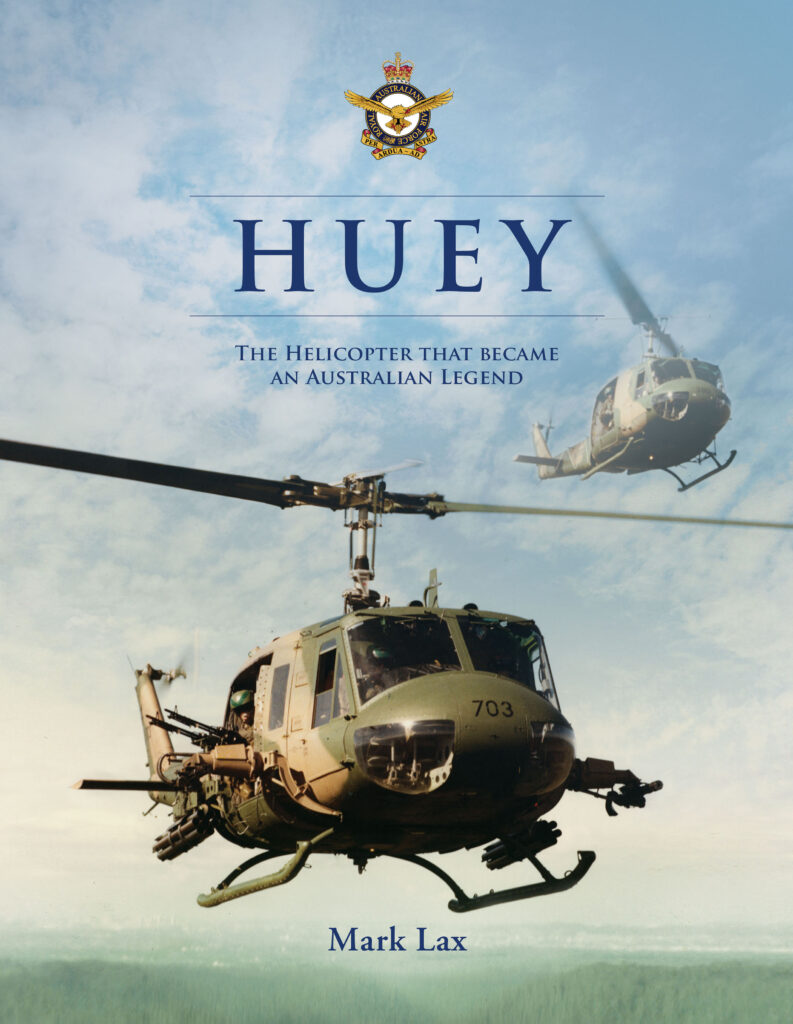
Newport, New South Wales: Big Sky Publishing, 2025
231 pages; hardback A4; $69.99
There are therefore tables and statistics galore, but interspersed throughout there are also various stories of some of the decision-makers; many of the notable incidents in which the Huey was involved, and anecdotes aplenty of the numerous types of service in which this versatile machine was involved.
Whoever thought up the helicopter must have had a unique mind. Those whirling and thrashing blades are not just a giant mechanical spin dryer. The main rotor blades are aerofoils – wings in their own right.
Although Chinese toys of the 5th century are said to have resembled helicopters in flight, many credit Italian genius Leonardo da Vinci with the first credible designs. A host of others followed, including some who may have launched credible unmanned craft, but it was likely In July 1901 the maiden flight of Hermann Ganswindt’s helicopter took place in Berlin, with at least one human passenger. It is probable the French brothers, Jacques and Louis Breguet, successfully flew their Gyroplane No.1 around September 1907 for a one minute flight, although it remained tethered.
Around the world others were experimenting, but nothing significant developed in the Great War years, and it was not until 1924 that Frenchman Étienne Oehmichen flew his quadrotor helicopter – with four rotors, like many modern drones, for a distance of 360 meters. Military interest world-wide was evident, and the US Army supported inventor George de Bothezat with his quad-rotor helicopter for their Air Service until cancelling the program in 1924. In 1928, Spanish aeronautical engineer and pilot Juan de la Cierva flew his invention of the autogyro across the English Channel.
As WWII dawned Heinrich Focke at Focke-Wulf designed the twin-rotor Fw 61. Its flight in June 1936 began some of the German military’s use of the technology, but it was limited to small-scale participation in the conflict. It was in the USA that Russian-born engineer Igor Sikorsky in 1939 developed the VS-300 which settled on the classic design of a single small rotor on the tail boom.
The R-4 followed with 100 aircraft, serving in difficult terrain such as Burma and Alaska. The R-5 and the R-6 were next, with over 400 machines developed by the end of the war. In the 1950s, a radical engine replacement concept swept through the world of helicopters: the piston-engined design was replaced by a turboshaft engine, a much lighter powerplant giving a much better power-to-weight ratio.
Australia had been looking with interest at the new flying machine since the 1930s and in fact acquired four Cierva autogyros from September 1934. One was evaluated briefly by the RAAF. In WWII the Army looked with interest at helicopters for use in jungle areas, and the RAAF followed on, but nothing eventuated.
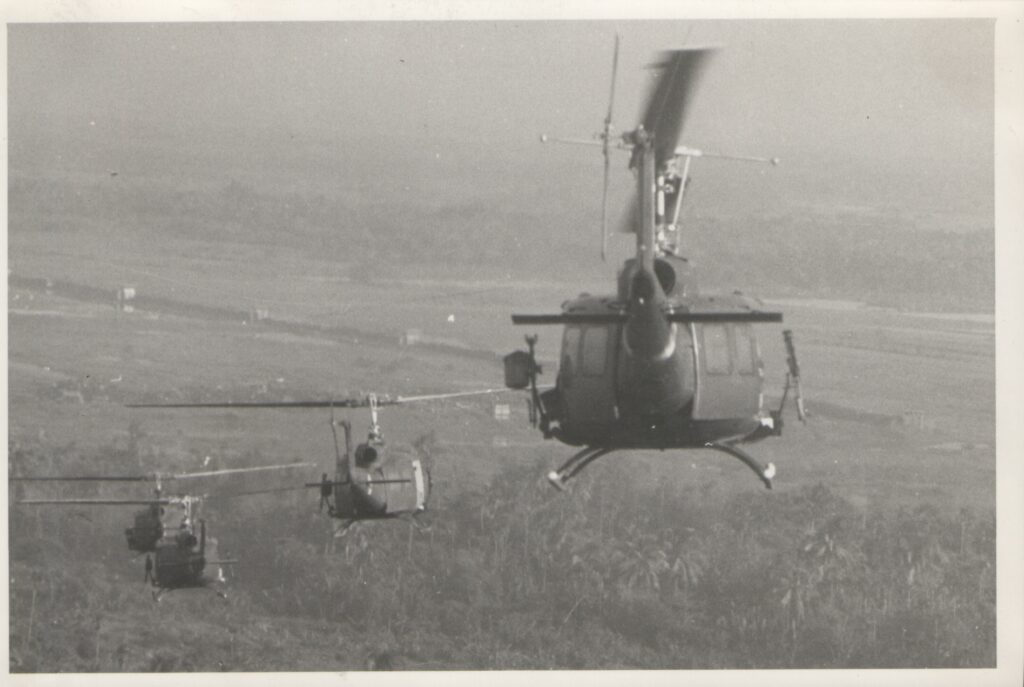
In military terms the ability of the helicopter to penetrate rough terrain was an obvious plus. Fixed-wing machines, with their need for forward speed to prevent a stall, found it very difficult to land men and equipment into such locations as valleys, hilltops, or heavily wooded areas. The helicopter, with its ability to hover, was ideally suited to such roles. Where it could land these, it might drop explosives or use guns. At sea could it attack ships or chase submarines?
The transport role was also uniquely suitable for the helicopter, given its ability to land – and take off – from small spaces confined by trees – and so from jungle or forests in battle areas. It was in the medical evacuation role during the Korean War, as the MASH movie and TV show showed many, that it came into its own.
Some interesting chapters in Huey outline further tinkerings around the edges by the armed services to acquire helicopters, and then why the Iroquois was chosen, which incidentally was initially known as “Huey” after its initial designation of Helicopter, Utility, 1.
This book is a work of 17 chapters, and four appendices. One chapter covers the Iroquois’s first deployment to active service, which was to Malaya, then transitioning from its time as a British colony to a full-fledged nation. A communist insurgency was threatening this, and British and Australian forces were involved.
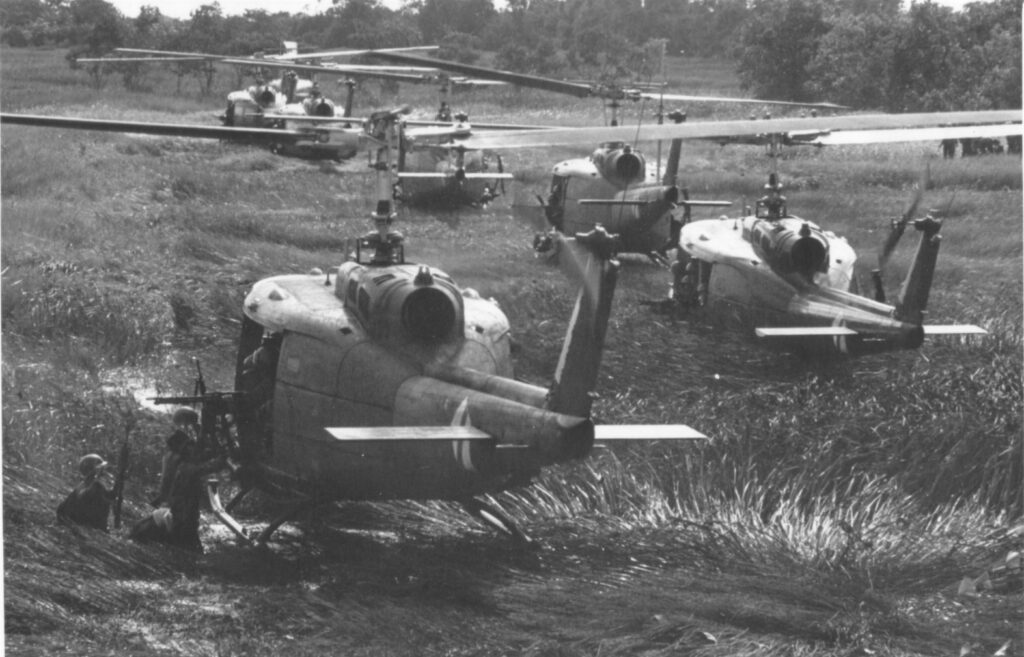
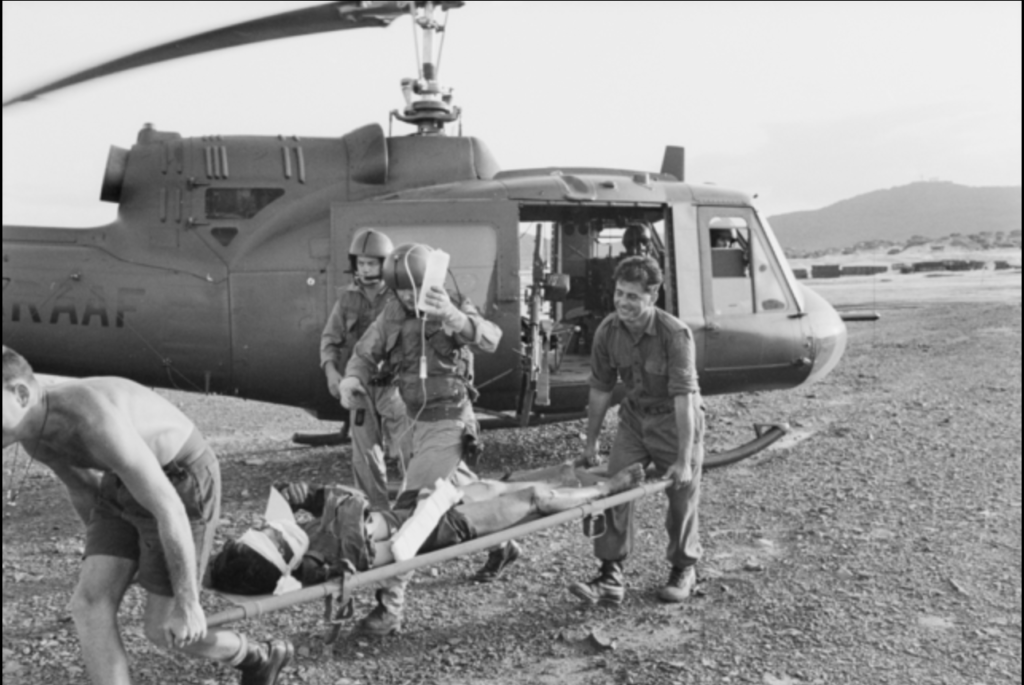
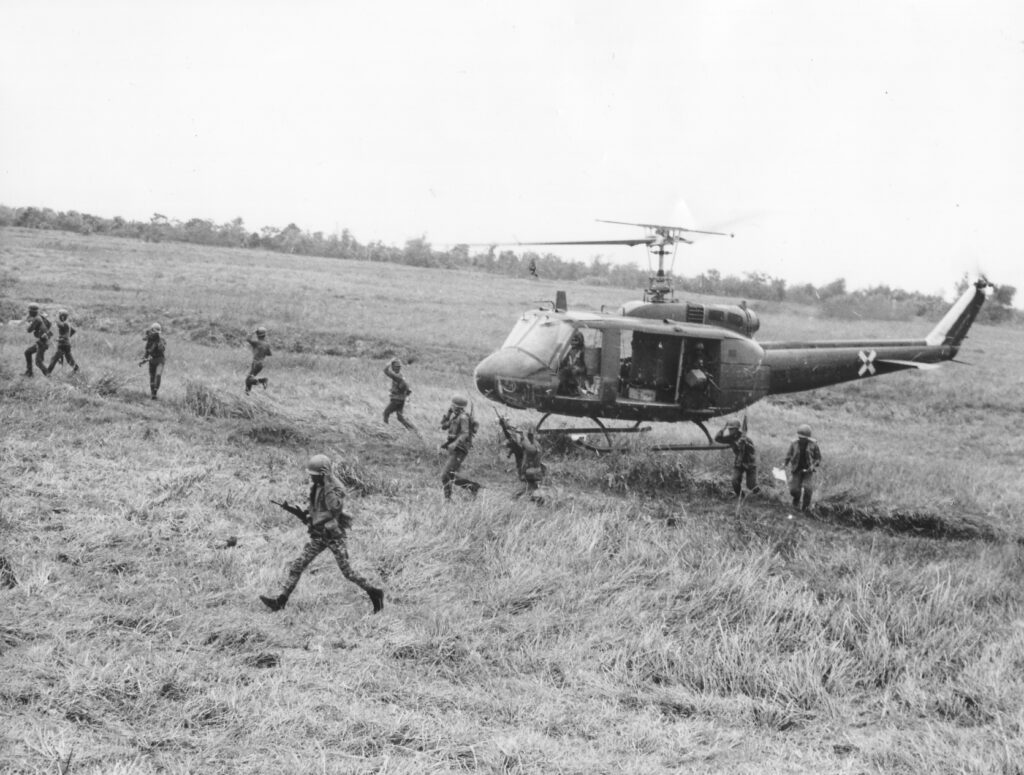
Two chapters cover the Vietnam war – substantially a helicopter war – in service as an air cavalry mount; a gunship, and a transport, including as a medical “dust-off” machine. Unusually, the Royal Australian Navy deployed a flight there alongside the RAAF, having by then its own 723 Squadron flying from ships. The Army’s Special Air Service was an important utiliser, developing fast-rope insertions and then extractions; the latter while often under gunfire.
There is a short subsequent chapter for a “maybe helicopter”, the Cobra, which was used very capably in Vietnam as a US gunship. In the end, largely due to government procrastinating, the opportunity to acquire this machine was not taken up, although as the author notes, there are four in Australia in museums.
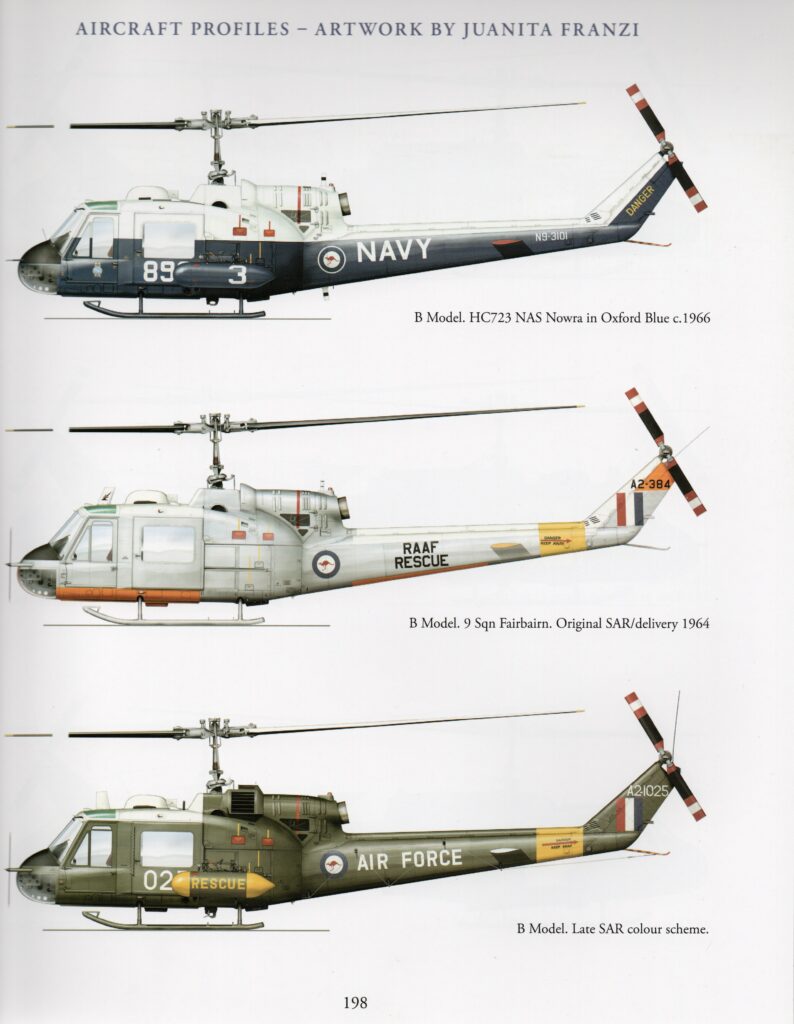
Final chapters cover some of the acquisition of other helicopters in Australian armed services, such as the Black Hawk. Chapter 17 list “where are they now?” for each Iroquois, and in a section which will be enthusiastically greeted by modellers, there are several pages in magnificent colour showing the paint schemes of the Iroquois’s livery in Australian service, with artwork by Juanita Franzi. Sadly there follows a list of those who died in Huey helicopter operations – in all Services – in Vietnam and in accidents. Appendices Three and Four covers all Iroquois in Australian service and what happened to them.
This is a work of considerable scholarship: there are substantial endnotes for each chapter; a bibliography, and an index.
The author is certainly the best man for the book. He is a retired air commodore of over 50 years service in the Royal Australian Air Force. He has completed a Masters degree and a doctorate in military history. So far Dr Mark Lax is the author or editor of 15 books, including the editing of a WWI airman’s diary – One Airman’s War; and the substantive recording of the F-111 bomber’s story in its time in the RAAF.
This is the definitive story of a very interesting helicopter in Australian service, and highly recommended.
-o-o-O-o-o-
Dr Tom Lewis OAM is a military historian. His most recent book is Australia’s Coastal War (Big Sky), analysing all of the submarine, surface, and air attacks around the country in World War II.
Contact MHHV Friend about this article.