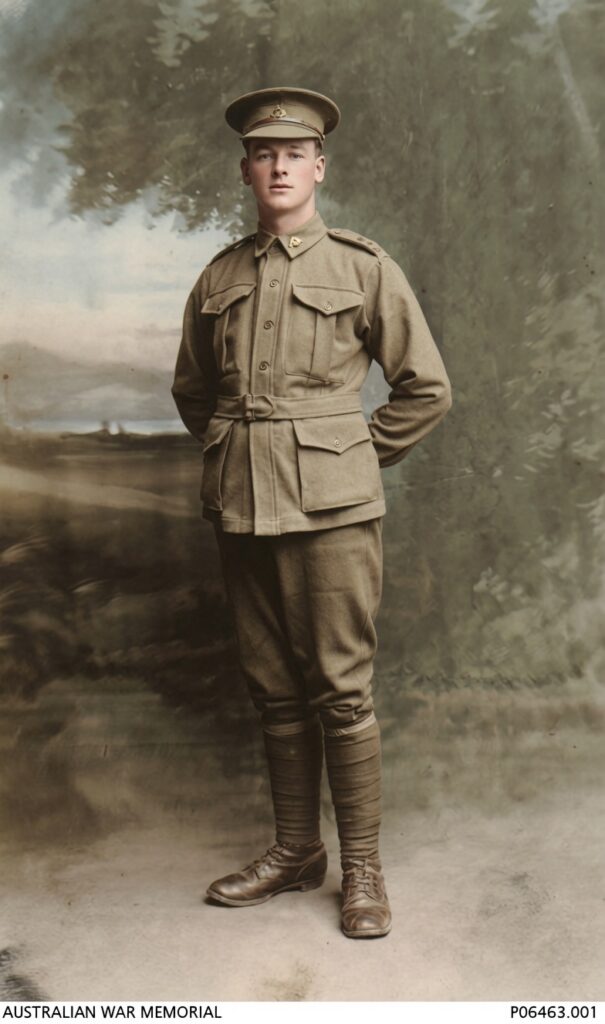
151 Private Henry James Wright.
 ‘I found the letters in a cardboard box.
I read the words, and the ink was frail and brown.
The paper dry after so many years of being kept.
The letter was from a soldier from the front, conveying his love and disappointed hope.
Of getting leave, ‘it’s cancelled now,’ he wrote.
My luck is at the bottom of the sea’ Adapted from ‘The Son’ by Clifford Dyment.
On the twenty-eighth of June 1914, the world was about to be cast into one of the blackest periods in human history. All it took was one idealistic 19-year-old Serbian Revolutionary, Gavrilo Princip, to shoot and kill Archduke Franz Ferdinand and his wife Sophie during an official visit to the Bosnian capital of Sarajevo. Ferdinand was the presumptive heir to the Austrian-Hungarian throne, and the assassination would begin the drums of war to beat throughout the world, forcing various nations to choose sides or remain neutral. Germany declared war on Russia and France, Russia on Germany then Great Britain on Germany. Just to complicate things even more, Japan, because of its alliance with Great Britain, also went to war against Germany. The often-referred-to as ‘The War to End all Wars’ would result in over four years of terrible hardship, death and destruction on a scale never before witnessed in human history. More than sixteen million lives, both military and civilian, would be lost. The guns would finally fall silent on the eleventh hour of the eleventh month of 1918.
When news reached Australia that England had declared war on Germany on 4 August 1914, the then Prime Minister of Australia, Joseph Cook, said simply, ‘When Britain is at war, so is Australia’. Politicians on both sides of the political spectrum, in a rare show of solidarity, were unanimous. ‘Australia was with England to the last man and the last shilling.’ This fine patriotic rhetoric was not, however, shared by a sizeable percentage of Australians who were opposed to sending anyone off to fight in a World War. Nevertheless, those against Australia’s involvement were, in the early stages of the war, far outnumbered by those who felt that ‘the mother country’, as England was known at the time, needed help. As patriotic fever spread throughout Australia, tough decisions were being made in the halls of government and by men of the general population. New Zealand’s Governor, Lord Liverpool, followed Australia’s declaration by announcing on 5 August that the Dominion of New Zealand was also at war with Germany. Other Commonwealth countries also followed the call to arms, declaring allegiance with Britain.
Now, with the dogs of war unleashed, Australian and New Zealand men of varying ages began queuing outside recruiting offices in vast numbers, eager to join the fight against the evil German Empire. Throughout the war, most of those who served from both nations were volunteers. Initially, they saw the war as an adventure, a crusade, and a chance to prove that they, the men of both young nations, could play a role in world affairs for the first time. This joining of the two nations would later evolve on the battlefields of Gallipoli to become known as Anzacs. The actual word ‘Anzac’ is an acronym that stands for Australian and New Zealand Army Corps, the name given to the body of troops raised by the two countries.
With the surviving correspondence and a few minor spelling and punctuation changes, the following is a chronological timeline portrait of four sons from the Wright family who enlisted to fight for the King and country.
Edward and Marion Wright lived at No. 6 Winfred Street, North Essendon, a suburb of Melbourne, in the Australian state of Victoria. The family consisted of seven sons and two daughters. Henry, [the eldest] Albert, Gordon, Frederick, Leslie, Charlie, Walter [married] Florence [married] and Elizabeth. Gordon, the youngest, would go on to serve in World War Two. They were a happy, close-knit family, but the looming war would begin to unravel their lives as it would for so many other families and relationships worldwide.
Twenty-six-year-old Henry Wright’s decision was final. No matter what his fiancée, Pauline Vale, said, or his parents, or any of his six brothers and two sisters. He was determined to enlist. War had been declared, and Australia needed men to fight. Besides, he argued, it was his duty to go. Henry traded the comfort of the family home for the spartan life at the Army barracks in Broadmeadows, a northern suburb of Melbourne. On 1 October 1914, Private H.J. Wright, regimental number 151, A Company, 14 Battalion, Australian Imperial Forces, began over two months of training.
While thousands were queuing up outside military enlistment offices in Australia to fight the evil Germans, one event in early August would change the coming war’s initial dynamics. Britain commandeered two warships that had been built in England for the Turkish navy for the coming war. Five hundred Turkish troops had arrived in England to sail the ships home. Turkey, at the time, was neutral, but this blatant act led the Turkish government to side with Germany. Their first act was to close the Dardanelles to Allied shipping.
The sixty-six-kilometre-long Dardanelles Straits is a narrow body of water beginning in southwestern Turkey that links the Aegean Sea to the Sea of Marmara. Known in ancient times as the Hellespont, the strait is only six kilometres at its widest point, with depths varying to a maximum of eighty metres, with the water flowing in both directions. From its mouth at Cape Hellas to the Sea of Marmara, the narrow waterway is bounded by the Gallipoli Heights and by many lesser hills. The entrance to the straits was guarded by four forts, two on either side. Seventeen kilometres up the straits was another series of forts and a single line of sea mines strung from shore to shore. At the Narrows, just twenty-two kilometres from the entrance, the channel has a width of less than one thousand, four hundred and sixty-three metres and is protected by more forts.
Britain and France, having strategic interests in the Dardanelles Straits and an alliance with Russia, had no choice but to declare war against Turkey on 5 November. It is purely conjecture, but if the British had not acted so irrationally, the whole Gallipoli Campaign might have been avoided. Nevertheless, the deed was done, and the dye was set.
Three days after Britain declared war on Turkey, British and French ships shelled the Dardanelles’ outermost forts, and after a twenty-minute bombardment and two lucky hits, the outer forts of Kum Kale and Seddülbahir were put out of action. This, in turn, gave the Allies a false sense of their ability to destroy all the forts and all but advertised they might be planning at some point soon, to attempt to seize the entrance and sail up the strategically vital Dardanelles Straits and attack Istanbul and possibly force Turkey out of the war. Turkey, now on a war footing, began strengthening the Dardanelles Strait defences, including shore-fixed torpedo tubes and the placement of an assortment of artillery pieces of varying calibres and increasing the sea minefield. In theory, the British campaign offered good prospects for success; therefore, an initial landing at Gallipoli was planned for an inland attack.
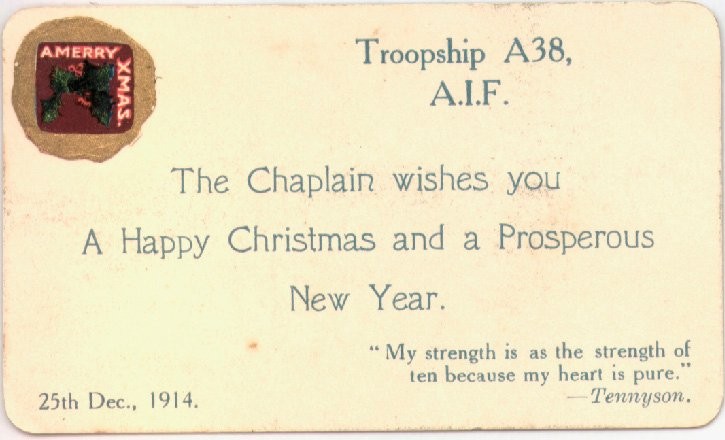 Whilst these international events were taking place, Henry managed to get compassionate leave and married Pauline on 12 December 1914. Twenty days later, the groom and the 14th Battalion, including the 13th Battalion and 4th Brigade Headquarters, sailed from Port Melbourne aboard the fifteen-thousand-ton troopship A38 Ulysses bound for Albany in Western Australia. From here, Ulysses is in the lead position of a convoy of eighteen other transport ships carrying both Australian and New Zealand troops bound for the Middle East. The convoy’s only armed escort was the E-class Australian submarine A.E.2, which later had the distinction of being the first Allied submarine to enter the Dardanelles Straits. This daring action took place on 25th April 1915, the same morning the Anzac troops went ashore at Gallipoli. The A.E.2 was sunk by the Turkish gunboat Sultan Hisar five days later. Fortunately, the entire crew survived and were taken prisoner, but four crew members died during captivity.
During his military service, Henry became a prolific writer and sent many letters and postcards home. Unfortunately, only a few of these have survived, and it is difficult to establish a timeline narrative because many have had dates, events, and locations removed by the military censors. What remains, however, contains enough information to piece together a portrait of a man of simple dignity written over one hundred years ago with sensitivity and showing the close family bond.
As the war progressed, his later correspondence begins to show his initial patriotic enthusiasm for the war slowly turning to disillusionment and his frustration at not being able to return to Australia after continuous fighting for over three years. Whilst Henry’s letters and postcards predominate, his three brothers’ letters are included as they too served the nation.
Henry Wright’s service life and experiences begin with the following correspondence with his mother. Unbeknownst to the soldiers and sailors of the convoy, Europe was not to be their initial destination, but the rugged shrub-covered cliffs, ravines, and gullies of Gallipoli on the Turkish coast near the Dardanelles entrance.
29 December 1914, Albany, Western Australia.
From Private H. J. Wright, 151 A Company XIV Battalion. Australian Infantry Brigade, England.
‘Dear Mother,
All is well. Cannot write any particulars. Love to all. Your loving son, Harry. Write top address’.
No date or location.
On Active Service. No Stamps available.
‘Dear Mother,
Just a line to say I am well and having a good trip. We are not allowed to write any particulars as to our whereabouts, but will write all when we reach our destination. With kind regards to all, I remain your loving son, Harry’
No date or location.
On Active Service. No stamps available.
Mrs M. Wright, 6 Winifred Street, Essendon.
‘Dear Mother,
Just a few lines to say I am well and having a good trip. We are not allowed to write any particulars as to our whereabouts. I will write you a letter as soon as we reach our destination. Wishing to be remembered to all, I remain your loving son, Harry.
Address letters, No 151, Pte H J Wright 14th Batt A Coy A I F, 4th Australian Infantry Brigade, England’
January 1915. Postcard. Colombo, Ceylon. [Modern-day Sri Lanka]
‘Picture of Sacred Tree, Ceylon.’
It’s possible the postcard was that of the Jaya Sri Bodhiya or Bodhi Tree. Buddhist devotees consider this to be a very sacred object, and it is in the city of Anuradhapura, approximately 127 miles [205 km] north of Colombo.
January 1915. Ceylon.
On Active Service. No stamps available.
Mr A. Wright, 6 Winifred St, Essendon.
‘Dear Bert,
Just a line to say all is well, having a good trip. Yours sincerely, Harry’
January 1915, Suez Canal, Egypt.
On Active Service No stamp available.
‘Dear Father,
Just a card to say all is well and having a splendid trip. We are just about to go through the Suez Canal. Clark is on this boat. Often have a talk with him.
I remain your son Harry’.
January 1915. Suez.
On Active Service. No stamps available.
‘Dear Mother,
Just a card to say all is well and having a splendid trip. We are just about to go through the Suez Canal. I will write you a few lines as soon as we reach our destination. Remember me to all. I remain your loving son, Harry’.
January 1915. Port Said, Egypt. Postcard.
‘Dear Mother,
This is the entrance to the canal from Port Said. We stopped for a day and night but were not allowed to go ashore. Your loving son Harry’.
January 1915. Port Said. Postcard.
‘Dear Mother,
This is a drinking fountain at Port Said. We came through on our trip over. Hoping all are well at home, your loving son, Harry. Letter following’.
The convoy made a series of brief stops at Colombo, India, on January 13, followed by the Egyptian ports of Aden, Suez, and Port Said, and finally arriving in Alexandria on January 31, 1915. After some time in the area, half the Anzac troops disembarked and were transported that night by train to a training ground known as the ‘Aerodrome Camp’ outside Heliopolis, a suburb of Cairo. The remaining troops followed the next morning.
For over ten weeks, the Aussies and Kiwis trained together, sweltering in the desert heat during marching exercises, practising field craft, rifle practice, kit inspection and the army’s obsession with parades. They began to toughen up to endure hardship in an unforgiving environment and formed a camaraderie, a band of brothers. When leave was available, they would have used the electric tram service from Heliopolis to Cairo to visit the tourist attractions, bars, and seedy brothels.
Regarding the subject of Cairo’s houses of ill repute, the ‘Battle of the Wazzir’ was the name given to a riot that took place on 2 April 1915. It involved Australian, New Zealand and British troops in and around a street called ‘Haret el Wasser’, which was part of the Wagh El Birkit brothel and bar district of Cairo. Historian estimates vary, but there may have been four thousand troops [ two thousand, five hundred were believed to be Australians] involved at the height of the riot, many obviously drunk. Tension had been building over time with complaints of increased prices for the use of the ladies’ charms, adulterated or poor-quality drinks, possibly even urine in the beer, rampant venereal disease, theft, and numerous other real or imaginary complaints.
There are conflicting reasons as to why the riot started. The first favourite contender begins with rumours that an Australian soldier had been beaten up by local thugs. The second is of an English soldier finding his sister working in one of the brothels.
So, the story goes, the sister is purported to have arrived in Cairo after having accepted a position as an au pair or domestic, but was instead forced to work as a prostitute. If true, the sister would have been a victim of the white slave trade active at the time. The brother, in attempting to remove her from the establishment, was forcibly ejected out of a window. Irrespective of the real circumstances, the build-up of frustration among the troops had, at last, found an outlet. At about 4 pm, the rampage began. Furniture was destroyed, prostitutes and pimps were thrown out into the street, a brothel or brothels were set on fire and the firefighters attempting to extinguish the flames were assaulted possibly to prevent them from extinguishing the fires. The riot petered out at about 10 pm.
In his excellent book ‘Bully Beef and Balderdash, author and historian Graham Wilson made a detailed study of the riot and suggests the real reason grew out of an incident arising from two or three disgruntled Australian soldiers. Wilson writes that they were trying to extort money from some prostitutes whom they claimed had given them venereal disease.
After everything had settled down, three hundred and twenty-two Australian soldiers were sent home for disciplinary reasons. How many of these participated in the riot is unknown, but in retrospect, as the war progressed and the horrific death tolls increased, they may have been the lucky ones.
A second riot took place on 31 July and again involved Anzac troops, and a third in February 1919, but this was a British affair. It is unknown where Henry was at the time of the first riot. In camp, rioting or indulging in his love of sightseeing, as indicated by the following.
- No date. Cairo. Postcard.
‘Dear Mother,
This is Cairo. I am sending you this just to give you an idea of how big the place is and how different the buildings are to our style. I do not know the population, but it must be enormous. I think there are people of every nation living here. I will send you more postcards in a week or two. I remain your loving son, Harry’.
- No date. Cairo.
‘I am sending you a couple of leaves from the Holy Tree that I got myself’.
Henry was possibly referring to the ‘Virgins’ tree situated at Matariya near Heliopolis.
April 1915. Cairo.
‘Dear Mother,
We are just about to steam away. I will write as often as we are allowed. I am quite well again. I wish you all goodbye and will try and do my best for my country. I remain your loving son, Harry’.
April 1915. Cairo.
‘Dear Mother,
Just a line to say that today we are leaving Egypt. We are now on board the boat. We are not allowed to state where we are bound for, but you are sure to read in the papers. I will write as often as I can. This card is of the Holy Tree where the Virgin Mary rested. The other two are the Holy Well and the Church, these places are twenty
-minute walk from our last camp. I will now close by wishing you all the best of health, and rest assured, I will do my best if I get the chance. I remain with fondest love to all, your loving son Harry’. Meanwhile, back home, Henry’s two brothers, Fred, aged 18, and Albert, aged 20, had, on 7 April 1915, also enlisted and been assigned to the 21st Battalion.
Henry’s reference in his letter to the ‘boat’ was the SS Seang Choon, a five thousand-ton Rangoon registered trader which departed Cairo on April 13, arriving in Mudros harbour at the Greek island of Lemnos in the afternoon of 15 April. Lemnos is the eighth largest of the Greek islands, situated 31 miles [50 km] from the Gallipoli Peninsula and played a pivotal role in the entire Gallipoli campaign. This was where the troops practised landings, where the Allied troops embarked for the battlefield and when wounded or sick, returned to before onward transfer to hospitals in England and Malta. It was also to become the first stop for the troops before being transferred to the Western Front in France after the evacuation from the Gallipoli beaches. Sadly, the islands’ historically key role in the entire campaign has been overshadowed by the concentration of events on Gallipoli.
By April 21, around two hundred ships had gathered in Mudros Harbour. The British force’s focus would be an amphibious landing force at the southern part of the peninsula at Cape Helles and Sedd el Bahr. The recently trained Australian and New Zealand troops were to join the British forces in the landing. The British 29th Division would land on five separate beaches, and the Australian and New Zealand Army Corps would make a subsidiary landing about twenty kilometres up the coast north of Gaba Tepe and seize the southern part of the Sari Bair ridge before advancing across the peninsula to Maidos. From there, they could mount a threat to the Kilid Bahr plateau from the rear. The French division would, in the meantime, make a temporary landing at Kum Kale on the Asian side of the peninsula. This would prevent Turkish gunners there from bombarding the troops landing at Hellas. To divert Turkish attention, the Royal Naval Division would make a sham attack at Bulair at the narrow neck of the peninsula.
The landings were originally scheduled to take place on 23 April 1915, but adverse weather delayed them for two days. The first Australians ashore were members of the 3rd Brigade, which was to land before dawn and advance to Gun Ridge. Following them, the 2nd Australian Brigade would occupy Sari Bair Ridge as far as Hill 971. The 1st Australian Division’s remaining Brigade would land by 9 am. With the covering force in place, the New Zealand and Australian Divisions would join them, and the drive across the peninsula would begin.
Even with the best-laid plans and perfect conditions, things can and often go wrong. In the case of the Gallipoli campaign, it was ill-conceived from the start. General Sir Ian Hamilton, in charge of the Mediterranean Expeditionary Force, had about a month to finalise plans for the landing of troops on the rough coastline of the Gallipoli Peninsula. Although the Turkish high command knew the enemy would eventually come, the exact landing locations were unknown. There was much improvisation in the weeks preceding the landings and little time to practise. The invading forces were not even fully equipped, especially with supplies of ammunition. There may also have been a fatal degree of complacency by the British about the fighting ability of the Turkish defenders. This was a very delusional view considering the Turkish defenders would be fighting an invader of their homeland. Unseen in the early morning darkness on 25 April 1915, an invasion force of three battleships, HMS London, Queen and the Prince of Wales, troop transports, and destroyers arrived off the Turkish coast at the Gallipoli Peninsula.
From Tony MacDougall’s narrative history ‘Australians at War’, he wrote and quoted here in part that on Sunday, 25 April 1915, an amphibious assault force comprising British and French troops went ashore at their planned respective points, but for the Australian troops, something went horribly wrong. The Australians, strangely silent for such a rowdy bunch of soldiers, began climbing into the ship’s boats from the battleships in the pitch darkness of early morning hours. Royal Navy steam-powered pinnaces towing troop-laden row boats began chugging towards the shore. There was no moon, and the sea was like glass.
As they made for land, a naval officer in the north noticed that those to the south of him [starboard] were making a northerly course, one that would bring them to land too far north of Gaba Tepe, their originally planned landing point. It appears that several pinnaces mistook the small headland of Ari Burnu for Gabe Tepe and began steering towards it when the station keeper in the south tried to head them off. They mistook his intent and headed even further north. Between 4-29 and 4-45 am, the first-row boats grounded on the shingles and the Australians of the 3rd Brigade leapt into the water and began to flounder through the shallows onto the shore. There was no broad beach, just a stretch of shingle beneath sloping cliffs on which shadowy figures could be seen on the crests. ‘Tell the colonel the damn fools have landed us a mile too far north’ a naval officer shouted but then firing broke out and men began to fall. They had landed at Ari Burnu, well off course, and had no choice but to make the best of the situation. Whatever the real cause was behind the pinnaces going in the wrong direction, it was to be a disastrous mistake. There are a few theories why the Australians landed at the wrong place. The tides, faulty navigation, a belated change of orders or an unauthorised change of direction by one of the midshipmen commanding the leading steam pinnace resulted in the others following.
One soldier, Private Facey, possibly from the 3rd Battalion A.I.F., describes the landing from his perspective: ‘All went well until we were making the change into the rowboats. Suddenly, all hell broke loose; heavy shelling and shrapnel fire commenced. Bullets were thumping into us in the rowboat. Men were being hit and killed all around me. When we were cut loose to make our way to shore was the worst period. I was terribly frightened. The rowboat touched bottom some thirty yards from the shore, so we had to jump out and wade onto the beach. The water in some places was up to my shoulders. The Turks had machine guns sweeping the strip of beach where we landed- there were many already dead when we got there. Bodies of men who had reached the beach ahead of us were lying along the beach, and wounded men were screaming for help. We couldn’t stop for them. The Turkish fire was terrible and mowing into us. The order to line up on the beach was forgotten. We ran for our lives over the strip of beach and got into the scrub and bush. We used our entrenching tools to dig mounds of earth and sheltered from the firing until daylight.’
The forward scouts and the more adventurous spirits were first up the cliffs. ‘Come on, boys, they can’t hit you’, Lieutenant Talbot Smith shouted above the noise of the rifle fire and began to lead his men up the sloping cliff face. ‘Come on, bloody eleventh’ another officer shouted to his West Australians. The men hauled themselves up the seventy-metre slope of the small headland and, on reaching its summit, they saw another plateau, later named Plugge’s, and climbed that too, driving off a handful of defending Turks. From Plugge’s, the Australians looked out in the early morning light on a nightmare landscape of mountains, ridges, gullies and ravines, down which Turks could be seen scurrying in retreat. ‘Go like hell for the third ridge,’ someone shouted. ‘You must go forward. You must get on’ they were told. Breaking into small groups, the Australians plunged inland.
By the day’s end, this terrible terrain would consume an entire division. The area where the Australians had landed was later called ‘Anzac Cove.’ There is some debate as to how exactly the word ‘Anzac’ originated, but one strong theory is that when an army stores clerk tiring of the clumsiness of the official name, suggested the initials ‘Anzac’ be used as a codename for the two forces. True or not, the name was approved by higher command and has now become synonymous with past and present serving members of both armed forces and is incorporated into English language dictionaries.
Depending on which ship they came from, the lifeboats used in the landing on the Gallipoli beaches were made of either metal or wood. The latter was of clinker wood construction and had a single bowel and stem posts connected to a heavily exposed keel. The posts are made up of several fitted sections. Each side had twenty planks. There is also an external lead patch fitted to the Port bow. Internally, the structure consists of single ribs running down the gunwale to the keel. This is reinforced with a heavy keel, which provides a socket mounting for the mast and several other socket fittings for unknown elements.
The boats could be propelled by using oars via rowlocks mounted in the gunwale, by sail or towed. During the Gallipoli landing, the boats each carried over thirty soldiers with their equipment. Within the hull, there is a narrow deck with boxed-in sides that runs at the same level around the interior, approximately twenty centimetres below the level of the gunwale. This decking is boxed in with tongue and groove boards that run down to the internal frames in the bilge, and inside the structure are a series of copper sheet flotation tanks, lining the top and also seating for use whilst rowing. The second board from the bow also has fittings to allow a mast to be erected. The bilge of the boat is protected by raised decking sections in this extreme fore and aft, each approximately two metres long.
The central part of the bilge is protected by loose gratings, one on the Port side and one on the Starboard. The planks are attached to the frame using clenched copper alloy fasteners. Major structural elements are bolted together with ferrous metal fasteners, some of which are galvanised. The replacement sections of the deck, vertical timbers and gratings have all been secured with ungalvanized ferrous metal nails. These boats could absorb considerable punishment from rifle fire.
A wooden rowboat numbered five, from the troop transport Devanha, is only one of two used by Australian troops to survive the war. It is on display in the Shrine of Remembrance as the central highlight in the ‘Galleries of Remembrance’ in Melbourne. The other is from HMT A3 Ascot and is of steel construction, and is located at the Australian War Memorial in Canberra. Both lifeboats are among Australia’s most precious artifacts.
Of the initial invasion fleet, one ship was delayed. The Seang Choon did not leave Murdos Harbour until later in the morning of the 25th, so the troops of the 14th Battalion were unable to participate in the earlier historic landings. When they finally went ashore, it was at Anzac Cove at a point near Monash Gully. Private Henry Wright would finally get into action.
 On Gallipoli, during the quiet times when there was a break in the shooting and shelling, men’s thoughts more than likely turned to home. They may have written to friends, lovers, families, and wives about their innermost thoughts. The harsh conditions on the Gallipoli Peninsula tested the soldiers’ ingenuity to write home in many ingenious ways. Their drawings, artworks, poems, and letters were sent home on scraps of paper from all manner of sources. Henry, for example, between the period June 1 and July 3, fashioned postcards from the cardboard of bulk cigarette boxes and even a matchbox cover and sent these home.
The men were under no illusions that much of what they wrote would not be read. It was worth a try anyway. It was made quite clear to all the service personnel of the three-armed services that the heavy hand of the military censor was ready, willing, and able to remove anything that was considered unacceptable. Censorship even interfered with official dispatches and newspaper reporting, resulting in the Australian population knowing little about the war. Civilian war correspondents found it particularly irritating to have to redo their reports to suit the censorship rules. Some newspapers, however, wholeheartedly embraced the idea and were omitting so much that official reports were misleading, resulting in the public knowing only what the Government chose to let them know about the war.
Interestingly, some of Henry’s letters towards the latter part of the war somehow bypassed the censor’s rigid inspection. Many of Henry’s letters and postcards whilst on active service arrived at his parents’ home without any official markings or stamps. How far back Australian troops on active duty were allowed to send mail home without postage is an elusive subject. Certainly, the availability for those on active service to send letters and cards home without stamps was available during the Boer War of 1899-1902 and even possibly before that.
Back in Australia, after completion of basic training also at the Broadmeadows Army camp with the 21st Battalion, Fred, one of Henry’s two brothers, departed on 8 May from Port Melbourne aboard the Ulysses, which had returned to Australia. It is hard to decipher from his brother Bert’s digitised service records in the Australian National Archives the exact circumstances as to why he remained behind. It seems that sickness delayed his departure. He would follow later and rejoin his younger brother.
En route to Gallipoli, the troops on the Ulysses were subjected to whatever military activities only the Army could devise to keep mind and body active. Generally, it was a boring trip, although one soldier tried to add humour to the voyage with this poem.
‘A soldier on the Ulysses,
left home amidst cheers and kisses,
He got out to sea when up came his tea,
now he wishes he’d stayed home with his missus.’
Composed Lance Corporal Silver, 21 Battalion. 2026
9 May 1915. Gallipoli in the trenches.
On Active Service. No stamp available.
‘My dear Mother,
Just a few lines to say I am getting on all right; we are giving the enemy a very hot time. We are getting looked after as well as we can expect. The enemy thought at first, we were easy to stop, but they soon changed their tune and found that the Australians were hot stuff. I will write as much as possible, remember me to all. Your loving son, Harry’.
23 May 1915. Gallipoli in the firing line.
‘My dear Mother,
Just a line to say I am getting on all right. We are having lovely weather and getting looked after as well as can be expected. I received sixteen letters on 20th May. There were six weeks of letters. I had two from you dated 16th & 28th March, and was pleased that all are well. One from Charlie, Florrie, Bert, Gordon and two from Fred. I was pleased to hear that Bert & Fred had joined and know that you, my dear mother, will be proud now that you have three sons fighting. I will now close, hoping all are well as it leaves me at present. Remember me to all with love, your loving son, Henry’.
‘Can only write to you. Tell the others to write as often as you can, as we cannot get writing material’.
31 May 1915. Gallipoli in the firing line.
On Active Service, no stamps available.
‘Dear Mother,
Just a line to say I am well and getting on splendidly. I got your last letter on 19th April and pleased to hear all are well. We are having lovely, warm weather over here. Hoping this finds you all well, I remain your loving son, Harry’.
1 June 1915. Gallipoli in the firing line. Postcard.
On active service. No stamps available.
Mr Lesley. Wright, C/o Mr J Higton. Farmer. Post Office, Little River, Victoria, Australia.
‘Dear Les,
Just a card to say I am getting on A1.
We are in a lovely place. I cannot give you any information as to our doings, but you will read in our papers all the news. Hoping you are keeping well. Do not forget to drop me a line. I remain your loving brother, Harry’.
Brother Fred arrived 9 June at Alexandria and, like his brother before him, was sent to the Aerodrome Camp for training.
10 June 1915. Gallipoli Peninsula in the firing line.
On active service. No stamps available.
‘Dear Mother,
Just a card in answer to your two welcome letters received here June 7th and dated from home May 5th. I also got one dated March 7th. It must have gone astray. We have been boxing on for six weeks and are still going strong. Trevillian, Herweg, and Stuckey have been wounded but are now back with us again. We are all waiting for papers in the next mail to read of our fighting. I am glad to hear Bert & Fred have joined and hope to meet them soon over here. With fondest love to all, I remain your loving son, Harry’.
13 June 1915. Gallipoli in the firing line.
On active service. No stamps available.
‘My dear Mother,
Just a card to say I am getting on all right. We are waiting anxiously for news next mail. I am sorry I cannot send you any papers from this country, but as soon as we get to a town, I will not forget. See by our papers that [the rest is illegible]
Love to all, Harry’.
17 June 1915. Gallipoli Peninsula in the firing line.
On active service. No stamps available.
‘My dear Mother,
Just a card to say I am well and still pegging along. We are quite used to the bullets, shells, and Jack Johnsons, and keep on smiling. Don’t forget to let me know where Fred and Bert are going, so that I can write to them. My address is the same as you have always written. With love to all, I remain your loving son, Harry’.
Henry’s reference to ‘Jack Johnson’ was to a high explosive German howitzer shell named after a black American champion boxer [1878-1946] because of its ‘punch’ meaning the size of the crater it created upon detonation. Although Germany had supplied the Turkish army with a great deal of modern artillery, many Turkish artillery pieces used at Gallipoli were antiquated, and fortunately, some shells failed to detonate.
20 June 1915. Gallipoli Peninsula in the firing line.
On active service. No stamps available.
‘Dear Mother,
Just a card hoping this finds you all well. I am quite well and getting on splendidly. I had a few lines from Aunt Bessie a couple of weeks ago. I answered it thanking them down there. Remember me to all. I remain your loving son, Harry’.
20 June 1915. Gallipoli Peninsula in the firing line.
On active service. No stamps available.
‘Dear Charlie,
Just a line to say I am well and have managed to dodge the bullets up till now. Remember me to all the boys. I remain your loving brother Harry’.
Henry’s reference to his ability to dodge bullets is, of course, a general reference to battle conditions. However, it should be pointed out that one of the many hazards the Allied forces on the Gallipoli Peninsula had to contend with was being sniped at by Johnny Turk, Jacko or Abdul, as the Anzacs called the Turkish soldiers. This was a continuous problem throughout the whole of the ill-fated Dardanelles campaign. The static trench conditions and the sniper-friendly scrub, steep gullies, hills, and ravines made it risky for anyone foolhardy enough to raise their head above parapet level and risk a bullet in the head. Johnny Turk placed his faith in Allah to guide his bullet to the infidel. There were, however, many Australian crack shots such as William [Billy] Sing, Stan Savige, Jeff Peirce, Alan Campbell, and Raymond Clarke to name but five, who gave the enemy as good as they got and more relying on skill not Allah.
The sniping initiative remained with the enemy because of their advantageous positions until May 1915, when the Australian ‘periscope’ rifle debuted. There are two contenders for the credit of this ingenious invention. Twenty-three-year-old Private George Tostee from the 10th Battalion A.I.F., or 36-year-old Lance Corporal William Charles Bullock Beech, 2nd Battalion A.I.F. It is debatable whether the two soldiers invented the periscope rifle at the same time, but Corporal Beech was officially credited with the invention. This simple device enabled a soldier standing below the top or lip of a trench to take aim and fire without exposing himself to the enemy. A rifle was attached to a wooden frame with two reflective mirrors fixed in place in a slim box so that the upper mirror of the periscope reflected the rifle sights to the lower mirror, allowing the soldier to aim. Firing was achieved by pulling the trigger with a piece of string or wire. The idea was seized upon by higher command with great enthusiasm, and a factory was set up at Anzac Cove to produce periscope rifles as fast as possible, with approximately two thousand being produced. The new periscope rifle combination was accurate from two hundred to three hundred yards, and combined with the snipers, it was now the Turk’s turn to discover more than ever before that one careless movement might be their last.
27 June 1915. Gallipoli Peninsula in the firing line.
‘Dear Les,
Just a few lines in answer to your welcome letter received here on 23rd June and dated May 14th. Well, Les, I am pleased to hear you are well and like your place. I had a letter from Mother saying Bert and Fred had sailed, but they did not know what place they were going to. I thought that we still had a few brothers left who would enlist. I suppose you would have had a try had you been old enough. Well, Les, I have, up till now, managed to dodge the bullets, which fall pretty thick at times, and we are giving the Turks all the fight they want. They are very frightened of the bayonet; they squeal like blue hell when they get a touch. We live in dugouts in the side of the hill, just like rabbits; they are pretty safe from bullets and shrapnel. We do our cooking and are getting experts at it. Now, Les, I will close, hoping you are well and will always be pleased to hear from you. I remain your loving brother, Harry’.
‘Remember me to Mr Higton. HJW’.
There were a few lighter sides to Henry’s life in the trenches as illustrated by this poem.
‘How Private H.J. Wright ended the War.’
‘Is it true there’s a war old Wright said to me,
said I, ‘I dunno, let’s go and see’.
So off to investigate both of us went,
to try and find out what the word War really meant.
Over the creeks and up great big hills,
Having no sleep and missing our meals.
One day in the distance, some big Turks we saw,
We knew what it was like to be playing at War.
When around a few bombs and some Jack Johnsons fell,
Old Wright said I’m off, it’s too much like hell.
So away we both scooted with the Turks at our heels,
Old Wright gasped. I wonder how a bayonet feels.
At last, a Jack Johnson caught Wright on the bot,
and sent him along at a very fast trot.
I’m off home, he shouted, as he whizzed past my head,
but he hung in a tree, half alive and half dead.
When I helped him get down, he was a bit dazed,
his clothes were all torn, and his backside was grazed.
I soon fixed him up with some Vas and some plaster,
but the Turks they were coming up faster and faster.
At last, old Wright said, we’ll end this war,
the quickest way you ever saw.
See those big boulders up on that hill,
we’ll crush those Turks like flour in a mill.
Five hundred thousand were killed this way,
the rest surrendered, I’m glad to say,
So that is the way Wright ended the war,
the quickest way you ever saw.’
[Composed by Bert Havis, A Coy, 14th Battalion on the Gallipoli Peninsula, July 1915.]
3 July 1915. Gallipoli Peninsula.
‘Dear Charlie,
Just a card to say I am well and still boxing on. I was pleased to get your letter. I also got a reply from Harry at Bones’s, Wally Hazzard and Adrian Lord. I am sorry I cannot write much as we are not allowed. Well old sport, I will close hoping this finds you well. I remain your loving brother, Harry. Remember me to all at the Pits’.
The meaning of the reference to ‘Bones’ and Pits’ is unknown.
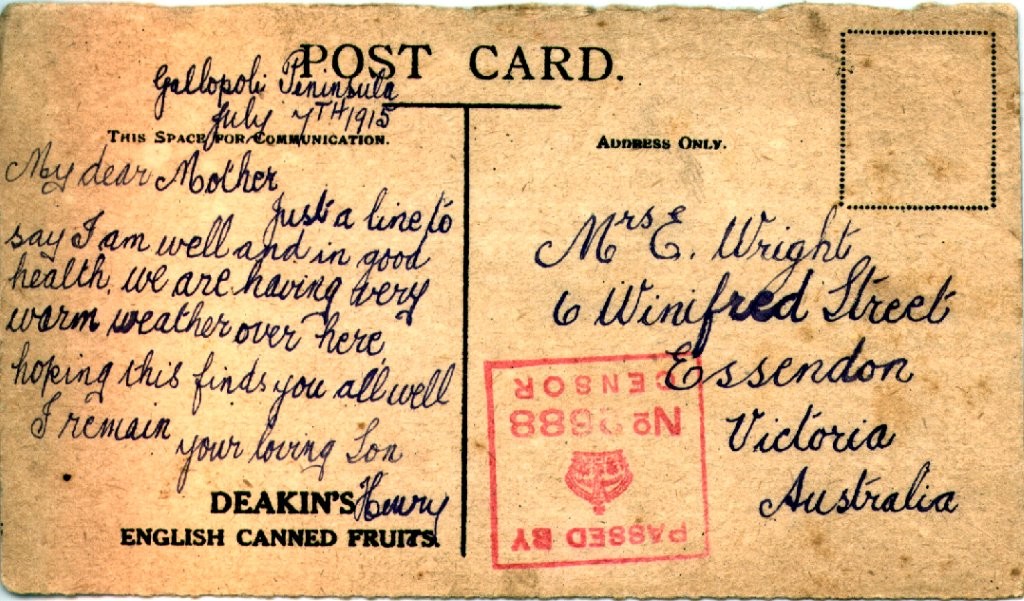 7 July 1915. Gallipoli Peninsula.
‘My dear Mother,
Just a line to say I am well and in good health. We are having very warm weather over here. Hoping this finds you all well. I remain your loving son, Henry’.
1915. Which family member and date are unknown?
‘Dear Harry,
I just received your nice long letter & was very pleased to hear from you, but was sorry to hear you had been in the hospital. I sincerely hope that by the time you receive this short letter that you will be all right again. Wally has just been in & I showed him your letter & I told him I was replying right away & he told me to remember him to you. Your two brothers were in last Friday night, the night before they went away & I must say they looked smart in uniform. Mick Whyte, Alec Bruce, Perce Payne & Jim Connors also went away last Saturday & Len Tyzack has been up the camp for about three weeks. You remember Sergt Murphy, who was over your tent when you just went up to the camp. He used to often call in & see me……………’
The remainder of the letter has been lost, but it’s possible the writer was Charlie, who, at this point, had not enlisted.
In the following correspondence, Fred briefly describes the camp activity. It was written before the troops departed from Egypt bound for Gallipoli aboard the 11,899-ton Australian troopship HMAT Southland.
8 July 1915. Cairo.
‘Just a line, etc. We are getting on alright and have been here five weeks.
We have a good time in Cairo which is about 1½ miles from our camp Heliopolis. We are learning bayonet exercises and taking trenches. Your brother, Fred’.
Bert writes to Fred about his sea voyage.
19 July 1915. [Postcard Melbourne YMCA]
‘Dear Fred,
Just a few lines to let you know I am all right and hope you are the same. It is pretty slow on the boat. You ought to know what it’s like. There is nothing to do, only sit about, and there is not enough room to do any drill. We have a full-dress parade twice a week. It’s only a small boat about five thousand tons [and]does about 10 knots and will take [censored] two months to get to [censored]. We did not call at [censored]. Will write a letter later, as news is scarce. I will close from your cobber. Remember me to all heads. Bert’. At some unknown point, the two brothers were finally reunited.
3 August 1915. Heliopolis. A letter from both brothers.
‘To all at home.
Am getting on alright and so is Bert, and like the life very much.
Your loving sons, Fred & Bert.
On 21 August, the 14th Battalion was part of a force that attempted to seize the heights of Sari Bair, specifically Hill 971. Things did not go well for the Brigade in the rough and broken ground north of the Sari Bair range. At night and with no reliable communications or navigation aids, their advance faltered, and then the elements of the Brigade were caught in the open exposed approaches by Turkish machine gun posts. Although Hill 971 was briefly held, the arrival of Turkish reinforcements forced the Australians off the hill, and they were to play no further part in what was a hopeless venture. During this attack, Henry’s ability to dodge bullets ended. He would, on 10 September, whilst in England for treatment and rest, write home about the circumstances of his being wounded.
23 August 1915. Cairo. Postcard from Fred and Bert.
‘Dear Mother,
We have not gone away as expected, and do not know when we are going. The picture is of the Citadel where we were garrisoned for one week.’
The Citadel referred to was an Egyptian Army barracks requisitioned by the British Forces as a training camp.
Date and location unknown. Bert and Fred to Mother.
‘Dear Mother,
We are having our photos taken in our uniform over here, that is shorts & helmets. Do not forget to send one of the Broadmeadows photos over and a few papers——The remainder of the letter has been lost. The location was most likely still the Citadel.
24 Aug 1915. Letters and cards. Bert to Mother.
‘Dear Mother,
Am sending you a few postcards. They only cost one shilling five piastres, that is about one shilling and a halfpenny. We do not know when we will go to the front. It might be this week or next, the sooner the better. We have got pretty well all the things that we want. We are the only companies in the 21st Battalion that is in the camp at the present time. The other companies are on guard in Cairo. They are making us drill pretty hard now. That is all I can write now, so I must close. I remain your loving son, Bert. PS. Give my love to Dad.
PPS. We have not received any letters, yet we have been here eleven weeks tomorrow. We do not know whether we are going to the Dardanelles or to France. We hope it is France. It is nearly 16 weeks since we left Australia. We hope the war does not last long as we are sick of this. I remain your loving son, Bert’.
24 August 1915. Heliopolis, Egypt,
Mr Leslie Wright.
‘From your dear brother Bert. Just a few lines to let you know that I am all right and keeping fit and feeling well. It will not be long before we are in the firing line, so I must say goodbye for the present. I remain your loving brother, Bert’.
24 August 1915. Heliopolis, Egypt. Postcard.
‘To my dear brother Gordon, Just a few lines to let you know I am getting on. I am pretty fit and feeling very well. We are off to the front in a couple of days’ time, so I must say goodbye for the present. Bert’.
While Henry was in the hospital, so too was his wife, Pauline, giving birth to a son, Henry Maidos Wright, on 30 August. Their son would go on to serve in World War Two in the Pacific as a Captain with the Second A.I.F.
Bert may have stated in his letter that he was feeling fit and well, but another bout of sickness again prevented him from sailing with his brother, and as it transpired, it was possibly good fortune for him. His brother Fred was among the eighty-seven officers and nine hundred and sixty-eight other ranks aboard the HMAT Southland that departed Alexandria on 30 August for Gallipoli via Lemnos Island. Partway into the voyage, approximately thirty nautical miles [fifty-six km] from Lemnos, many of the troops and crew took an unexpected swim in the Aegean Sea. On 2 September, the German submarine UB14, commanded by Kapitänleutnant Heino von Heimburg, torpedoed the ship. Sources vary as to the exact casualty figures, but thirty men died either from the resulting explosion or by drowning. The surviving troops and sailors were rescued by nearby ships. The Southland remained afloat, and fortunately, the UB14 did not remain in the area to finish the job. A skeleton crew of volunteers managed to beach the ship back in Mudros harbour at Lemnos. Fred was amongst the survivors.
It would have been natural that many of the survivors would have written home of their first experience of action, but the Australian authorities imposed complete news censorship about the torpedoing. The public was only officially informed two months later. The government possibly deemed it was not good for civilian morale to admit enemy successes and the loss of Australian lives so early in the war. The survivors on Lemnos finally boarded the small transport steamer Abassieh during the late afternoon of 6 September, and just after midnight the next day, with no lights to indicate their presence, arrived at Anzac Cove, and the troops were ferried ashore via rowboats. For the next three months, the 21st would occupy the 8th battalion’s section on the line around the area known as ‘Lone Pine’. This area was the quietest at this stage of the war and would remain so right up until the Gallipoli evacuation on 18-20 December 1915.
9 September 1915. Hampstead Heath, England.
On active service from a wounded soldier in the hospital.
‘My dear Mother,
Just a card to say I am getting on splendid. My wounds are getting on as well as can be expected and are not serious. This is the boat that I came over from Dardanelles. I am writing a long letter and will give you a better account. Hoping this finds you all well. I remain your loving son, Henry’.
Henry’s hometown newspaper, the Essendon Gazette, published a letter from Henry to his mother describing the events leading up to his being wounded on or near Hill 971.
10 September 1915.
The letter began;
From H.J. Wright to his parents, who reside in Winifred Street Essendon, he being one of three sons who are serving the King.
‘My dear Mother,
You no doubt are very anxious about me, for I suppose you would get a telegram to say that I was wounded, and you are wondering how badly. I am pleased to say my wounds are not serious, and also that I am a lucky man to be sitting up in bed in dear old England, writing this letter to you. I will start from the —-of August when we started to make an advance to straighten up our firing line. [I am writing of our Battalion only, but there were scores of others engaged in this big move]. We moved at about 10 o’clock at night in full fighting order, each man carrying 250 rounds of ammunition. We were told before we started that our job was to go two miles along the beach, then push inland for about a mile or so. We were to take the Turks by surprise.’
‘After doing our two miles in strict silence, we got the order to fix bayonets, then we started to push inland. We had taken John Turk by surprise. He stood his ground for a little while, but when he heard the Australian war cry, he was soon on the run. But what a great treat we had; the Turks knew where they were going, we did not, and the country was nothing, but hills and gullies covered thickly with small bushes behind which the Turks would hide and try and put up a bit of a stand until we routed them out with a bayonet. We were not to fire a shot – all work to be done with the bayonet.’
‘They were blazing away all the time, but it was so dark they could only fire in our direction. A few of our chaps were hit. One of my mates next to me suddenly called out and dropped. I asked him what was up. He said, ‘Only a bullet in the knee, but never mind, I’m alright. Go on, Australia, give it to them, show ’em what you’re made of etc. The bullets were cutting up the dust around us when I got a bullet through the butt of my rifle, but I was not hit. Frank Trevillian, myself and a few more of our boys got cut off from the rest of the Battalion that night and thank goodness it was dark, or we should certainly have had a hard time of it. We thought our chaps were still coming on. We had just got to a small rise with a fringe of bushes when in front of us we could hear a party of Turks talking. We dropped behind what cover we could. It was while we were lying there that we found out that we were on our own and that the Turks were creeping up. We had an officer in our party, and we owe him our escape.’
‘He belonged to the 13th Battalion, N.S.W [ New South Wales]. He said to us, “Well boys, we are in a tight corner here and with a little bit of bluff, I think we can manage them”. So, while some of us dug in, others were keeping watch. We had just made a rough cover for ourselves when one of the observers saw a movement in front. The officer had us ready. We were to wait until they got within a dozen yards and fire for all we were worth, and if necessary, use our bayonets. I cannot explain the feeling when you know you are going to have a scrap at close quarters. It makes one feel that he is good enough for half a dozen. We allowed them to come up within a few yards. They could not see us, and I think they imagined we had gone. Then we got the order to fire. We pelted lead into them as fast as we could pull the trigger and then got up and yelled like a lot of Indians. We had no occasion that time to use the bayonet. John Turk broke and fled screaming “Allah, Allah” and disappeared down the hill, going like blazes. It was just breaking day, so we worked our way back to the rest of our Battalion, whom we found five or six hundred yards back. We do not know what damage we had done, but guessed we had settled a few.’
‘We moved from this position early that morning and joined the rest of our Brigade (4th Brigade). Our casualties in this were not a great lot. The Turks got a big surprise that night, all along the line. We found bags of bread, pots and pans, ammunition, and equipment. They bolted in such a hurry that they had no time to bother about these things. The Turks were now entrenched on a big hill called 971. This hill was always well fortified, and we were brought round to help take this.’
‘On the morning of August—–, we were lined up at 3 a.m. to make an attack on a portion of this hill, so we were told, but this is what happened. On this morning, about two thousand of us advanced with fixed bayonets. All went well until we had passed through a big ravine. We reached a flat piece of land that had been cultivated, and had to cross this at the double, for dawn was just breaking, and the Turks had spied us and came at us in thousands. We were a splendid target. I will never forget crossing this cultivated ground about three hundred yards wide. They turned machine guns on us, and our poor fellows were dropping like flies. We reached a place at the end of the ravine and dug in. The Turks were bringing up more reinforcements. This is just what our side wanted, for we were drawing the fire while a very large force of Tommies and Gurkhas made an assault on this big hill on the right, we being on the left. We soon found out what we had fallen into. We had been sent out to draw as many of the enemy as possible to make out that we were the main attacking party.’
‘While the Turks were advancing on us, our big guns from the cruisers just blew them sky high. When the shells burst amongst them, we could see Turks, pieces of men, earth, and bushes, all in a heap. The Ghurka is a splendid soldier; he likes best to fight with the knife and is very severe on the snipers and will search for them for hours, and snipers, when caught and wants to be taken prisoner – he has no chance. The Gurkhas are good friends of the Australians. They are small men, but very strong and wiry. When we got the Turks moving our way, we received the order to retire, and to carry back all wounded on our way. The stretcher-bearers were working like Britons. I and another 14th man carried a poor fellow who was shot through the stomach. We had to move ourselves too, over ridges, along gullies through thick bush. There was no time to have a spell. We were being shelled, and John Turk was pumping the lead our way. He, no doubt, thought we were running away, but this was part of our plan for the Tommies and Gurkhas were doing great work on our right.
We eventually reached a place of safety and got our man to a dressing station. The wounded were coming down in scores from this big hill, but others were going up with a determined look on their faces that boded ill for the Turks. It is rather a peculiar feeling when you first see a wounded man being carried past, but one soon gets used to it, and the more determined he is to avenge him. We made a line of trenches and held them for a couple of weeks. During this time, we had a very hard job getting water. Of course, water was coming along as well as they could send it, but for thousands and thousands of troops, it means a big thing. We dug down fifteen feet and discovered beautiful spring water; from that day on, we had plenty.’
‘I will now pass on to the afternoon of August…We were to make a charge on the Turks’ trenches. This was to be another big move for us. You no doubt read in the papers about the big landing of troops at Suvla Bay. This was the time that we moved. Now I will describe it to you, just as it appeared to me.’
‘At 3 p.m., we were lined up and told our job. We were to advance for three hundred yards, and previous to our going, our cruisers and land artillery bombarded the Turks for a good hour. The first hundred yards were not too bad, but the last hundred was hell. We rested for a breather for this final spurt on a ridge. We had to run over the brow, down the other side, across a flat and gain another ridge. As soon as we started, the enemy worked machine guns, rifle fire and shrapnel at us. I saw dozens fall in front of me. One poor chap’s equipment and clothes caught fire, I think a bullet struck his cartridges and set alight the cordite. He screamed something awful. I had not gone far when I got a nasty blow to my leg. I did not stop, though to do so was certain death. I managed to scramble down to the ridge and crawled to a place of safety. My wound was dressed, and the leg began to get stiff. We had no hope to get back to get a doctor until dark, so just had to lie there and wait. I did not mind waiting, but we were getting Jack Johnson’s shrapnel and bullets dangerously close. Anyway, I had the satisfaction to see that we had gained our position, and our fellows were busy digging in. While lying here, I was in full view of the hill we came down. It was a terrible sight. Men were lying around in dozens, some groaning terribly, and the Tommies were coming over. It is only then that a fellow realises the awfulness of it. They came over in a rush and were cut up like chaff, but they would not turn back. I and a lot more wounded were waiting in this place to be taken away when we saw a poor chap staggering towards us. I found he was one of the 14th – a chap I knew well.’
‘A machine gun had made a horrible sight of him. The bullet entering his mouth, cutting away the bottom teeth, then passing through his neck, breaking the collarbone and making a nasty gash in his shoulder. He could not speak but wrote down on a piece of paper that he was not downhearted and that he was satisfied when he saw our boys had taken the position. That night, when we started to make for the beach, we had plenty of bullets humming around us. I’m afraid we looked a sorrowful pair. I hobbled along, and my poor mate hanging on to the back of my tunic. We had a lot of spells on our way down and reached the hospital ship at dawn. We had a nice warm bath and got between nice clean sheets. We steamed away from the Dardanelles and went onto Lemnos – one of the islands forty miles away. We were here for two days, then put on a sister ship to the Lusitania and on 24 August, we started for England, called in at Malta for a day and Gibraltar for five days, and finally reached Devonport on September 8.’
‘We travelled by hospital train to Paddington about 230 miles, then motored to Hampstead (New End) Military Hospital, where we are looked after splendidly. When the boys are able to walk, they are allowed out from 2 p.m. to 6 p.m. They are often taken for motor trips all over London. The people are very kind and invite the boys to afternoon tea. The Old Bull and Bush Inn is only a ten-minute walk from here. Little did I think I would one day see the original. I will write to you again about the different places when I can get about. Don’t worry about me, my wounds are not serious. I expect to be about in a couple of weeks. I have an appetite like a horse. I should think so after bully beef and biscuits for four months.’
In another letter, he writes about the treatment of Australian troops in England.
Date unreadable.
‘My dear Mother, Father, brothers, and sisters.
I am getting along splendidly and can get about with the aid of a stick. I have had a great week for outings.
Sunday- Motor drive to the country and saw the great flying grounds at Hendon; then afternoon tea at a lovely house at Highgate [ photo taken on the lawn], entertained with music; plenty of cigars and cigarettes.
Monday– A motor drive to the country, 30 miles of lovely scenery; afternoon tea on the lawn.
Tuesday– 20 of us were entertained at the Hampstead Golf Club. We had a competition game and I reckon I am hot stuff at golf. We were treated very well—plenty of cigarettes, and our tea was good. I thought I would never be able to get up from the table. The ladies sang songs to us. Of course, I made eyes at one of the young ladies, and we got quite chatty, and I was sorry we had to go. I am looking forward to the next invitation to play golf.
Wednesday- Three of us motored out to Watford and had afternoon tea at the big house’.
Saturday. A lady took five of us in a motor to Richmond, about 18 miles from here. We had a glorious time.’ We passed Lord’s Cricket ground, over Hammersmith Bridge, through the great Richmond Park, covered with forests of oak, chestnut and silver birch trees and saw hundreds of deer. We had afternoon tea on the banks of the Thames, and came back through Bush Park. We were shown Hampton Court Palace, the favourite residence of Queen Victoria. We crossed over Kingston Bridge and had a real good time. The people here are very good to Australians and cannot do enough for us. If we go for a walk in the afternoon, we are stopped by the women and children and given cigarettes and sweets and asked to come for tea. We have concerts two or three times a week, some of the best singers and artists from theatres entertaining us. The weather here is getting cold, so we are to have more concerts and moving pictures. Corporal Stuckey is herewith me. He was wounded the same day as myself. You remember he and Trevillian came to tea one Sunday night before we left Broadmeadows. Tomorrow, Stuckey, two other Australians and myself are invited for a motor ride to the principal parts of London. So tomorrow I will have some news to tell you about our trip.
Tuesday-I do not know how to tell you what a splendid outing we had today. I will do my best to explain it. We left here at 2 pm and were soon in the crowded but wonderful city of London. We crossed Blackfriars Bridge over the Thames, did Regent Street, Leicester Square [ high monument of Ajax defying the lightning], Trafalgar Square, with the splendid monument of Nelson and the Duke of Wellington. We motored around the historical building, the Tower of London, which dates back hundreds of years. I cannot write how these wonderful buildings impress one at first sight. The German spies are shot here. When I get my furlough, I am going to look over this building and I will write you more news of it. We passed over Tower Bridge- a tremendous, big bridge. A roadway is lifted up by hydraulic power to let the steamers pass. We then recrossed the Thames over Westminster Bridge, saw the bronze statue of Boadicea, and the wonderful obelisk of Cleopatra. This huge stone was brought from Egypt in Queen Victoria’s time and was cut out of solid granite about the time the Pyramids were built. We saw the Houses of Parliament and Big Ben, Scotland Yard, Westminster Abbey, Albert Memorial, St Paul’s Cathedral, Buckingham Palace, the wonderful Queen Victoria Memorial, Hyde Park, Rotten Row, and dozens of other places of interest. I have not written of the splendour and wonder of it all, but when I get out on furlough, I mean to spend most of the time inside these old historical places and will be able to describe them better to you.’
‘Well, my dear mother and father, I know you must be having a most anxious time, wondering how we are all getting on and dread each day to hear bad news; but the danger is not so great as you imagine, and if you could see us at our work in the trenches and under fire, and how lightly we take it all, I am sure you would not worry so much. I, and my brothers, I am sure, are always thinking of you at home. I can see you now, dear mother, sitting down doing crochet work, and Dad on the sofa reading the paper. How lonely the old house must seem, but cheer up, we will someday all return again. We are doing work for our country that you must be proud of. You have given four sons, and this is a very big thing out of our family. I will send you postcards of London and the principal buildings when I get out. I cannot draw any money while in the hospital. I do not mind being here for we are treated like toffs.’
23 November. Fred contracts Typhoid at Heliopolis and is hospitalised.
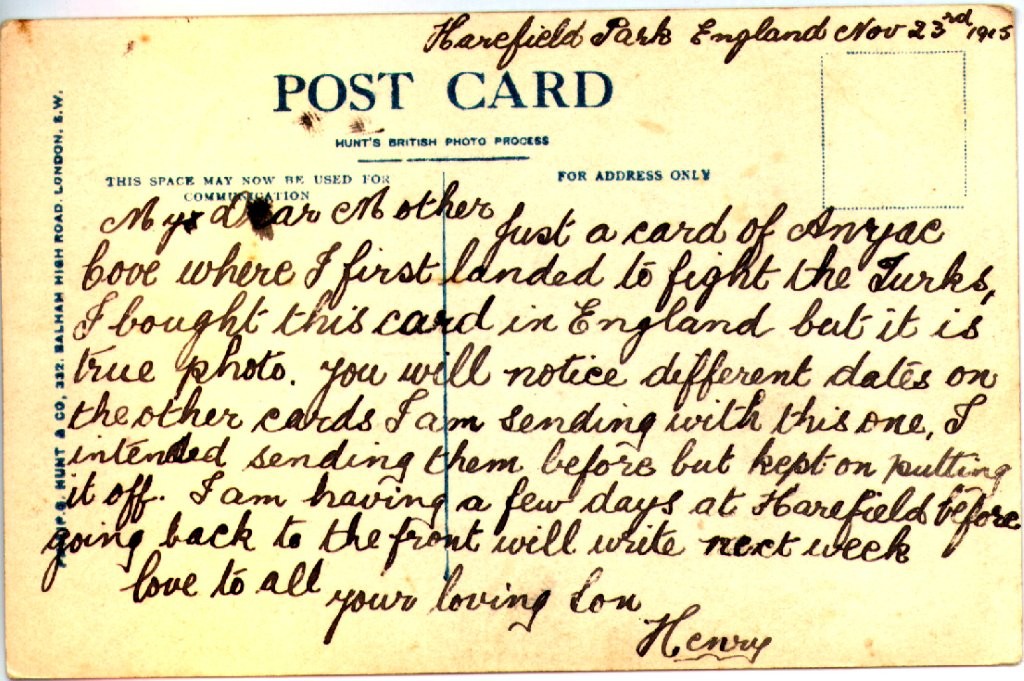 23 November 1915. Harefield Park, England.
‘Dear Mother,
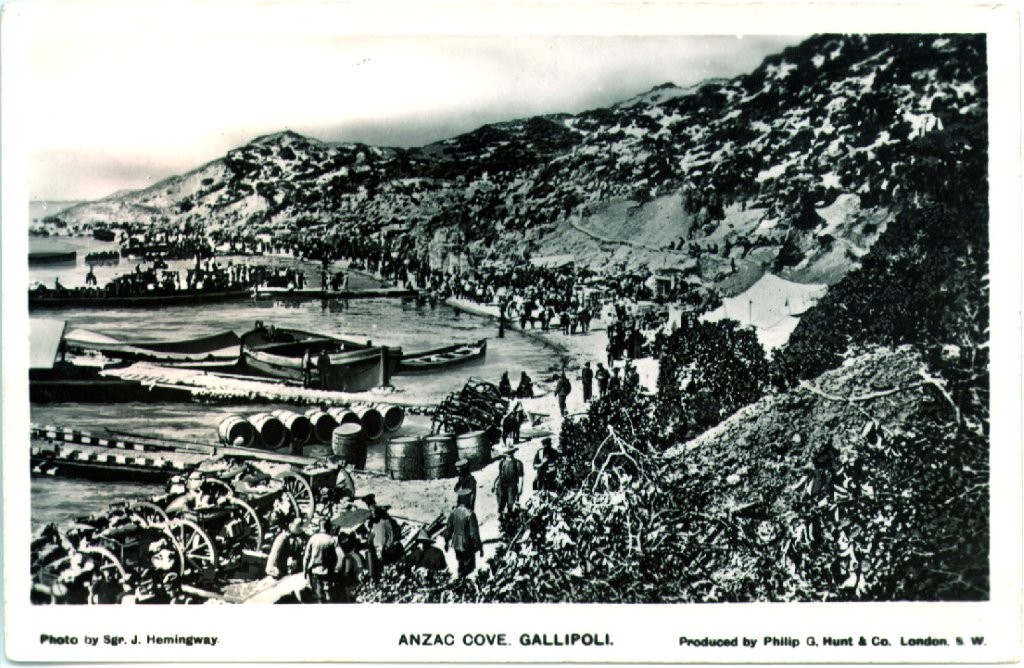
Just a card of Anzac Cove where I first landed to fight the Turks. I bought this card in England, but it is a true photo. You will notice different dates on the other cards I am sending with this one, I intended sending them before but kept on putting it off. I am having a few days at Harefield before going back to the front. Will write next week. Love to all, your loving son, Henry’.
In a letter to his mother dated 8 December 1915 from the Australian Base Camp, Abbey Wood, Kent, England, Henry wrote, in part, of a funeral that Australian soldiers had voluntarily attended. The letter was published in the ‘Our Soldiers’ tribute section in his hometown newspaper and was found by Lenore Frost, a local Essendon/Moonee Ponds historical researcher, during a search of local Great War soldiers’ historical records.
‘We had a military funeral here last Tuesday. One of the Australian Light Horsemen [Trooper William Keelan, 5th Light Horse, 3rd Reinforcements] was run over by a motor car and killed and was buried in the Woolwich/Plumstead Cemetery. We were told by our officers that the funeral was voluntary, but 1,500 of us followed his remains to the graveside. The coffin was mounted on a gun carriage and drawn by four horses. A band playing the ‘Dead March’ headed the fellows.’
Trooper Keelan was laid to rest with full military honours while Reverend C.A. Peacock, the senior chaplain to the forces, officiated at the funeral service.
‘At the graveside, a party fired a volley over the remains, and the Last Post was played by the buglers. It was a most impressive sight and one I am not likely to forget. This poor chap was married to an English girl for only two weeks. [It was almost seven weeks] The poor thing [Elizabeth]was very much cut up and had our sympathy. Well, dear mother and father, I will close my letter. I remain your loving son, Henry’.
The large turnout at the funeral was not unusual at the time. There were many men at the depot who had nothing much else to do with their time. However, by attending, they not only paid their respects to a fellow soldier, but they also hoped to be paid the same respect if it were them.
The personal belongings of Trooper Keelan were sent to his next of kin in package number 7563 and consisted of; a Testament [arcane reference to the Bible] hairbrush, knife, Emu feathers [part of the Light Horse slouch hat decoration] shells [a collection of seashells from Gallipoli], matchbox, cigarette holder and money clip. His kit belonged to the government and had to be returned, but many times the unofficial practice was to auction off a soldier’s kit, with the proceeds going to the soldier’s widow. A person would buy a particular item and replace it with a similar worn item. At the end of it, a ragged kit was returned to ordnance, which was generally destroyed.
Back on the Gallipoli peninsula, the campaign ended when over ninety thousand Allied troops withdrew from their beach positions between 8-20 December 1915. Henry’s Battalion was withdrawn from Gallipoli on 18 December 1915. The Turkish forces were unaware of the Allied withdrawal as it was being conducted with great secrecy and under the cover of darkness. To fool the enemy in the latter part of the departure, an ingenious setup involved the positioning of rifles along various parts of the beach and having gravity-fed water dripping at staggered time intervals into a tin attached with a string or wire to the trigger. The weight of water build-up in the tin would cause the string to pull the trigger and fire a round. Johnny Turk assumed this was normal rifle fire during one of the Allies’ quiet periods, but they had long gone.
The Gallipoli campaign did, quite aside from the historical and military perspective, create an enduring legend that has become deeply embedded in the Australian and New Zealand national psyche for over one hundred years and hopefully well into the future. Both countries began their first steps together on the world’s stage united in battle, and now, with the chapter of Gallipoli closed, the Aussie and Kiwi troops went on to write a new chapter on the battlefields of the Western Front.
The 21st Battalion was transferred to Tel El Kebir, 13 miles from Ismailia on the Suez Canal. This was a huge camp already occupied by the 4th, 5th and part of the 6th Reinforcements and the 1st Division. There was little time for the men to get any Rest and Recreation in Cairo as they were urgently needed in France.
Fred again fell sick, this time with Enteric Fever. The Army decided to send him home on 21 January 1916 aboard the A34 Persic and discharged him as medically unfit for duty.
25 January 1916. Australian Camp, Weymouth, England.
‘My dear Mother,
Just a card to say I am quite well. We expect to be moving from here any day now. I will write you a letter next week for I have no news this time, hoping all are well at home, I remain with fondest love to all, your loving son, Henry’.
Menwhile, back in Australia, the fourth brother, Charles Ison Wright, followed the three brothers who had enlisted and were also assigned to the 21st Division. He embarked aboard the HMAT Warilda, departing Melbourne on 8 February 1916, bound for France. He was, at some point, reassigned to the 22nd Battalion and would arrive on the Western Front lines in June 1916.
30 April 1916. Egypt.
‘Dear Mother,
Just a card of Anzac Cove where I have had many a swim. Fondest love, your loving son, Henry’.
22 July. Bert’s digitised Army records are difficult to read, as previously mentioned, but it seems he picked up a disease requiring an injection in his arm, which accidentally created a fibrous condition of the Pectoral muscle on his right arm. This meant he could not raise his arm past a certain level. He also contracted trench feet. This time, he was also declared medically unfit and sent home aboard the A71 Nestor on 22 July 1916, arriving back in Australia on 24 September 1916. Whilst Bert was sailing home, Henry was still recuperating, enjoying English hospitality and afternoon tea on the lawns, motor drives in the country and contacting his family.
13 August 1916. Postcard-Durham Cathedral.
‘Dear Mother.
Was all over this place a few days ago. Twelve of us Australians were shown over by the Dean. It is over 800 years old and a very interesting old place. The view from outside is most beautiful. Hoping you will like it; I remain loving son Henry.’
Henry may not have been aware that the enormity of Australian casualties on the Western Front, which was becoming common knowledge back home in 1916, and that the anticipated quick end to the war began to look highly unlikely. The number of men volunteering began to fall steadily and dwindled to a trickle compared with the initial 1915 flood. The British government began exerting pressure on the new Australian Prime Minister, Billy Hughes, to fill the numbers needed to maintain the troops at the Western Front. Although Hughes may have been in complete agreement with the British, he had to provide five thousand, five hundred reinforcements per month to maintain Australian forces at an operational level. To counter the declining numbers of volunteers, Hughes proposed conscripting those who were unwilling or opposed to enlisting. Rather than riding roughshod over the public, which he could legally do as Prime Minister, he initiated a conscription referendum instead and called for a national vote on 28 October 1916. Supporters and opponents started campaigning on the issue. The net result was one million, eighty-seven thousand, five hundred and fifty-seven for conscription and one million, one hundred and sixty thousand, and thirty-three against. Hughes decided politically to scrap the idea.
The issue of conscription had been divisive politically, religiously, and socially and had placed Hughes in a position that put him at odds with his own Labor Party. He quit the party and formed the Nationalist Party, which won the elections in 1917. That same year, Australian enlistment figures were still on the decline, and Britain suggested raising a sixth Australian division for active service. To meet this request, at least seven thousand per month were required. The death and casualty figures continued to mount, and there seemed to be no tangible gain in the war for such a large butcher’s bill. The war had reached a stalemate, and the economic cost continued to hurt the government and the community. The re-elected Australian PM once again proposed a national referendum on conscription on 20 December 1917. Single men, widowers, and divorcees without dependents between 20 and 44 would be eligible for conscription.
Those ‘for’ and ‘against’ once again fought a bitter campaign and once again the conscription issue was defeated but this time, by a higher margin than the previous one with one million, fifteen thousand, one hundred and fifty-nine in favour and one million, one hundred and eighty-one thousand, seven hundred and forty-seven against. Billy Hughes again dismissed the issue of conscription, but fortunately for him, World War I ended the following year. The conscription issue and the results showed that Australians were no longer prepared to support their youth being sent to die in the slaughterhouse of the Western Front. This divisive issue led to an increase in men being given white feathers by ladies in the streets.
According to the Australian War Memorial website, the Order of the White Feather was founded in Britain in August 1914 as part of a propaganda strategy by encouraging a female ‘patriotic’ movement throughout the Commonwealth to exert more pressure on men to join the depleting military ranks. Whilst government enlistment programs made direct appeals to masculinity and manhood, it became the widespread practice for women to give men a white feather, whom the women deemed, rightly or wrongly, fit for service.
The white feather was a symbolic gesture insinuating they were cowards. This practice was so rampant during the war that the Australian Department of Defence was forced to issue two badges to prevent men from encountering this so-called ‘dishonour’. One badge declared the wearer was ‘Medically Unfit for Service’ and the other stated the individual was ‘Required for Home Service’. Whether the badges worked or not in the face of female patriotic determination is debatable. One thing is certain: the ideology behind the distribution of white feathers was one of the saddest and most shameful episodes in the history of World War 1 and would undoubtedly have caused a great many unnecessary deaths due to perceived public shame.
Both Australia and New Zealand contributed more than their fair share of men, money, and material, considering the small populations at the time. Figures vary, but from a population in 1914 of four million, four hundred and sixteen thousand, eight hundred and nine Australians enlisted, and fifty-eight thousand, nine hundred and sixty-one died. In New Zealand, with an even smaller population of one million, one hundred and twenty thousand enlisted. This figure includes two thousand, two hundred and twenty-seven native Maoris and four hundred and sixty Pacific Islanders. Again, figures vary, but New Zealanders killed were eighteen thousand, five hundred.
At this point in the saga of the Wright family’s four sons who volunteered for service, Henry is still in an English hospital, Fred and Bert have been sent home and discharged as medically unfit, and Charlie is on the Western Front.
It was now Charlie’s turn to continue the family tradition of lead collecting by being wounded in action during the 26 August 1916 attack on Mouquet Farm. Charlie was sent to the Mater Misericordia Hospital in Dublin to recover.
26 September 1916. Postcard -Mater Misericordia Hospital, Dublin.
‘Dear Mother, Just a line to let you know I am doing well and expect to go into convalescence in a week or so. This is a photo of the hospital I am in. Hoping everybody is well at home. I remain your loving son,
Charlie’.
29 January 1917.
6 Winifred St, Essendon.
‘Dear Charlie,
Just a few lines to let you know that we are all well at present. I am glad to hear you are getting on pretty well, and I hope you will have good luck to get through all right and hurry up for the champagne. I remain your loving Dad’.
On 17 April that year, Mrs E. Wright wrote to the Army base records with the following request; ‘Dear Sir, Should you get word that either of my three sons [ Bert had returned home] has fallen [God forbid] will you please inform the Reverend Madsen, Methodist Minister, Richardson Street, Essendon’.
While Charlie remained in the hospital, Henry was declared fit enough to rejoin his Battalion in April 1917 and sent back to the front lines. Charlie writes again to his Mother.
28 April 1917. France.
‘Dear Mother,
Just a line to let you know I am well. I sent along some (Whiz Bangs). Did you get them alright? We don’t always get a chance to write letters here, so sometimes we have to send field cards, as they are called by us (Whiz Bangs). That’s the name we have for a German shell, you don’t hear it coming like the ordinary shells. Just a Whiz Bang and it’s got you before one has time to duck. So, I hope you understand the meaning of the field cards as a hurry-up way of sending things.
‘Well, ma, I have just received by one mail 36 letters all from old Australia. You can guess how pleased I was to get them and to hear from everybody at home. I had letters from all my dear brothers and sisters and dad and Mrs A Davison, but you must tell them that I cannot answer them all just at present as I am lucky to get the chance of writing this one, but I will write to everybody in a week or so as I will have plenty of chances then to write to everybody. I still have that watch that the boys gave me at the Lincolnshire Hotel [corner of Keilor and Mt Alexander Roads, North Essendon-Melbourne], it’s as good as ever. I would like to send it over to Harry, but don’t like chancing it in case it goes astray. Jimmy Harrison looked after it for seven months for me while I was away, wounded. I gave it to him to mind when the Monquet Farm hop-over was on. He is in our 1st Aid dressing station and is still here.
Well, Mother, I had letters from Harry and Bert; they had holidays together in London and have had their photos taken together. I know how pleased you all will be when you get them. I’m on one as they come to light. You know, mother, I had good intentions of having mine taken while in London and had plenty of spare time, but you know —- I will next time. The old excuse is I am getting all the papers and paper clippings, and also the piece with poor old Les Steven’s death in it. What a good fellow gone. He will be well revenged before this war is over. I’m still of the opinion that about July will see the end of it.
Tell Dad that we will all be home for that champagne by next Xmas. Was sorry to hear that Wally’s Mary hasn’t been too well and hope by this that she is getting on well. Tell Pauline that I will write to her in a week or so. Harry showed me the photo of the baby. What a bonza he does look. Well, my dear parents, brothers & sisters, this is all this time. From your loving & affectionate son, Charlie’.
Charlie returned to active service on 3 May. Perhaps, the Germans recognised him, ‘Verdammt Er schon wieder’ ‘Bloody hell. Him again and shot him twice. This time, the wounds were on the right arm and back. He would take seven months to recover.
Private H. Wright had also arrived back at the front to annoy the hell out of the Germans as well, and their irritation was obvious, as Henry is once again wounded, this time in the right arm and left leg and suffered from shellshock in or near Pozieres on 2 July 1917. He was sent to the Northumberland War Hospital in England to recover.
Henry was to remain in England for quite a while, as his wounds were taking a long time to heal. He was eventually fit enough to be transferred from the Northumberland hospital to the School of Musketry in Tidworth on 2 February 1917, where he was given light cleaning duties. It was from here, Henry wrote of his recollections, his innermost thoughts about the war, the nostalgia for home and about his life in general.
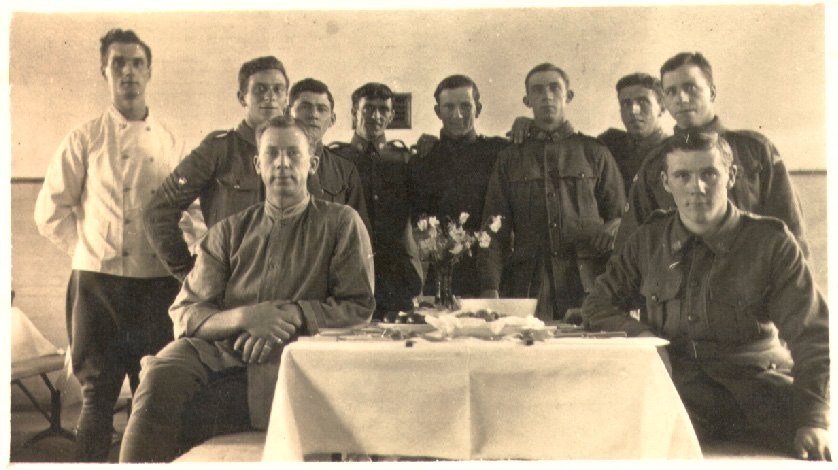
6 October 1917. School of Musketry. Bhurtpore Barracks, Tidworth, England.
‘Dear Les and Gordon,
I think it is about time I wrote you a few lines, for no doubt you want to know a little news about this side of the world. It always appeals to anyone who has not travelled that they would like to see different parts of the world, but take my dinkum tip and stick to the dear old home, for there is absolutely no place like it. Mind you, I am not sorry I came away because to hang back would be like a coward’s game, but to leave home just to roam about is a very foolish idea. I know when I was your age, I was always wanting to roam the world. I know perfectly well now that one’s home sweet home is paradise. I have been hungry many a time and scores of times been without a smoke. Just sitting down to bully beef and biscuits for three meals a day. Of course, next day, you would get a change to biscuits and bully beef. Well, dear brothers, I will begin my explanation of the countries I have visited with Egypt. Now Egypt is a pretty but dirty place. The natives are a very stinking lot of devils, and if you do not watch them, they will put a knife between your ribs. They are very treacherous, and the only way to treat them is to make them frightened of you. When we first went to Egypt, we could get things very cheap, but when they found out the Australians had plenty of money, everything went up double the price. We could buy 2 big oranges for a halfpenny, 6 eggs for twopence or a good feed for sixpence. The native women do all the work. It is a very common sight to see them carrying heavy loads on their head and a baby on their back. Of course, these are the Arabs, and they are black. The Egyptians are as white skinned as us and are a very fine race of people. As you know from the history books, Egypt is a very old place and has some very old interesting sites.’
‘The Pyramids are a wonderful sight, and the Tombs which date back thousands of years ago. I think every Australian who went to Egypt took the opportunity of seeing these wonderful old places. We were camped at Heliopolis, about 10 miles from Cairo and close to our camp was a very old burying ground and often our boys would go over and dig up the remains and find beads, coins, and other curios. I have seen some of the boys come home with a skull and put a lighted candle inside of it at nighttime. You can guess it would give the boys who came home late a big scare, especially if they were a bit tipsy. Heliopolis camp was only a desert when we first landed there but all sorts of shops went up like lightning and many a nigger made a fortune in no time. Our boys spent thousands and thousands of pounds in Egypt. Australians are the best-paid soldiers in the world, and they deserve it for they are bonza fighters. Well, dear brothers, we did not have the luck to take Constantinople. I cannot tell you much about the Turkish cities, but I saw plenty of Turks at Gallipoli. I can say they are a fine body of men and dash good fighters. My remembrances of the four months on the Peninsula are like a big nightmare. I had a charmed life there and don’t know how I
escaped being blown to pieces many a time. I could fill a book of narrow escapes. Now we will pass on to France, the land of frogs and snails. By Joves, it seemed a lovely country after Egypt and Gallipoli. Everywhere you see lovely fields of grape vines, fruit trees, cultivated land and rivers. The people are a splendid race and women work in the fields like a man. It is a common sight to see them ploughing and hoeing in the fields, and we Australians were always greeted at the time of day. We often bought bread from them instead of eating our biscuits.’
‘Our three-day trip from Marseilles to a place called Baielui was through the prettiest country I ever saw. We were within 8 miles of Paris and could see the Eiffel Tower plainly. It was a certainty that if they took us through Paris, we would have taken leave and had a look around Paris. We were only a little over a week at Baielui, about 10 miles from the trenches. We could hear the booming of the heavy guns. We also saw plenty of aeroplane fights which were interesting to watch. The English and French airmen are much superior in the air than the Germans, and our fellows would soon hunt the German home to his lines. An aeroplane is most useful in warfare and are used mostly for spying out guns and watching the movements of troops. I saw as many as 26 of our aeroplanes in a mob going on a raiding expedition. When our airmen fly over the German lines, old Fritz opens up a terrible bombardment with their aircraft guns, but our fellows take no notice but go on with their work. Sometimes the Germans score a hit and bring our man down, but there is always plenty more, only too eager to take his place. These aeroplanes are all fitted up with wireless apparatus, and they watch the result of our gunner’s fire and wire back the result. Too far, too short as the case may be until our gunners eventually blow up the object they are after.’
‘Now here is a story of one of our airmen, an Englishman who was known as the Mad Major. This man was supposed to have consumption and only had a few months to live, so did not care if he was killed. I have heard this story from Englishmen, Australians and Canadians who have seen him often. He would fly over the German lines and swoop right down on their trenches and drop bombs. He had the luckiest escapes, and often the plane’s wings were riddled with shrapnel and bullet holes. He would often loop the loop over Fritz’s lines and end up turning his machine guns on them. He is credited with bringing down many a German machine, for he would attack any number of them single-handed.’
‘Here is another story of the Mad Major, but I will not say it’s true. One day, he was flying over the German lines when something went wrong with the works, and he had come down and had just fixed it up when he was surrounded by a couple of German Officers. Thought they would like to be flown a couple of miles back to their camps, and each with a loaded revolver, commanded him to fly there. He agreed and got in his machine and strapped himself in. The two German Officers were seated behind him, covering him with their revolvers. He flew up into the air and looped the loop, which threw out the Germans. He then came back to our lines. Of course, you can believe this if you like, but I reckon it beats Sexton Blake hands down, ‘eh what’.
Henry may have been referring to Squadron Leader Major Christopher Draper, D.S.C., Royal Naval Air Service, a daredevil pilot who became known as the ‘Mad Major’.
Sexton Blake was a fictional detective solving crimes from 1893-1978.
‘Well, brothers, everyone who goes to the front has narrow escapes, and I have had mine. One day in the trenches, previous to doing this raid, Frank Trevillian and I were just killing time and having a singsong and old Fritz was shelling our part of the trench with a 9-point 5 shell (known amongst the soldiers as coal boxes). Now one of these coal boxes landed two yards in front of the trenches where Frank and I was, and by a piece of luck, missed fired. Had it gone off, we should have been in little pieces. Frank and I looked at one another and then went on singing, but I can tell you, it made us think of better places than that dammed old trench. By Joves, as I sit here and write these lines to you boys, I am indeed thankful I am having a spell from it all and sincerely hope I have no more fighting for a while. I am not afraid to go back, but I think it only right that we old hands should have a spell. I now have six scars from bullets to show, so think that is quite sufficient. I had word from Charlie lately saying he was being discharged from the hospital, so I am in hopes of seeing him soon. Poor old Bert will miss Charlie very much. I do hope he gets through alright. Fred is very lucky getting his discharge, and I am very glad that it will help to cheer up Mother and Dad. I’ll bet you boys are proud of your soldier brothers, and you have the satisfaction of saying that none of them were slackers. Well, dear brothers, war is nothing else but pure murder and the sooner it is all over the better for everyone concerned. I am looking forward to the time when it is all over and we can come home again. I guess we will have a good old time’
‘I am positive that at Dad’s spree, the champagne will get a severe hiding. I have contracted a terrible thirst since joining the Army. Of course, I put it down to bully beef. Well, dear brothers, we have some characters in the Australian Army. All kinds, from bank clerks to bushwhackers. Wherever there is a mix-up with fists, some of our boys are in it, but a softer-hearted lot you could not find in the whole world. They are ever willing to help a man wounded, or anyone down on his luck. They have taught many an Englishman manners by getting up and giving a lady their seat. They are rough and ready, but no matter what country they go to, they are classed as gentlemen. In the hospital over here, we are treated with great respect and want for nothing. We get scores of invitations to visit the wealthy people’s houses. I have had many an outing and hope for many more similar ones. I have a nice light job now, looking after these rooms in a musketry school. I only have to keep them tidy and can finish them in two hours. The job may last six weeks or six months. I hope it hangs out until the end of the war. Three good meals a day and a nice warm bed to lie on, so I can’t growl. Now, Leslie and Gordon, I want you to write me a letter and let me know how you are getting on, what kind of work you are doing, and if you want to know any particular news about different countries I have been in. Just mention it in your letter, and I will be only too pleased to give you any information I can. I will now close, hoping this finds you both well.
I remain your aff brother,
Henry’.
Henry’s brother Charlie, after seven months of treatment and convalescence, was sent home aboard the H.M.A.T. Persic on 21 December 1917 and discharged as medically unfit.
16 April 1918. School of Musketry.
‘My dear Mother,
Just a few lines to say I am well and still going strong at the Musketry School. All those rumours of having to go to France again have now died down, and we are going on as usual. I am very thankful that I should not like going over there again. I have had all the fighting I want for all time. Well, dear mother, I was very pleased to receive 6 letters today from Australia, three from you, two from Pauline and one from Charlie, and you can guess how pleased I was to hear Charlie had returned home safely. I only wished I could see you all seated down in the old home, so happy and contented, all would be. Well, cheerio dear mother, my time is coming along by next Xmas and don’t forget to keep that Hogshead of beer on ice. Joves, I get thirsty every time I think of it. I guess I can do justice to my share of it. I do not mention Champagne now as I reckon the Australians have drunk all that in France. You can bet I had my share when I was there.’
‘By Joves, young Gordon [Author’s father]is a brick and is sticking to that job in N.S.W. [New South Wales] I reckon it will be the making of him. I sincerely hope he sticks to banking his money as he is doing. It is the finest thing for a young fellow to have a few pounds behind him. I will write him a letter next week and address it in C/o Mr Mc Geoch.’
‘I really had no idea work was at such a standstill in Australia. Is Leslie a carpenter?
For some months back, you mentioned that he was working for Mr Musgrove. So, Fred is once again a Postman. Does he think it is better than soldiering? I wish I had half his luck. I suppose Bert is a gentleman, gets out of bed at 6 every morning [I mean 10]. By Jove’s, I laughed at Gordon’s letter that you enclosed. He said his boss had been to America, the South Sea Islands, and Christ knows where. [I wonder where that place is]’
‘I am very pleased to know Miss Addey writes to you. In every letter I get from her, you are mentioned, and I have always an invitation to call and see them whenever I can get leave. Charlie will be able to tell you what a lovely home they have and how splendid they treated him and myself. It is indeed a home away from home. I hope Charlie will not forget to write a few lines to her. I was surprised to hear Bob Bruce is in the hospital. Still, he is indeed having a bad time of it. Remember me to him when you write. I suppose Herb and Ern won’t attempt to join up and fight for their King and Country. By Joves, those are two beauties. I wonder does it ever enter their mind what cowards they are. Well, thank goodness people cannot say the same of your sons.’
The reference to his cousins, Herbert and Ernest Bruce, residing in Bulla Road, North Essendon was, rightly or wrongly, perceived by Henry as a lack of commitment to the war effort. It’s unknown why the two cousins could not, or would not, enlist, therefore, Henry’s opinions are personal and highly speculative. Henry’s reference to Bob Bruce was to Private Robert John Bruce No 3698 ‘C’ Company: 46th Battalion, who was a horse driver. Private Bruce was wounded in the side at Pozieres on 4 August 1916, and after eight weeks in number eleven hospital, he returned to fight at Bullecourt, Ypres, but was invalided home on 18 September 1917, after being diagnosed as having tuberculosis. He died on 21st November 1918, aged thirty-three. His parents, John and Mary Bruce, laid their son to rest in the Will Will Rook cemetery located near today’s still-operational Broadmeadows Army Camp. Sadly, his grave, like so many others, is impossible to find as they have long since disappeared through years of wanton destruction and possibly an indifferent public appreciation of the historical significance of the cemetery.
‘Well, mum, I will soon be out of the twenties, only a few days to go now and I will be 30 years of age and reckon it quite a time I was home and looking after my little son and heir and I am sure he will want a little sister to play with. I am thinking he will soon be following his old dad over here if this war lasts much longer.’
‘Well, dear mother, what do you think of this big German offensive? Old Fritz is winning ground off us now wholesale, but I am sure by the time this letter reaches you, the news will be of the Allies pushing old Fritz to blazes. The Allies will sweep old Fritz back to Germany and completely crush his military power to nothing. This French General, Foch, will strike soon, and there will be hell to pay. Germany is absolutely starving; our fleet have blocked all means of her getting foodstuffs from any neutral country, and she has only her own land to harvest from. What a grand time it will be when it is all over and we get back again to dear old Aussie. You cannot imagine how the dear old place appeals to us after being years away.’
‘Dear mother, I still do the washing here for the Sergeants, and it always brings me in a few extra bob. Everything is so very dear over here. Just now, cigarettes are five and a halfpence a packet of 10 and tobacco is nine and halfpence an ounce. I was very lucky in receiving a lb of Havelock tobacco from Pauline a couple of weeks ago. It is 2/6 of a two-ounce tin over here. The civilian population are having a terribly hard time of it, and I do not know how they manage to live; the prices of foodstuffs is awful. Thanks very much for the papers and paper cuttings. Everything like that is all news to me. Your Gazette enclosed in the letter received at the same time as your other letters, so by addressing the letter directly here and putting on the 14th Battalion made no difference this time.’
‘So, Florrie [Henry’s sister] has another daughter. By Joves, those two mean business, and I don’t think it fair, for I have no chance of keeping pace with them. I reckon I will have to knock them out two at a time. Well, now my dear mother, I must close my letter for this time as I will be soon running out of ink, or you will be charged extra postage, so with fondest love to all and cheerio till Xmas next.
I remain your ever-loving son, Henry’.
20 June 1918. Sutton Veny, Wiltshire.
Letterhead – Salvation Army Recreation and Reading Room for His Majesty’s Troops, No 1 Command Depot, Sutton Veny, Wiltshire, England.
‘Dear Leslie,
I have just received a letter from Mother dated 18th April, & you were at that time wanting Dad’s & Mother’s consent to join up. Well, dear brother, I certainly admire your pluck for wanting to do your bit, but if this reaches you before you have taken that step, I would like to point out a few of the disadvantages of this rotten life. First of all, you will miss all those comforts you are used to at home & this is more than you can ever dream of. You will be allowed to draw 2/- per day (only) & this at the present time is equal to 6d in peacetime. I am drawing 1/- & I cannot keep myself in smokes. You will find out the tucker is much harder to take than what you are used to at home. I wish I could sit down to a good square meal like Mother can cook, but I am on Army Rations, & as I have not any spare shillings to buy any extra. I have to just want.
Here is our day’s menu: Breakfast -1 slice of dark bread with dripping, a very small quantity of a greasy-looking mess called Curry & Rice, ½ pint of tea minus the sugar. Dinner – Stew, 1 slice of bread, rice pudding or sago. Tea – I slice bread, jam [referred to at the time as fly bog] margarine, ½ pint tea. I do not know if you ever tasted margarine, I hope not’.
What the troops were to receive in rations and what they got in reality certainly would have differed depending on the situation. During the war, community groups and the friends and families of Australian and New Zealand soldiers sent food and other articles to the fighting men on Gallipoli and later, to the Western Front. Due to the time delays in getting food items to the front lines, what they sent without the benefit of refrigeration had to remain edible for long periods and retain a high nutritional value. One famous food item that met these criteria was the beloved ‘Anzac’ biscuit. It was first known as the ‘Soldiers Biscuit’ but was also known as the ‘Anzac wafer’ or ‘Anzac tile’. It was essentially a long-life, hard-tack biscuit eaten as a substitute for bread. Although there are variations, the basic ingredients are rolled oats, sugar, plain flour, coconut, butter, golden syrup [or treacle], bicarbonate of soda and boiling water.
They were very hard, and some soldiers preferred to grind them up and use them as porridge. The current name, Anzac Biscuit, has much to do with Australians’ desire to recognise the Anzac tradition and the Anzac biscuit as a part of the staple diet at Gallipoli and beyond. Today’s mass-produced packet versions that appear in Australian supermarkets before Anzac Day are not quite the same as the traditional homemade ones ‘me mum used to make’, but nice, nevertheless.
Corporal Charlie Smith, another 14th Battalion man, outlines the Australian rations in France, but his ration menu must be viewed in the light of ideal situations. In the following, ‘bully beef’ is mentioned. This is a variety of meat from finely minced corned beef in a small amount of gelatine. The name is thought to have originated from the French ‘bouilli’, meaning boiled.
Australian rations.
On active service, rations are divided into three classes: Wet, dry, and iron rations. Wet rations consist of tea, stew, fried or boiled bacon, porridge, boiled rice, pork, beans, and such like. Dry rations comprised [per man] a quarter loaf of bread, quarter tin [quarter pound] jam, and a small piece of cheese, the latter every alternate day. Biscuits were also generally available in unlimited quantities. Iron rations were simply ‘bully beef’ and biscuits; they were always on issue immediately before going into action, and the ‘diggers’ simply helped themselves. A pound tin of beef was carried with sufficient biscuits to last forty-eight hours. The iron ration was only to be consumed in case of an emergency and was always carried on the person. Indeed, it was regarded as of equal importance to the equipment of a soldier as was his field dressing or identity disc.
When out of the line, rations were issued thus: Dry rations every day at about 4 pm. Each Company Quartermaster-Sergeant took three or four men to the Battalion Q. M’s store and drew his company rations, obtaining beforehand the ration strength from the company clerk. The C.Q.M.S. then divided the rations into four platoon lots, including signallers, etc, and issued them to platoon sergeants. The latter, in turn, issued them to section commanders, who finally passed the rations onto the men under them. Wet rations were not issued by platoons when a company was out of the line. The Orderly Corporal for the company took a small ration party of men to the cookhouse, drew the meal [including generally two or three dixies of tea each meal per company] and supervised its distribution. The men lined up in a queue, and two or three lance-corporals portioned out the tea and stew with their own mess tins. Fried bacon was issued [with tea] for breakfast, and stew [made with fresh meat for lunch, or midday meal. ‘Tea and Tea’ as the ‘diggers’ said, was issued at teatime. For this meal, the dry rations [bread and jam] were in evidence.
Comforts Fund money was sometimes available to each company and was spent to the best advantage. Oatmeal was occasionally an official issue, therefore, when the units were out of the line and billeted near a farmhouse [as was generally the case] the officer entrusted with his company’s share of the fund asked the orderly corporal to arrange with the French householder to supply sufficient milk on certain mornings for the company’s need. Porridge and milk made an acceptable dish for tired troops on cold mornings. Again, potatoes and onions were purchased as ‘extras’ for the midday stew and were likewise welcomed. Whilst in the Messines sector, the men of the 14th, [in common with those of other units] enjoyed many meals of stew with turnips, the latter being gathered from the fields vacated by the retreating Germans.
When in the line, however, many difficulties had to be faced. It was essential that the troops should be fed with hot food, and ration parties had, therefore, to be employed to carry it from the cookhouse to the trenches. Both tea and stew were made in similar containers -known as ‘dixies’. As a rule, two men could handle a dixie fairly comfortably at each handle. Another type of container was tried for stew [one that fitted over the back], but the unfortunate carrier generally had his tunic ruined by hot stew cascading over him. This type was only tried experimentally and was soon withdrawn. Naturally, ration parties were often shelled [especially if they had to cross open country] and on many occasions, frontline troops waited in vain for their hot meals. It was often a mystery where the rations disappeared. Speaking generally, though, everything that was humanely possible was done to get hot food to the trenches as it was recognised that an army fought and marched on its stomach.
Breakfast in the line was generally at 10 or 11 am, and hot stew [normally the midday meal] was about 2 or 3 pm. [These times are as per the written account]
Most diggers partook of the dry rations at midday, washed down with a drink from the water bottle. ‘Tommy’ cookers were a welcome innovation towards the latter part of the war and were extensively used. They were provided by the comfort fund. This cooker consisted of two small tins, the bottom one containing congealed [this may not be the correct term] methylated spirit, the top tin serving as a tray to support the mess tin. Tins of sweetened coffee and cocoa were also supplied in a semi-liquid form ready for use. Passable rissoles have been made from grated bully beef and bread over a Tommy cooker, and many an appetising hot drink for the men in the trenches.
Orderly corporals were not appointed in the line for there, the platoon sergeants took charge when the rations arrived and issued them directly. Dry rations were treated similarly. Wet and dry rations were sent up at night by the company Q.M. sergeant, who drew them in the rear from the battalion Q.M. sergeant. Company cooks’ supplies [fresh meat, bacon, vegetables, etc] were drawn directly by the cooks from the battalion QM store so that the orderly corporal never saw them until issued. The latter was responsible for every man in the company getting his proper share of rations. ‘McConochy’s’ rations’ and ‘pork and beans’ [both tinned] were sometimes issued in lieu of bacon for breakfast, the former being probably the best ration on the issue. It was certainly the most popular. It was an agreeably seasoned stew, and each tin contained sufficient for two men. Pork and beans, though not as good, were still enjoyable and always provided a delightful change. McConochy was a British ration tin of stew consisting of sliced turnips, carrots, potatoes, onions, haricot beans and beef.
As Henry’s letter continues, his initial 1914 enthusiasm for Army life, the war and his perceived patriotic duty had by now, begun to rapidly wane, and is beginning to show in his correspondence.
‘Now you are bossed & bullied about by Corporals, Sgnts, Officers & Lance Jacks from morning till night & you have to do all kinds of unpleasant duties. You cannot refuse unless you like to lose a few days’ pay & do a few days’ clink [prison cell].
Now, Les, just consider yourself well off where you are & try & use your common sense a little. Surely, you must admit Mother & Dad have had enough worry over Fred, Bert, Charlie & myself. I am going to France in a couple of weeks’ time. I will represent you there & as a last wish, I want you to hang on where you are. You can never realize the misery of it all until you have seen some of it. Hoping, dear brother, this finds you well & that you think before enlisting.
Your loving brother, Henry.
As mentioned in his letter, Henry was quite comfortable in the School of Musketry, Bhurtphore Barracks, and would have naturally been in no hurry to return to active service. Unfortunately, Henry, for some unknown reason, ran foul of the military authorities. He possibly failed to obey an order and was fined seven days’ pay on 24 April 1918 and ordered to return to active duty. Years later, the family claimed he was victimised because he refused to go out in heavy snow to buy an N.C.O. a paper. This claim cannot be verified as fact, as the National Archives of Australia in Canberra, which holds the World War 1 records of service personnel, contains no information in his digitised records as to what the charge was. It merely states he was disobedient and the amount of his monetary fine. It is purely speculative, but perhaps if he had not disobeyed who or whatever the order was, he may have been fortunate enough to stay sweeping the barracks until the war ended on 11 November.
27 June 1918.
Overseas Training Battalion.
Longbridge, Deverill,
Warminster, England.
‘My dear Mother,
Just a card this week to say I am well and that I am in Training Camp for 3 weeks before going to France. Do not worry dear mother, I will soon be back in England and will write a letter next week. Fondest love to all your ever-loving son, Henry. PS. This is a photo of some of my mates at Tidworth. JHW’.
12 July 1918.
Longbridge, Deverill, Warminster England.
[Letterhead Naval & Army Canteen Board] Overseas Training Battalion.
‘My dear Father,
Just a few lines to say I am well and will, in four days’ time, be going back to France to fight this Hun. I am now in splendid health and can almost tip the scale at 13 stone. I am just about jumping out of my skin with good training we get and do not mind in the least having to go back. It is for you, dear people at home, that I am thinking. You will be worrying, but you must buck up for I may be back again in England before this reaches you.’
‘Well, Dad, she is some war and is hanging out a long time, years longer than any of us thought, but there is no doubt that America’s millions of men are going to bring us a victory within a few months. America now has a million men in France, and she is sending on an average of 10,000 every day and can continue this until the war ends. The Germans are at present holding a big part of France, and they are trying their damndest to reach Paris. They will never do it. They have advanced over the ground in a few weeks which had taken the Allies nearly two years to get, but in my opinion, this was all part of the Allies’ plan to fall back to gain time for the American Army to come in and also to kill off as many of the Huns as possible. You will see a great change will take place soon. The Allies will start an offensive and push ahead, and the Lord help old Fritz, for it will be one of the biggest lickings she has had. The war will only start, then the slaughter will be terrible, but it is the only way for peace.’
‘Well, Dad, I was in hopes of having Christmas back home with you all, but will have to again postpone it. Still, I guess that Hogshead beer will keep for another year. We must not forget a goodnight then. I guess you were pleased to have Fred, Bert, and Charlie home again and don’t forget Dad, I will soon be back, my good luck will always stick. So, Dad, I want you all to cheer up, I am going over to the big stouch with a good heart, and I want you to keep the home fires burning and don’t let anything happen to that beer. Your loving son, Henry’.
7 August 1918. France.
‘My dear Mother, Father, sisters, and brothers,
I am going into a big fight tonight and would just like to write a few lines, for one never knows what may happen. I cannot tell you where we are making our drive, but you will read about it in the papers. Well, dear parents, brothers, and sisters, should I go under you will know I have done my duty and have always tried to play the game. I do indeed feel very thankful that Charlie, Bert, and Fred are back home with you. I am going into that great fight with a good heart and with loving thoughts of you all.
My ever-fondest love to all,
I remain your ever-loving son, Henry.’
Corps Headquarters. August 7, 1918.
To all the soldiers of the Australian Army Corps.
Australian Lieutenant General John Monash wrote in part, ‘For the first time in the history of this Corps, all five Australian Divisions will tomorrow engage in the largest and most important battle operation ever undertaken by the Corps. They will be supported by an exceptionally powerful Artillery, and by Tanks and aeroplanes on a scale never previously attempted. The full resources of our sister Dominion, the Canadian Corps, will also operate on our right, while two British Divisions will guard our left flank.
On 8 August, three Army Corps, the British 3rd Corps, the Australian Corps, and the Canadian Corps advanced side by side astride the Somme River, twenty kilometres east of the city of Amiens. The three Corps, with the Australians leading, broke through the German defences and forced them into a large-scale withdrawal. The German General, Erich Ludendorff, declared that this was ‘Der Schwarze Tag’
meaning it was a ‘Black Day of the German Army’. In the following letter to his parents from the Western Front, Henry recorded his recent battles and his nostalgia for home, as he had not been back to Australia for 40 months.
25 August 1918, France.
‘My dear Mother,
Have just come out from the front line, and our division was supposed to be out for a couple of weeks’ spell, but everything is so indefinite we may have to go in again in a few days’ time. Well, dear mother, we had not nearly as much fighting as in our last advance. What do you think of the war news now? Old Fritzy is getting it hot all along the front. I think it is only the beginning of a severe hiding for him, as every day the Allies are pushing him back at some part, and the number of prisoners we are capturing is enormous. Guns, ammunition, and salvage of all kinds we are getting every day. One of the Battalions of our Brigade was back in the reserve line while amusing themselves in their spare time firing back thousands of rounds of shells [whiz bangs] from captured German guns. An artillery officer had obliged by fixing the guns on a busy part of Fritz’s lines, and our men peppered him with his own medicine. You can imagine the Huns would be wild being bombarded with their own artillery. Well, dear mother, I was very pleased to receive your letter of 23 June and know you are all right, but you must not worry so much about me. I will come through all right and will admit it is a touch different to my job at Tidworth but still don’t mind, and guess it is my fate to see it through and dear mother, I am ever so grateful it has fallen to myself as the eldest of our four boys to carry on. It does indeed make it easier for me to know my younger brothers are safe at home.
‘I am applying for my furlough to Australia, but of course, I will probably have to wait my turn. Pauline says in her letter that she is also trying to get me home, so between us, we may soon have satisfaction. I think I should just about go out of my head at the thought of coming back to Aussie again. We are always hearing news of the 1914 men being relieved from the line, but it seems to stop at that. Anyway, I mean to try hard for it’.
‘The letter was a soldier from the front, conveying his love and disappointed hope. Of getting leave, ‘it’s cancelled now,’ he wrote.’ My luck is at the bottom of the sea’.
Henry would have danced for joy had he known that on 8 October, Australian troops would be selected from those who had been serving since 1914 to be sent home and given six months’ leave. To spend time with his wife, Pauline, his baby son, his mother, father, brothers, sisters, and friends and sleep in a decent bed with clean sheets, and a soft pillow and enjoy home-cooked meals. A cherished dream come true!
‘Well dear Mother, I am pleased to know Charlie is going through the operation on his arm and do hope it will be a success. I am also pleased to know Bert, Fred and Leslie are working and hope Leslie has changed his mind about joining up and hope dad is all right again. I reckon Dad ought to have a spell for good, he has done his share’.
‘Still dear mother, I know Dad would not be satisfied with nothing to do. I still have that snap that Fred took of Dad in the garden and like it very much. It brings back memories of that day Charlie and I were told to weed the peas, but we went off bird nesting. When we came home for tea, we had to set to and do the weeding anyway. Well, they were good old times and we boys had as good a home as anyone could have wished for. I received a letter from Charlie, Les, and Fred by the same mail as yours, but I will owe them a letter as we are limited in sending letters and I want to make certain of one for you and Pauline every week. Well, dear mother, I have made a lot of friends since coming back to the trenches, but I cannot say they are nice ones. They are grey in colour and have legs on both sides. Some say Keating’s powder is good, but I think a change in flannels is much better. People say ‘chats’ [lice] will not live on a person in poor health. I must be in tip-top health. Well now dear mother, I draw my letter to a close hoping this finds you all in the best of health and fondest love to all. I remain your loving son, Henry’.
Having survived the 25 August battle, Henry’s participation in the next battle would be the Hindenburg Line, the last and strongest of the German army’s defence-consisting of three well-defended trench systems established in 1917. Australian forces had helped the British army secure positions from which an attack on the Hindenburg Line could be launched. The planners hoped this attack would finally break the power of the German army. Their objective was the Hindenburg Outpost Line, which overlooked Bellicourt and a canal.
18 September, at 5-20 am.
On a rainy foggy morning, an hour before sunrise, a preliminary barrage opened up, and then as the barrage began to roll over the enemy lines the Australians were let loose. The 14th Battalion men were held back in reserve until seven am.
After bitter fighting, the Australian troops finally took their objective just before nightfall. Historical figures vary but around six thousand, eight hundred Australians attacked and netted four thousand, three hundred prisoners but suffered one thousand two hundred and sixty casualties.
Quoting an extract from the book ‘Jackas Mob’ by Albert Jacka VC, 14th Battalion
who was involved in the attack. ‘I got my platoon to move forward a little in the direction of Ascension [Wood?] but by going forward in short bounds and getting into shell holes, we reached it without a casualty though strange to say the platoon which was supporting me suffered quite a few as it came down into the gully. Three machine guns were afterwards found in this wood, but the Hun had bolted when we approached. After clearing the wood, we try to push on again out of its left-hand corner but just as soon as we showed over the rise came over such a stream of lead that we had to get back a little bit behind the crest and hold a confabulation direction. Our direction was from Ascension Wood to the place called Big Bill; from there straight on to an embanked [ sunken] road; and then on to the [now] Hun front line. Our dispositions were; C Company on the right with D Company in support of it 200 yards in the rear the company was on our left with support in my platoon on the left bank of the company and thus in the centre of the 14th’.
A and C Company had reached a sunken road but was barred by masses of barbed wire that could not be dealt with without artillery support which was now lacking. The Germans used some trench mortars on the Australian positions, fortunately falling short of their target. The exhausted men of A and C companies rested overnight in the sunken road and around eleven am on the 19th, German machine guns were active, and their artillery was shelling the woods and gullies. The Australian troops would remain quiet in this position until Zero Hour at eleven pm that night when further attacks were scheduled. This was to be the Australian’s last charge of the war.
Unknown to both sides of the conflict, only fifty-three days remained before an armistice would come into force and the horrific slaughter was finally over. Sadly, Henry’s luck finally ran out just nineteen days before possibly being one of those chosen to go home with the 8 October selection.
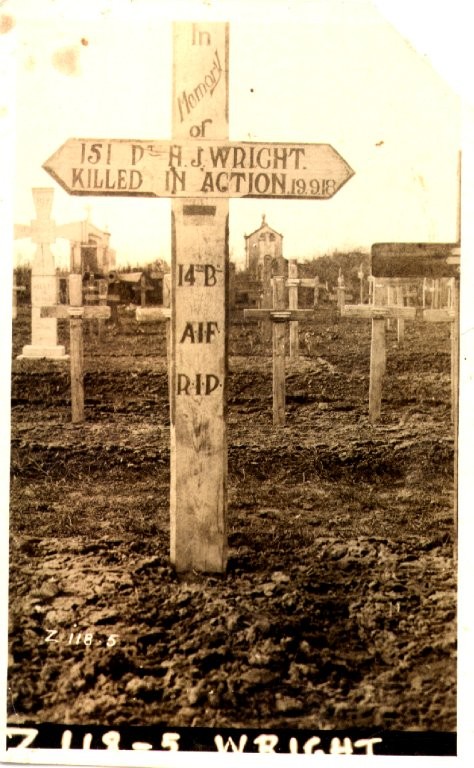 The official report read.
No. 151 Pte Wright H.J, was killed by shell fire whilst asleep at 4 pm, 19-9-1918 and was partially buried. Map reference; burial place [ In the vicinity of Ascension Wood, 3500 yards Southwest of Bellicourt] Sheet 62b.G.25, b, 50.70 A Regimental cross was erected on the grave.
[Sgd] W.R. Wadsworth. Major, for Lt Col, T Commanding 14th Battalion, A.I.F.
Private Charles Garlick, 1714, also of the 14th Battalion, later stated to the Australian Red Cross Information Bureau about Henry’s demise. ‘The casualty was on the ridge in front of Ascension Valley. It was the front line. He was in his dugout when a shell landed on it, burying him. We dug him out, but he was quite dead. We buried him again. There was a cross erected over his grave with his name, number and unit on it.’
As requested by Mrs Wright’s letter of 25 April 1917, the Army notified the local Methodist Minister, the Reverend Mr A. Madsen, of Henry’s death. It was now his unenviable duty to notify the family.
In Memorial notices for H. J. Wright.
WRIGHT – In loving memory of our dear brother, 151 Pte H J Wright, 14th Battalion (Anzac), killed in action, France, 19th September 1918.
This day recalls sad memories.
Of a loved one gone to rest
And those who think of him today.
Are those who loved him best.
(Inserted by his loving brothers, Walter; Charlie, Bert, Fred, late AIF; Leslie and Gordon.)
WRIGHT – In proud and loving memory of my dearly loved husband, No 151 Pte H J Wright, 14th Battalion, dear daddy of little Harry, killed in action, September 19, 1918, after four years of service, Egypt, Gallipoli, France.
Think of him still as the same, and say,
He is not dead, only just away.
(Inserted by his wife and little son, Pauline, and Harry.)
WRIGHT -In loving memory of our dear son and brother, 151 Pte H J Wright, 14th Battalion (Anzac), killed in action, France, 19th September 1918.
Thou art not forgotten, Henry dear,
Nor will you ever be.
As long as life and memory last
We will remember thee.
(Inserted by his loving parents and sisters.)
During the family’s period of mourning, two events would cause additional heartache. The brief official Army letter to the family detailing the circumstances of Henry’s death, the approximate coordinates of his grave and that a Regimental Cross had been erected at the site were not good enough for Henry’s wife Pauline.
The first sad event began on 3 February 1919, after Pauline had written to the Australian Base Records Department in London.
‘Dear Sir,
I have received a letter from Captain Wilson who is commanding the 14th Battalion telling me of my husband’s death in France. No 151 Pte H.J. Wright, 14th Battalion was killed in action on 19 September 1918. Captain Wilson informs me that the official position of his grave is sheet-62b.G.25, b,50.70. As I am the next of kin and wife, I would very much like to have a photograph of his grave and for his mother. Could you possibly send me two photos for which I would be very grateful and if any of his relatives apply such as cousins and aunts will they also get a photo? Also, one of his cousins is thinking of erecting a stone to his memory. Will that be allowed as I am his wife and feel that should be left up to me? Trusting you will grant me a reply and thanking the Defence Department for all treatment in the past as I feel there are some too ready to find fault with those who I am sure have tried to do the best for the dependants of the Australian Soldier.
Yours faithfully, Pauline Wright’.
Pauline was not sent the following response letter from Base Records but was notified of its contents.
Australian Imperial Force. 130, Horseferry Road, London, S.W.1. 28 April 1919.
Officer i/c Base Records,
Department of Defence,
Melbourne. Victoria.
No 151. Pte H.J. Wright. 14th Battalion. A.I.F. Deceased.
A receipt is acknowledged of your 84626 of 6-2-1919 regarding the above-named soldier. In reply, you are advised that Pte Wright is buried in an isolated grave in the vicinity of Ascension Wood, approximately 3,500 yards S.W. of Bellicourt, France.
In due course, the remains of soldiers buried in isolated graves will be exhumed and re-interred in the nearest recognised Military Cemetery.
The A.I.F. Photographic Section now operating in war areas will eventually photograph the graves of all Australian Soldiers which have been located and registered by the Graves Registration Units. On receipt of the negatives for this grave, two prints will be forwarded to you for transmission to the next of kin.
It is the intention of the Imperial War Graves Commission to erect permanent headstones on all graves in France and Belgium and the policy adopted by the Commission will not permit the relatives to erect private memorial stones on the grave. May Mrs Wright be advised in accordance with the text of this communication, please.
R.W. Murphy.
Lieut-Colonel-Officer i/c Records.
The second and more heart-wrenching news arrived between the time Pauline sent her request for photographs on 3rd February 1919 and the arrival of one or more photographs as requested.
Mrs P. Wright. 18 August 1923.
11 Spencer Street,
Essendon, Victoria.
‘Dear Madam,
With reference to the photographs forwarded to you purporting to depict the final resting place of your husband, the late No.151 Private H.J. Wright, 14th Battalion in the Jeancourt Communal Cemetery Extension, I am in receipt of advice from the overseas authorities intimating that as the result of further investigation regarding the report of the burial of the late soldier, it has now been definitely ascertained that [the photograph of] the cross is of a memorial nature only and does not mark an actual grave. According to information in the possession of the War Graves Commission, the remains of your husband were originally interred in an isolated grave in the vicinity of Ascension Wood, approximately two miles south-southwest of Bellicourt, and as all burials in this area were finally concentrated into the Bellicourt British Cemetery, the presence of a cross in the Jeancourt Communal Cemetery Extension immediately invited enquiry, and it was only then that the regrettable fact was disclosed that no actual grave existed and that the cross was purely of a memorial nature’.
‘Unfortunately, the present site of your husband’s grave cannot now be identified and as no record exists of his exhumation and removal to the Bellicourt British Cemetery. The only possible action remaining is to provide for the inclusion of his name and regimental particulars, etc, on one of the collective memorials to the missing in France and Belgium. This will accordingly be done, and despite the fact that no individual headstone will mark his resting place, you have the assurance that his death will be commemorated in a manner no less fitting than the memory of other of his comrades who laid down their lives in the Great War.
Assuring you of the Department’s profound sympathy and regret at the distressing circumstances arising.’
Yours faithfully,
Captain [ name unreadable] i/c Base Records.
[PS] ‘It is noted in this connection that Mrs M.E. Wright, the mother of the late soldier, is also in possession of several copies of the above-mentioned photographs and as presumably, you are in intimate touch with her, I should be very much obliged if you would kindly arrange to make her acquainted with the contents of this letter.’
This news would have caused great consternation to family and friends. Now, like many other grieving families, there was no fixed grave for those who wished to pay their respects. In situations like this, it leaves an empty hole in the family’s lives. In due course, his family received the traditional War Service Medals, and the British Government sent his parents a Memorial Death Plaque commonly called the ‘Dead Man’s Penny’ by the troops. By no means adequate compensation for the loss of their son, but at least the Government made the gesture.
It might be of interest to understand the concept and implementation of the ‘Dead Man’s Penny’. It began in 1916 with the realisation by the British Government that some form of an official token of gratitude should be given to the bereaved next of kin of all fallen servicemen and women. The enormous casualty figures were not anticipated at the start of WWI, therefore prompting this gesture of recognition. In 1917, the government announced a competition to design a suitable plaque with a prize of two hundred and fifty pounds sterling. There were eight hundred entries from all over the Empire, the Dominions, and even from the troops on the Western Front. Mr E Carter Preston of Liverpool, England, was named the winner.
His design was a 12-centimetre disk cast in bronze gunmetal, which incorporated the following: An image of Britannia and a lion, two dolphins representing Britain’s sea power and the emblem of Imperial Germany’s eagle being torn to pieces by another lion. Britannia is holding an oak spray with leaves and acorns. Beneath this was a rectangular tablet where the deceased individual’s name was cast into the plaque. No rank was inscribed as it was intended to show equality in their sacrifice. On the outer edge of the disk, the words, ‘He died for freedom and honour’.
A scroll, 27 x 17 centimetres made of slightly darkened parchment headed by the Royal Coat of Arms accompanied the plaque with a carefully chosen passage written in old English script.
‘He whom this scroll commemorates was numbered among those who, at the call of King and Country, left all that was dear to them, endured hardness, faced anger, and generally passed out of sight of men by the path of duty and sacrifice, giving up their own lives that others may live in freedom. Let those who come after see to it that his name be not forgotten’.
Beneath this passage, written in the same style, were the name, rank, and service details of the deceased. To accompany the scroll, again in old English script, a personal message from King George V.
‘I join with my grateful people in sending you this memorial of a brave life given for others in the Great War. ————George R I.
The plaques were packaged in stiff cardboard wrapping folded like an envelope.
Production of the plaques and scrolls, which was supposed to be financed by German reparation money, began in 1919 with approximately one million, one hundred and fifty thousand issued. They commemorated those who fell between 4 August 1914 and 10 January 1920 for home, Western Europe, and the Dominions, whilst the final date for the other theatres of war or for those who died of attributable causes was 30 April 1920. Unfortunately, the production and delivery of the plaques was not a complete success, and the scheme ended before all the families or next of kin of the deceased received the official recognition they deserved. There were some relatives who, in complete disgust, returned the pennies to the Australian Government in protest as they felt it was an insulting gesture and it did not replace their loved one’s life. Of course, nothing can replace a life lost. It is hoped that those ‘Dead Man’s Pennies’ that are in private public collections, museums, and national archives, will always be a constant reminder of the ultimate price paid by the men and women of the armed services during the Great War of 1914-1918. Henry’s ‘Penny’ is sadly, in the hands of a private collector.
Today, the Australian dead are immortalised at remembrance services, e.g., Anzac Day and Returned Service League clubs, books, official histories, museums, and suburban and country town monuments. It is, however, fitting to also acknowledge the many returned military personnel from World War One who were beset with the legacy of multiple wounds, such as amputations, gas effects, and disfigurement. The war was one where the soldiers of both sides suffered horrendous casualty rates in this, the first mass industrialised war of the 20th century. The raw statistics of death and wounds within the Allied armies of 1914/18 on the Western Front began with the British Army incurring almost 2.7 million battle casualties. One-quarter of them were killed, and over half suffered a wound in battle. Prolonged static trench warfare and sustained artillery bombardment eroded morale and undermined their discipline and fighting spirit. The slaughter of the French soldiers in the opening phase of the war in 1914 was unmatched in the rest of the conflict, with thirty-two thousand, nine hundred killed within the space of two months and half a million by the end of the year. History is full of stories of lone assassins who have changed the course of history for better or worse, but this one Serbian act was the catalyst that brought the world into a great conflict that should never be forgotten.
The staggering toll of dead and wounded is only a part of the World War One story. What of those who survived and were traumatised by war? They were the unfortunates who suffered mentally from shell shock, better known today as Post Traumatic Stress Disorder. This condition was not understood during the 1914-18 war. The prevailing attitude of the time by the British High Command about men who suffered mental breakdowns was that they were cowards or deserters. They believed that maintaining army discipline was a crucial enabler of military success, particularly when engaged in a war of attrition. The highest number of German casualties in a single two-month period, March-April 1918, was sixty-eight thousand, three hundred and thirty-seven. The worst two months for the British in France were July-August 1914, when forty-five thousand and sixty-three men and officers were killed.
As one French officer described the experience of combat in 1914. ‘Men were sent to their deaths senselessly. All day long, they lie there being decimated, getting themselves killed next to the bodies of those killed earlier. Machine guns and rifles simply scythed the soldiers down as they endeavoured to implement their orders. Nearly two years later, the British still had not learned the simple lesson that to advance in a line as they had from Napoleonic times was a form of mass suicide. The Germans were equally guilty of this same tactic.
‘How much easier it is to attack than to stand and await an enemy attack’ wrote the British Commander in Chief, Field Marshal Douglas Haig, in a letter to his wife.
Haig’s idea of attack as the best form of defence way of waging war, undermines the brilliant military strategist Carl von Clausewitz’s teachings that defence is a stronger form of attack.
By the end of 1917, the men from the previous year who remained were tired beyond description, and morale was most likely at its lowest point than at any other period in the war. Many of the men had been on the front for up to two years with little break. Those who recovered from wounds were sent back to the trenches time and time again. They began to think that the war would never end and that they were doomed to fight on until they were all dead. The initial ideals and the spirit of patriotism had long since vanished, and self-inflicted wounds, almost unheard of in the early days, became a great problem as the war progressed. For some, their mental stress became so unbearable that in desperation, they resorted to suicide.
Massed artillery bombardment was used to destroy the enemy and defences before an advance. For many a soldier in the trench, being shelled was a form of torture that he could see no end to. A feeling of helplessness and vulnerability induced the most excruciating mental strain. Men might be killed instantly, but without apparent damage, by the concussion of a shell blast. Others were cut up as if by some malicious butcher or crippled by fragments of their comrades’ bodies. Some were shocked into babbling incoherence by a capricious explosion that left them unscathed among the remnants of their friends. Being mutilated and still alive caused the greatest suffering during a bombardment.
Captain R. A. Goldrick, Military Cross. The 33rd Battalion, Australian Imperial Forces wrote during the battle at Armentieres in 1916;
‘One of our men went suddenly demented. The shellshock had an electrifying effect on him. He dropped his rifle and rushed out over the front-line trench into no man’s land, the Germans blazing away at him; then he turned and ran between the lines of the two armies. No one seems to be able to bring him down. Then, he turned again and raced into our system, down through the support trenches where men from the battalion pursued him, overpowered him, and forcibly rolled him in blankets and tied him up with rope. He was unwounded but evacuated, raving mad.’ The number of shellshock cases in the British Army increased fourfold during the battle of the Somme, from three thousand, nine hundred and fifty-one cases in the first six months of 1916 to sixteen thousand, one hundred and thirty-eight in the last six months of the year. Officers whose nerves gave way were more likely to be removed to the rear or to England, but in a class-related rank structure, the lower ranks were not so fortunate. They were condemned to remain in the trenches in a private hell. That is, of course, until they either became wounded or unhinged mentally and might commit an offence which, under military jurisdiction, could lead to a court martial and the firing squad.
The following example is a short extract from a letter home by 22-year-old Private Albert Troughton of the 1st Royal Welsh Fusiliers. He was accused of desertion but the news of his brother’s death in the trenches tipped him over the edge and he wandered around France in a confused condition. He should have had the right to legal counsel, but was not.
‘Dear Mother, and Father, Sisters, and Brothers. Just a few lines to let you know I am in the best of health and hope you are mother. I’m sorry to have to tell you that I am to be shot tomorrow at 7 o’clock in the morning of the 22nd of April. I thought the most they would give me about ten years. I hope you got my letters, which I sent you while waiting for my court-martial. Goodbye to all at home. Goodbye, Goodbye. From your son, Albert.’
The British War Office records reveal that between 4 August 1914 and March 1920, approximately twenty thousand military personnel were convicted of offences for which the death penalty could be imposed. Of these, three thousand and eight were sentenced to death, with only three hundred and six executed. Of these, thirty-seven were for murder leaving two hundred and sixty-nine convicted of any one of the following offences: desertion, cowardice, quitting one’s post, disobedience, rape, striking a superior officer, casting away arms, mutiny, sleeping on duty or assisting the enemy to name a few.
The bulk of those executed were not cowards or deserters but were simply unable to take any more. Military contemporaries of the time had enormous trouble comprehending a set of conditions that did not fit normal categories of behaviour under fire, despite the ever-present reality of battlefield conditions. The rationale generally assumed to lie behind the army’s use of capital punishment is related to the perceived deterrent effect that the victims would have had on their fellow soldiers. With little consideration for the predicament of the offender, it seemed that the underlying attitude of the military courts was ‘shoot the bastards’. Military discipline must be maintained at all costs.
Not all condemned men were innocent of a crime. Some may have received the death penalty if tried in a civilian court for their crime such as murder or rape but at least in a civilian court, the accused had the benefit of legal representation. In the military system of the time, at least 10% of the soldiers on trial were unrepresented by any form of legal counsel. Had they had the legal assistance they were entitled to, the accused may have only been sentenced to a term of incarceration in a military jail rather than given a death sentence.
Among the British Commonwealth countries, five New Zealanders were shot, as were twenty-five Canadians. The French and Italians were particularly hard on their men. France executed seven hundred and Italy seven hundred and fifty [these figures vary], Belgium thirteen and the United States twenty-five. No Australians were executed due to the Australian government’s explicit instructions regarding the death penalty. This was due to the dubious British trial and execution of two Australian soldiers, Harry [Breaker] Morant and Handcock, in February 1902 during the Boer War.
Of the one hundred and fifty German soldiers who were sentenced to death by military courts, only forty-eight were subsequently executed. The German army was double the size of the British Army, yet executed many fewer of its men. Was the German soldier better disciplined than their enemy, or did their High Command take a more enlightened approach to the matter?
The treatment of those who suffered genuine mental breakdowns is one of the most shameful and inglorious chapters in British military history. It also illustrates the ineptness, ignorance, and unfairness of the British court-martial system at the time.
During World War Two, the attitude to mental breakdowns was only marginally better, and sufferers were labelled as ‘lacking moral fibre’ and their service records stamped as such. The servicemen or women would have to bear this unnecessary stigma like a horrible mental scar for the rest of their lives. It was, and is, a distortion of true historical facts.
The war had ended, the celebrations had passed, and life went on. Now, with the final release from the constraints of the military passed, demobbed soldiers of all the warring parties could finally go home to an uncertain future. From the Australian perspective, the war had unforeseen circumstances. It was a staggering statistic, but 50% of the men who returned home from the war died within 20 years from multiple causes, no doubt exacerbated by the onset of the Great Depression. The crash of financial institutions during the period 1929-1938 impacted most countries throughout the world. It was the longest, deepest, and most widespread depression of the 20th century. The results were terrible. For those overseas who are not aware that in Australia and New Zealand, April 25 is ‘Anzac Day.’ It is a public holiday that had originally begun as a commemoration of the landing at Gallipoli but has now become perhaps the most important national day in both countries. It is a time when people of all ages gather in cities, suburbs, and country towns of both nations for a dawn service, to honour the men and women of the three military services who not only bequeathed a justifiably proud national military heritage but of their sacrifice and all who have followed in their footsteps. Battle honours from Gallipoli, the Western Front, North Africa, New Guinea, the Pacific, Korea, Malaya, Vietnam, East Timor, Afghanistan, Iraq, and various peacekeeping operations. Australian ‘Diggers’ and New Zealand ‘Kiwis’ lived, fought, and died alongside each other, united in a bond that was born on the beaches of Gallipoli 100-plus years ago.
A typical Anzac Day commemoration first begins with a six am dawn service. This is a major part of the Anzac Day tradition and harks back to the military practice of ‘standing to.’ For the military, dawn and dusk are always the most favourable times to attack and soldiers were called to ‘stand to’ and man their posts in full kit, ready to repulse the enemy or to launch attacks of their own. A prayer and a hymn follow either Rudyard Kipling’s ‘Recessional’ or ‘Lest we forget’, and a dedication that concludes with the fourth verse of Laurence Binyon’s ‘For the Fallen’, written in late 1914.
‘They shall not grow old, as we that are left grow old.
Age shall not weary them, nor the years condemn.
At the going down of the sun and in the morning, we shall remember them.’
‘Lest We Forget’
The last post is then played by a bugler, and this is followed by a minute’s silence, then the bugler sounds reveille. A brief address is given by a dignitary or a serviceman or woman, then the service concludes with a prayer and the singing of the national anthem. This service is held across the nation in capital cities, towns, and suburbs and also in various parts of the world. For example, a dawn service has been held in London since 1916. In Australia, descendants of Italians, Japanese or Germans are barred from taking part in the march, but more recently, descendants of Turkish soldiers who fought at Gallipoli are welcome to participate.
All Australian capital cities hold a memorial march where service personnel, men and women, or their descendants, many resplendent with medals, march behind banners and standards denoting what unit, battalion, ship, or Air Force Squadron they or their forebearers served with and where. These marches are no less intimate or emotional than the dawn service and always attract large crowds. A dignitary, a serving serviceman or woman or a veteran delivers a speech that would stress nationhood and remembrance. When the march has concluded, many of the veterans retired to the local RSL [Australia] Return Services League club or RSA [New Zealand] Returned Services Associations where they catch up with any remaining old mates, swap war stories and enjoy perhaps more than a few drinks and possibly plan to meet up again the following year. Sadly, many never make it to the next reunion.
Many people make the pilgrimage to Anzac Cove on Gallipoli for the annual dawn service above the same area where half a million men fought to gain a foothold in 1915. However, in Australia during the 1960s and 70s, anti-Vietnam protests posed a major challenge to Anzac Day services, and it was feared that Australia’s most important day of remembrance might disappear. Thankfully, the number of people who attend the dawn service and the march continues to increase year by year as the younger generations come to understand and appreciate the day’s significance.
In Australia’s modern society, there have been three debates about the Anzac Day remembrance tradition. The first is centred on the military spirit, having been established exclusively on the Gallipoli beaches. The second suggests that other battles are equally deserving. Tobruk, Kokoda and Long Tan, to name but three. The third is that the celebration of Anzac Day has no more relevance in Australia’s modern multicultural society. Whilst these three points may or may not be valid, for the moment, the emphasis still strongly remains on the Gallipoli centenary of 25 April. The retired Chief of Army, Lieutenant-General Ken Gillespie, may have summed up the spirit of Anzac when he said as part of an Anzac Day dawn service address;
‘It has been written that a nation that cannot remember its dead, will soon cease to be worth dying for’.
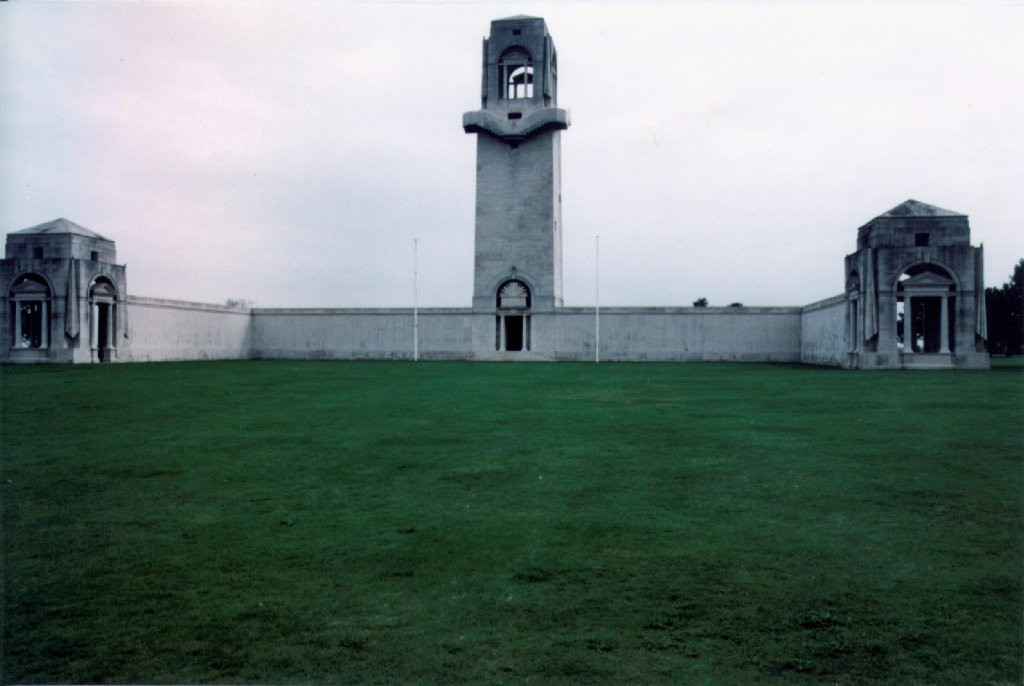 Throughout many parts of the world, on battlefields, in cities, country towns and villages, memorials have been erected, and due tributes paid to the fallen of all nations. One of the collective memorials mentioned in the Army’s 11 August 1923 reply letter to Pauline is located near the French village of Villers-Bretonneux. This Australian National Memorial was dedicated by King George VI in 1938 to commemorate all Australian soldiers who fought in France and Belgium. Henry Wright is one of ten thousand 1914-18 war casualties whose names are inscribed on the walls of the memorial of those who fell in battle and to those, like Henry Wright, whose final resting place still remains unknown. Of interest, the 14th Battalion’s total casualties during the war totalled approximately 915 killed and 2,229 wounded.
‘He sleeps not in his native land,
But under foreign skies.
Far from those who love him’
Perhaps, one day, someone will uncover his remains and he can finally return home.
[C] Ken Wright 2002 updated 2023.
Bibliography.
Background. The Gallipoli Campaign http; /www.nzhistory. net. nz/war/the-Gallipoli; campaign/background Ministry of Culture and Heritage.
Personal material from the author’s collection.
Battle of the Wazzir- Wikipedia.
With kind permission, MacDougall. A.K. Anzacs-Australians at War. Reed Books Pty Ltd, Australia. 1991. Page 34-5.
Ward. Eric. ‘Ward Diary’ 6 October 1914.
Anzac to Amiens. C W. Bean. Australian War Memorial Publication, 1961.
Official WWI Service Records, National Archives, Canberra, ACT. Australia.
Smith. N.C. The Red and Black Diamond. The History of the 21st Battalion- 1915- 1918. Mostly Unsung Military History. 1997.
The Empire Called and I Answered. [Website] Editor and historian Lenore Frost.
History of the 14th Battalion. Newton Wanliss. The Naval and Military Press Ltd.
Australian Rations. Corporal C Smith, 5th Platoon, 14th Battalion, A.I.F., appendix 1, Wanliss. History of the 14th Battalion Page 398.
Monash. The Soldier Who Shaped Australia. Grantlee Kieza. ABC publication, 2015.
Contact MHHV Friend about this article.