Dr. Tom Lewis’s entry into the Australia Remembers series provides an accessible and beautifully packaged gateway for children aged 6 to 12 to explore one of the most solemn chapters in Australian military history.
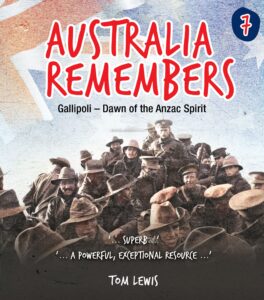
Moving far beyond “dry old facts,” the book frames the complex realities of the 1915 Gallipoli campaign around core values that forged the legendary ANZAC spirit: courage, mateship, and sacrifice. Created with a multi-generational appeal, it successfully sparks vital conversations across families, helping younger readers contextualize exactly why April 25 remains deeply sacred “Down Under.”
The production quality of this hardcover volume stands out immediately, leveraging a highly engaging, magazine-inspired format that caters to visual and reluctant readers alike. Rather than presenting intimidating blocks of continuous text, the chapters are thoughtfully broken down into digestible, bite-sized sections. Every page spreads wide with a brilliant integration of official imagery from the Department of Defence and the Australian War Memorial, coupled with detailed tactical maps, clear timelines, dynamic illustrations, and informative call-out boxes. This intentional layout breathes immediate life into the geography and timeline of the peninsula.
What makes this history feel intensely human is the expert integration of eyewitness accounts, diary entries, and letters straight from the front lines. Rather than strictly documenting abstract troop movements or political calculations, Lewis emphasizes day-to-day survival—what the diggers ate, the extreme trench conditions they endured, and the profound bonds of mateship that sustained them. This delicate balance honors the raw reality of the soldiers’ experiences while remaining entirely respectful and age-appropriate for primary school students.
While the volume has earned wide acclaim from educators for its accessibility, it has drawn constructive criticism from serious military enthusiasts and older readers. Critics suggest that the narrative relies somewhat heavily on traditional, romanticized “myth-making,” occasionally glossing over the strategic blunders and catastrophic failures of the high command. For children over the age of ten or confident readers looking for deep analytical critiques and perspectives from the Turkish side, the prose can feel a bit surface-level. However, as an introductory historical work, it provides an invaluable baseline of national heritage.
Reviewed for MHHV by Jason McGregor June 2026
Contact Jason McGregor about this article.