I must confess to a personal interest in this book. Being a military historian myself, on my first visit to Berlin I wanted to “walk the ground” – to see when; where, and what happened in the massive attack on the centre of the Third Reich which resulted in the collapse of Hitler’s regime along with the suicide of its founder.
I duly looked at some maps and then traced my way from the Brandenburg Gate – that massive and magnificent edifice which still stands as a monument to the empires of the Germans. I thought I was quite on track until I found myself standing in a car park.
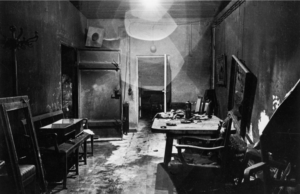
Nearby was a not overly-large sign. It gave a brief and curt explanation of the complex below that indeed was the Fuhrerbunker – the location of the last stand of Hitler and his closet staff and acquaintances. Anecdotally it seemed the local shopkeepers had become tired of inquiries over the years as to the site, and pestered the local government authority to put the sign up. Post-war the Russians – the invading and then occupying power – had sealed up the complex, and Germans post the fall of the Berlin Wall had no inclination to open up the Fuhrerbunker. Understandable but disappointing to students of history.
The Vorbunker was the original bomb shelter for Hitler and his staff. The Fuhrerbunker was built next to it at a deeper level. It was only a command centre for the closest of Hitler’s staff: several secretaries; a few communications staff members, and the on-duty guards. It provided bedrooms for the Fuhrer; his long-time girlfriend – and in the final days, wife – Eva Braun, and Propaganda Minister Goebbels and his family. The majority of the support staff, cooks, valets and so on, along with the off-duty guards, existed in nearby buildings, often heavily damaged from bombing raids.
Many aspects of the story were fascinating. The water table in Berlin is such that pumps were needed to operate constantly to keep the floors of the bunker complex dry. After five days of non-operation following the Soviet storming of the place, the water was 15 centimetres deep. After five years the complex was flooded to a depth of 2.5 metres.
For a supreme leader’s command centre, the Bunker was an enormous let-down from the huge and (deliberately) awe-inspiring edifices which Hitler and his chief architect Albert Speer had been designing and building since the early 1930s. Halls with fifteen-metre ceilings; sheets of marble floors; and rows of motionless SS guards in immaculate uniforms had given way to underground rooms measured in mere metres, which was dank and smelly: the nearby water meant constant humidity and unpleasant smells throughout the bunker’s operation from early 1945.
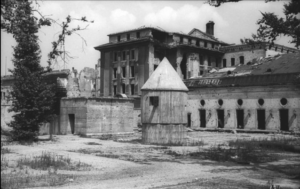
The slide downhill into the abyss accelerated quickly in the last weeks of Berlin. The severe discipline and indeed adulation surrounding Hitler started disappearing. Here, for example, is a quotation from Speer which is cited in the book:
Hitler must have noticed that the discipline in his entourage was also slackening. Formerly, whenever he had entered a room, everybody had risen until he sat down. Now conversations continued, people remained seated, servants took their orders from guests, associates who had drunk too much went to sleep in their chairs, and others talked loudly and uninhibitedly. Perhaps he deliberately overlooked such changes.
These scenes affected me like a bad dream. They corresponded to the changes which had been taking place for several months in the Chancellor’s residence: The tapestries had been removed, the paintings taken down from the walls, the carpets rolled up, and valuable pieces of furniture had been stowed away in an air-raid shelter. Stains on the wallpaper, gaps in the furnishings, scattered newspapers, empty glasses and plates, a hat that someone had tossed on a chair, added up to an impression of a place in the midst of moving day.
One interesting aspect of the account of the last few days was that the Soviet troops advancing into Berlin did not know where Hitler was. Their standard question of any German civilians was “Wo ist Hitler?” to which the answer was along the lines of probably in a bunker in the government sector, around the Chancellery – which is quite right.
Those familiar with the story will recognise the major events: Hitler’s marriage to Eva Braun; the murder/suicide of the Goebbels family; the rants of the leader – so impressively portrayed in the epic film Downfall; the escape of many leaders such as Himmler – they are all here. Comprehensive maps, plans and photos support the text.
The work relies heavily on accounts such as Speers; Hitler’s valet and chauffeur, both of whom survived the war to publish their memoirs; the Fuhrer’s several secretaries, and several Soviet reports of the final battles for Berlin.
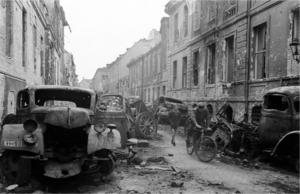
For me the book got to its most interesting when it had covered the material I have read of before: the slowly advancing Allies and what was going on in Hitler’s circle in the final days. After Hitler’s suicide the story of what happened to the Fuhrerbunker is then covered. It was thoroughly explored by the Soviets, who were obsessed by the certainty – or not – of whether Hitler had escaped. They took away what remained of the two bodies of the leader and Eva Braun, and kept them for decades – in fact the dental remains of Hitler are still stored in a Soviet vault. The other remains – including those of the Goebbels family and Braun’s – were buried; disinterred, analysed and finally cremated in 1970. Considerable confusion was created by the Soviet’s deliberate disinformation used at the time in their Cold War. But Discovering Hitler’s Fuhrerbunker does successfully dispel the myths here.
The bunker slowly flooded, but the Soviets tried twice – both times unsuccessfully – to entirely destroy the system with explosives. After the end of the division of Berlin following the collapse of the USSR there was much debate about what to do with the bunker system. Today, somewhat ironically, it remains buried some mere 200 metres from the new Holocaust centre, both of them within walking distance from the Brandenberg Gate.
This is an interesting and well-researched book. Recommended.
–o-o-O-o-o-
Reviewed by Dr Tom Lewis OAM
Dr Tom Lewis OAM is a military historian. His acclaimed work The Sinking of HMAS Sydney was recently awarded the Commodore Sam Bateman Book Prize from the Australian Naval Institute. His most recent works are The Battle of the Coral Sea – Explained, and the upper primary work Australia Remembers 7 – Gallipoli.
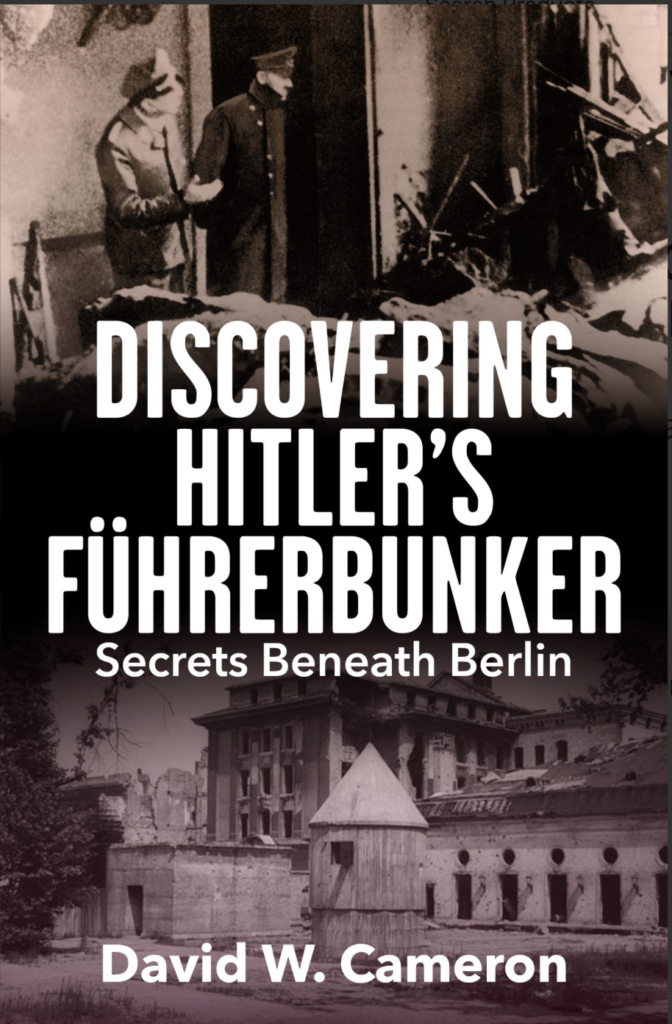
By David W Cameron
Published by Big Sky
Soft cover; 342 pages; $32.99
Contact MHHV Friend about this article.