The transcript of the ‘Commonwealth Court of Marine Inquiry into the circumstances attending the collision between the MV Duntroon and HMAS Goorangai off Queenscliff on November 20 1940’ was only released to the public in 2010 and ran to 479 printed pages.
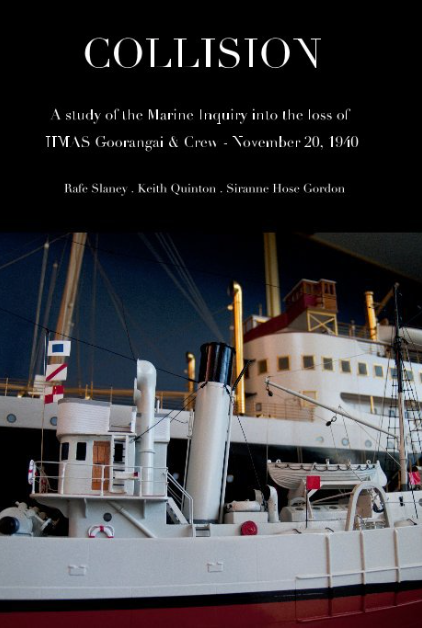
After attending Australian Minesweeper Memorial services held at Queenscliff in 2013 & 2014, Rafe Slaney, who as a child had known Goorangai’s telegraphist Albert McDonell as a farmhand on his parents farm, purchased a full transcript of the ‘Inquiry’. He, with the assistance of his co-authors ( all three researchers at Fort Queenscliff A.A.H.U.) spent two years collating available related information to produce “Collision”.
This book deliberately restricted its text to an interpretation, without judgement, of the evidence given before the court and attempts to analyse the presented evidence and the cross examination of individuals by the Coroner and the attorneys representing both the Commonwealth and owners of MV Duntroon. From the outset the Inquiry was beset with evidentiary issues, not the least being the complete absence of evidence from the minesweeper due to the loss of the entirety of HMAS Goorangai’s crew.
The text does not set out to question, or discredit, the inquiry findings; nor does it attempt to provide ‘definitive’ answers to the decisions and actions of the various ships officers. What it does suggest is that there was the possibility of a number of scenarios as to the course of events during the 30 minutes following the departure of HMAS Goorangai, as it attempted to traverse from the ‘pilot anchorage’ off Queenscliff, across South Channel to a more protected berth at Portsea pier. This included two other possible courses that may have been taken by Goorangai due to the synchronous entry of the MV Kitano Maru through Port Phillip Heads.
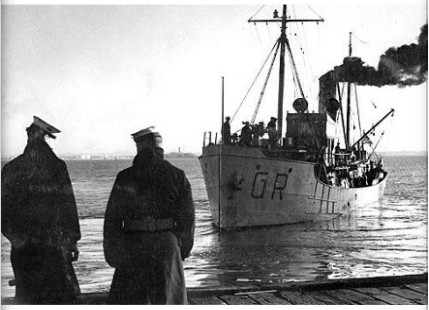
The Marine inquiry was exacting in its examination of witnesses. The two opposing King’s Counsel were also exacting in their cross examinations and interpretations of evidence given by those called before the enquiry. While the course and speed of MV Duntroon and the action of its officers was largely established, this could not be definitively done for Goorangai as there were no survivors. It also became clear that there was an issue with the positioning of Goorangai’s navigation lights following the addition of a gun deck to the bows of the fishing trawler. The problem was dealt with in great detail by those conducting the inquiry. Eventually the finding was that MV Duntroon’s captain Ignatius Lawrence Lloyd had been negligent while exiting his vessel down South Channel, and that the officers on HMAS Goorangai had no case to answer.
This decision against Lloyd was overturned at a later date, (April 1941), following acceptance of evidence from the Department of Defence that the navigation lights on HMAS Goorangai may not have been efficient at the time of collision.
‘Francis Robert Nicholas, Lightfoot St., Mont Albert, hull overseer for the Department of Defence, said he had been in charge of the conversion of the Goorangai from a trawler to a mine sweeper. The side lights were of the old type on a swinging arm, so that they could be swung in during bunkering. The swing was 18 inches. He did not regard the lighting as efficient, as the additions made to the ship and the structure for the gun constituted a definite obstruction to the side lights. The bracket in which the side lights were placed was fitted with eyes, which were worn to such an extent that the bracket would move, and thus affect the lighting. Orders had been given that the side lights on similar vessels were now to be placed 7ft. higher, and to be fixed, in order to try to prevent another disaster.’
Finding At Inquest: Geelong. Monday.- The Argus 8 April, 1941 page 7
Keith Quinton (co-author of ‘Collision’.)
Contact Keith Quinton about this article.