A Definitive Maritime History That Resurfaces a National Memory.
Almost anybody who has studied Australian Military History knows about or has researched the raid by Japanese midget submarines in Sydney Harbour on 31 May 1942. Ghost Below: The Lost Submarine of Sydney Harbour by Steven Carruthers gives the story its definitive final chapter
For me, the interest in the attack on Sydney Harbour came from my first visit to the Australian War Memorial as a child. I recall vividly climbing on, around, and in the remains of two of the Japanese Midget Submarines that sat outside in the western forecourt of the AWM, along with some heavy guns and a variety of tanks. Over the decades that followed I observed those two submarines being removed and restored to their current display condition. I learnt that there was another Midget Submarine, but like many I wondered what had happened to arguably the most significant boat in the attack. In 2006 the wreck was located off Sydney’s coast, 60 metres under the Pacific Ocean by No Frills Divers from Sydney’s Northern Beaches. “Ghost Below”, digs deep into the story of the Submarine and its eventual discovery.
“Ghost Below” is a compelling example of meticulous scholarship. At once a work of wartime history, maritime archaeology, and modern detective story, the book succeeds in illuminating an episode that has long hovered between fact and folklore. While the book offers the most comprehensive account yet of the Japanese midget submarine M24 and its eventual discovery, it occasionally struggles to balance scholarly thoroughness with narrative discipline
Whilst “Ghost Below” has a strong focus on the discovery, the book also covers the Imperial Japanese Navy development of submarine warfare pre-WW2. Despite many difficulties the IJN created submarines that could deliver and launch a 2-man floatplane for recognisance and other submarines that were designed to deliver a Mini-Sub for an attack.
The first recorded Japanese Mini-Sub attack was December 7, 1941, at Pearl Harbor, Hawaii. All 5 Mini-Subs launched failed to survive the attack or cause any damage. The three Mini-Subs that would attack Sydney Harbour, in May 1942, were a comparatively serious improvement on the 1941 model. But ultimately just as impossible for the two-man crew to survive.
On the night of 31 May 1942, three Japanese midget submarines entered Sydney Harbour to sink allied shipping anchored at Garden Island. The mini-sub M24 torpedoed HMAS Kuttabul, killing 21 of the sleeping Australian and British Sailors. Their second torpedo missed the USS Chicago. Whilst one of the three boats was caught in the harbour boom defences and another was depth-charged by RAN patrol boats, M24 escaped Sydney harbour and remained unfound until 2006.
Amongst the many relevant and interesting tangents, Carruthers, an expert diver and naval veteran gives the reader a history of underwater diving, which serves to highlight the troubles not only finding the wreck, but continuing to survey it at depth. Carruthers’ background as a diver enriches the book’s technical sections, but the level of detail—particularly regarding deep‑dive procedures, equipment, and underwater hazards—may feel excessive for general readers. Those without an interest in diving may find these passages slow or overly technical.
There have been many theories as to what had happened to M24, some of which were farfetched to be sure. Did the M24 submariners try to return to their mother boat? “Ghost Below” seeks to understand why M24 sits prominently upright with signs that indicate the crew remain inside. The upper hatch appears to be open as if to allow in water. Finding M24 has revealed so much more of the story.
“Ghost Below” gives a detailed explanation of the importance of protecting the wreck from looting and damage. Thankfully the M24 is protected by both physical and legal strategies and requires a licence to dive the wreck that is specific to the site and its legal requirements.
The book is meticulously sourced, with 24 pages of endnotes and a substantial bibliography. Carruthers draws on Japanese naval records, Allied reports, personal correspondence, and interviews with surviving participants. The inclusion of rare photographs, charts, technical drawings, and even a photogrammetry model of the wreck elevates the work beyond standard military history.
The production quality is equally impressive. The hardcover edition includes more than 20 pages of colour illustrations, numerous black‑and‑white photographs, and four appendices that deepen the reader’s understanding of the submarine, the raid, and the broader war off the East coast of Australia.
Steven Caruthers has woven naval history with diving passion and investigative intrigue.
Reviewed for MHHV by Jason McGregor
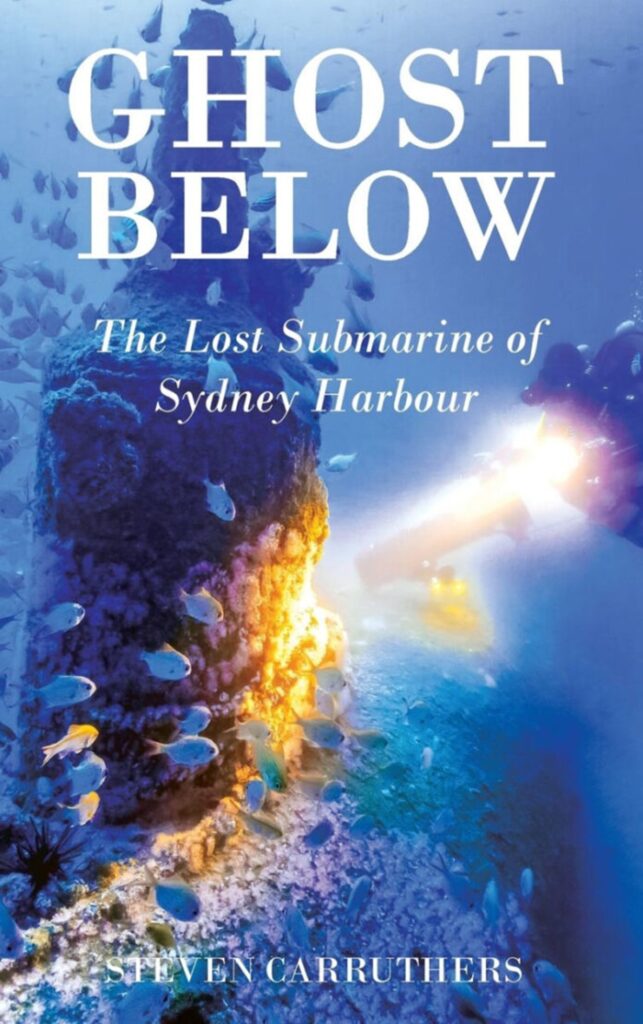
366 pages. Bluewater Press, NSW.
ISBN: 9781764220248
ISBN-10: 1764220242
Published: 1st November 2025
Format: Hardcover
Language: English
Number of Pages: 366
Audience: General Adult
Publisher: Steven Carruthers
Dimensions (cm): 22.86 x 15.24 x 2.87
Weight (kg): 0.83
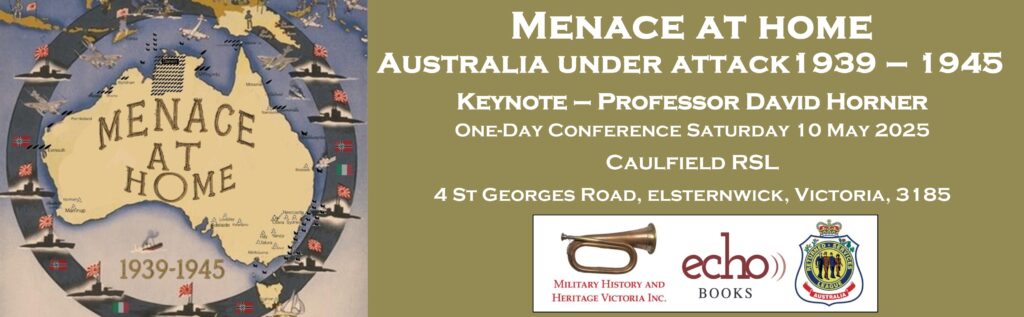
Learn more about the very real threats to Australia during WW2 by clicking the image below
Contact Jason McGregor about this article.